F1 Aerodynamics: The Science of Downforce Explained
At its core, Formula 1 aerodynamics is the art of mastering the invisible: manipulating air to create a mechanical grip that defies physics. While a typical road car relies on its weight and tires to stay glued to the tarmac, an F1 car uses its surfaces like inverted wings to generate downforce—a force that literally pushes the car into the ground. Understanding how do f1 aerodynamics and downforce work is essential to appreciating why these cars can corner at speeds that would send a normal vehicle flying off the track.
What You'll Learn
By the end of this deep dive, you will understand the physical principles that allow an F1 car to drive upside down in a tunnel, the practical implications of aerodynamic efficiency on race strategy, and why this science is more critical than horsepower. You’ll walk away with a clear mental model of how air pressure differentials create the grip that defines modern motorsport.
How It Works: The Mechanics of Downforce
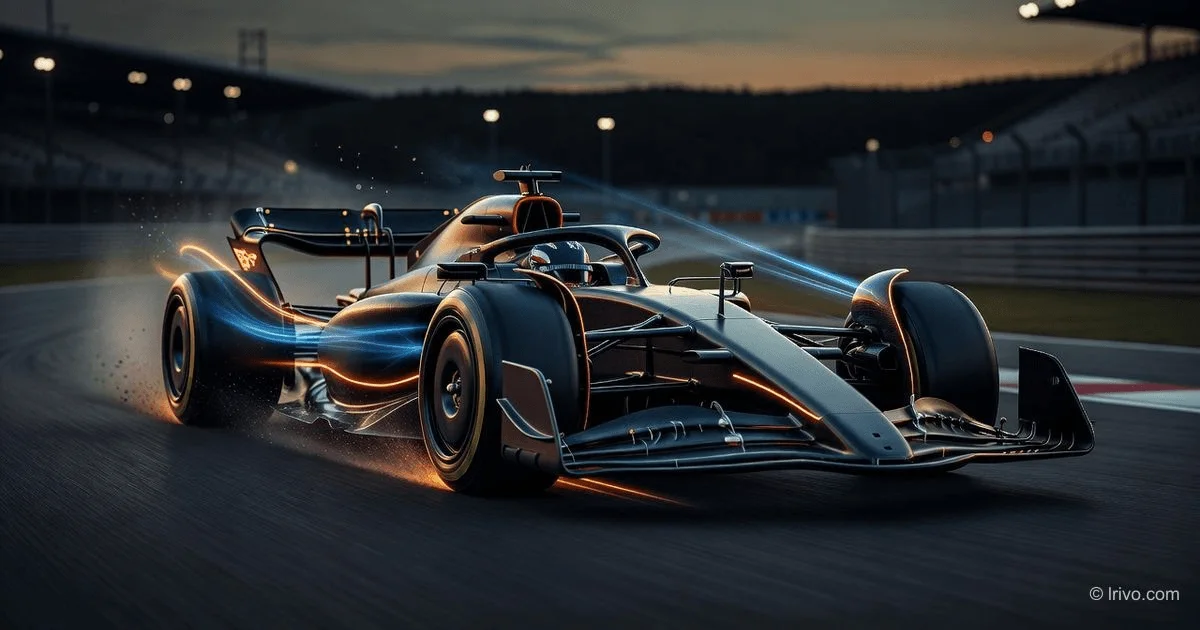
To grasp how a 750-horsepower machine sticks to the road, we must look to Bernoulli's principle and Newton's third law. An F1 car is essentially a collection of wings. The front wing, rear wing, and the underfloor (diffuser) are designed to accelerate air in specific ways.
The Wing Principle
Imagine holding your hand flat out of a car window. If you tilt your hand upward, the air pushes it up. If you tilt it downward, the air pushes it down. An F1 rear wing works on this same principle but in reverse. The wing profile is curved on the underside and flatter on top. As air hits the wing, it is deflected upward. By Newton's Third Law, the air pushes the wing downward with an equal and opposite reaction. Simultaneously, the shape of the wing accelerates the air beneath it, creating a low-pressure area. This pressure differential (high pressure on top, low on the bottom) generates a massive downward force.
The Ground Effect
The most significant source of downforce in modern F1 comes from the floor. Since the 2022 regulation changes, F1 has revived "ground effect" aerodynamics. The car’s floor is shaped like an inverted wing. As the car moves, air is sucked under the car and accelerated through Venturi tunnels. This acceleration causes the air pressure under the car to drop drastically. With high atmospheric pressure pushing down on the top of the car and low pressure pulling from underneath, the car is literally sucked onto the track. Based on Computational Fluid Dynamics (CFD) data released by the FIA, the floor now accounts for approximately 50-60% of the total downforce generated by an F1 car.
The Wake and Dirty Air
Aerodynamics isn't just about creating downforce; it's about managing the "wake"—the turbulent air left behind. When a car drives, it punches a hole in the air and creates a low-pressure zone behind it. The car behind suffers from "dirty air," where the disrupted airflow prevents its front wing and floor from generating optimal downforce. This reduces the following car’s performance by up to 35% in high-speed corners, a challenge that engineers continuously try to mitigate to allow for closer racing.
Why It Matters: The Impact on Performance and Safety
Understanding how do f1 aerodynamics and downforce work is critical because downforce directly determines cornering speed and tire degradation. A car with high downforce can corner faster because the increased vertical load allows the tires to generate more lateral grip. In fact, an F1 car can generate enough downforce to theoretically drive upside down—roughly 2.5 to 3 times its own weight in downforce at top speed. However, this comes at a cost: drag. Downforce usually requires drag (air resistance). On straights, teams want to reduce drag to increase top speed, but in corners, they want high downforce for grip. This is the eternal trade-off that dictates race strategy, pit stops, and overtaking opportunities.
By the Numbers: The Data Behind the Speed
To illustrate the extraordinary efficiency of these machines, look at the statistical evolution of the sport:
| Metric | Value/Data | Source Context |
|---|---|---|
| Total Downforce (2023 spec) | ~3,500 kg at 250 km/h | FIA Technical Reports |
| Downforce-to-Weight Ratio | 2.5:1 (Generates 2.5x its mass in downforce) | Racecar Engineering |
| DRS (Drag Reduction System) Effect | Reduces drag by ~20% | F1 Technical Regulations |
| Top Speed (Monza, low downforce) | ~360 km/h (223 mph) | Official F1 Timing Data |
| Lateral G-Force in Corners | Up to 6G (Six times the force of gravity) | Driver Biometrics (e.g., FIA medical data) |
| Floor Contribution (Ground Effect) | Approx. 55% of total downforce | FIA CFD Analysis (2022) |
Common Myths vs. Facts
There is a significant amount of misunderstanding regarding how these cars interact with the air. Let’s debunk some of the most prevalent myths.
| Common Myths | Facts |
|---|---|
| Myth: F1 cars rely on their weight for grip. | Fact: Weight contributes to grip, but downforce is far more significant. At high speeds, downforce multiplies the effective weight of the car by up to 2.5 times, allowing it to corner at speeds impossible for a heavier car relying solely on mass. |
| Myth: The rear wing is the most important aerodynamic part. | Fact: While crucial, the floor (underbody) is now the most important aerodynamic component, producing the majority of the downforce. The wing is primarily for balancing the car's "aero balance" (front to rear grip). |
| Myth: A smooth, flat floor is the best for downforce. | Fact: A flat floor is terrible for downforce. The "Venturi tunnels" and complex shapes under the floor (which look bumpy and sculpted) are designed to speed up the air, dropping pressure and creating suction. Smoothness is only good for reducing drag on the top surfaces. |
| Myth: "Dirty Air" just means dust or dirt on the track. | Fact: "Dirty air" refers to the turbulent, low-pressure wake of air left behind a car. This disrupted air prevents the following car's aerodynamics from working efficiently, reducing its downforce by up to 35%. |
| Myth: More downforce is always better. | Fact: More downforce means more drag, which slows the car on straights. Teams must balance downforce for corners against drag for straight-line speed. "High downforce" is detrimental on power tracks like Monza, where "low downforce" setups are preferred. |
What You Should Do With This Knowledge
Understanding the science of downforce changes how you watch a race. Next time you see an F1 session, pay attention to the front wing adjustments during pit stops—engineers change the angle of the flaps to alter the car's balance for the changing track conditions. You can also identify a car struggling with a poor aerodynamic balance by watching how much the driver corrects the steering wheel mid-corner. If you're an engineer or enthusiast, applying these principles—pressure differentials and airflow management—is critical, whether you are designing a high-performance vehicle or simply optimizing a bicycle for time trials. Recognize that the "magic" of an F1 car is not in the engine alone, but in the invisible 3,500 kg of force pushing it into the track.
Frequently Asked Questions
How do F1 aerodynamics and downforce work in simple terms? In simple terms, F1 aerodynamics turns the car into an inverted airplane wing. Instead of generating lift to go up, the wings and floor generate a downward push by creating high pressure above the car and low pressure below it, effectively sticking the car to the road.
Can an F1 car really drive upside down? Yes, theoretically. An F1 car generates about 2.5 times its own weight in downforce. If it were traveling fast enough (around 200 km/h) on the ceiling of a tunnel, the downforce would be sufficient to keep it pinned to the roof, provided the tires could maintain traction on the surface.
What is "Dirty Air" and why is it a problem? Dirty air is the turbulent, disrupted air left in the wake of an F1 car. It causes a car following behind to lose aerodynamic grip. When a car loses downforce in dirty air, it slides more, overheats its tires, and cannot follow closely enough to overtake.
Why do teams change front wing angles between qualifying and the race? Teams change front wing angles to adjust the aerodynamic balance (understeer vs. oversteer) and reduce drag. For the race, they often run a slightly higher downforce setup to protect tire life, whereas in qualifying they run a lower downforce setup to maximize straight-line speed for a single fast lap.
What happened to the "Ground Effect" in 2022? Ground effect was reintroduced in 2022 to promote closer racing. By allowing the floor to create the majority of the downforce, the cars rely less on complex front wings. This reduces the turbulence (dirty air) behind the car, making it easier for cars to follow each other closely.
— Editorial Team