How to Build Healthy Eating Habits That Actually Stick
For decades, the public health message around diet has been a monotonous drumbeat of "eat less and move more," yet global obesity rates have nearly tripled since 1975, according to the World Health Organization (WHO). The central failure is not a lack of willpower, but a misunderstanding of habit formation. This guide synthesizes evidence from behavioral science, nutrition research, and clinical practice to deliver a practical, sustainable framework for mastering how to build healthy eating habits that last.
What You'll Learn
Diets fail because they rely on conscious willpower, which is finite. To build lasting habits, you must redesign your environment to make healthy choices automatic and decouple eating from emotional cues. This guide provides a step-by-step system rooted in behavioral psychology to make nutritious eating the path of least resistance.
1. Deconstruct the "All-or-Nothing" Trap
The most significant predictor of dietary failure is the "perfectionism" mindset. A 2016 study published in Appetite found that individuals who exhibited high dietary restraint were more likely to overeat following a minor transgression (the "what-the-hell effect"). To truly understand how to build healthy eating habits that last, you must abandon the binary view of "good" and "bad" foods.
The 80/20 Rule
Instead of aiming for 100% compliance, aim for 80% consistency. This allows for flexibility, which is crucial for long-term adherence. The Harvard T.H. Chan School of Public Health emphasizes that dietary patterns, not individual meals, determine health outcomes. A single slice of cake does not negate a week of nutrient-dense eating, just as a single salad cannot fix a poor diet.
2. The Neurological Hack: "Temptation Bundling"
Behavioral scientist Katy Milkman, a professor at the Wharton School, pioneered a concept known as "temptation bundling." This involves linking a behavior you want to do (like listening to a podcast) with a behavior you need to do (like preparing a healthy meal).
How to implement:
- Identify a guilty pleasure: An audiobook, a specific TV show, or a favorite playlist.
- Restrict access: Only allow yourself access to this pleasure while engaging in healthy behavior.
- Execute: If you only listen to your favorite podcast while cooking dinner, you will train your brain to anticipate the reward of the podcast, making the cooking process less of a chore.
⚠️ Caution: This is distinct from using food as a reward. Using high-sugar foods as a reward for eating vegetables reinforces the neurological dominance of sugar. The reward must be an activity or media, not food.
Google AdInline article slot
3. Environmental Engineering (The "Choice Architecture")
Richard Thaler and Cass Sunstein, in their seminal work on behavioral economics, argue that the environment dictates choice more than information. Simply knowing that an apple is healthier than a cookie is insufficient if the cookie is at eye-level.
Step-by-Step Kitchen Redesign:
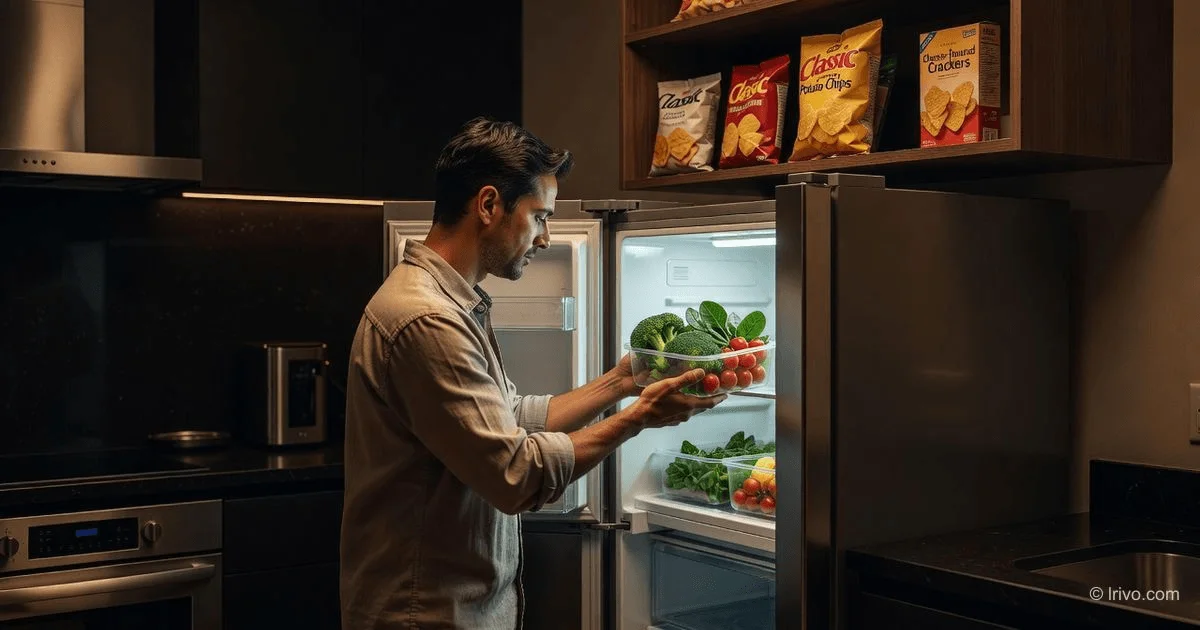
- The "See-Food" Principle: Place fruits, nuts, and vegetables in clear containers at the front of the refrigerator and on the countertops. A study in the American Journal of Preventive Medicine found that people eat what they see; proximity increases consumption.
- The "Out-of-Sight" Rule: Store processed snacks in opaque containers, preferably on high shelves or in the pantry. The friction of having to reach for them reduces consumption.
- Plate Size: A Cochrane review noted that reducing plate size from 12 inches to 10 inches can reduce caloric intake without the sensation of deprivation. This exploits the Delboeuf illusion, where smaller plates make portions appear larger.
4. Habit Stacking: Starting Small
In Atomic Habits, James Clear popularized the concept of "habit stacking." This is a cornerstone of how to build healthy eating habits that last because it piggybacks on existing neural pathways.
The Formula:
"After [CURRENT HABIT], I will [NEW HABIT]."
| Current Habit | New Habit (Stacked) | Outcome |
|---|---|---|
| Pouring morning coffee | Add a glass of water | Hydration before caffeine |
| Sitting down for lunch | Eat protein first | Stabilizes blood sugar spikes |
| Brushing teeth at night | Prepare veggies for tomorrow | Reduces morning friction |
Based on the principles of habit formation outlined by neuroscientist Dr. Wendy Wood, this method works because the basal ganglia (the brain's autopilot system) triggers the new behavior without requiring the prefrontal cortex (the decision-maker) to expend significant effort. This is how you override the "I don't have time" excuse.
5. The "Protein-First" Protocol
While macronutrient ratios vary by individual, a consistent finding across metabolic studies is the satiety index of protein. A 2020 study in the Journal of Obesity & Metabolic Syndrome highlighted that dietary protein increases satiety hormones (GLP-1 and PYY) while reducing ghrelin (the hunger hormone).
The Protocol:
- Breakfast: Aim for 30g of protein (e.g., Greek yogurt, eggs, or a quality powder).
- Lunch/Dinner: Build the plate around the protein source first, then add vegetables, and finally complex carbohydrates.
Why this works: This structure naturally displaces processed carbohydrates that spike insulin. Based on data from the National Health and Nutrition Examination Survey (NHANES), higher protein intake correlates with lower total caloric intake in free-living individuals, not because of conscious restriction, but due to reduced snacking frequency.
6. Managing Emotional Eating (The "Urge Surfing" Technique)
Habits are not just physical; they are psychological. Emotional eating is a response to stress, driven by cortisol, which increases cravings for high-energy (sugar/fat) foods. To build lasting habits, you must decouple the feeling from the action.
The "Urge Surfing" Intervention (Based on Acceptance and Commitment Therapy):
- Pause: When you feel the urge to eat outside of hunger, identify the emotion (boredom, stress, fatigue).
- Set a Timer: Allow 10 minutes. Tell yourself you are not denying the food; you are delaying it.
- Surf: During the 10 minutes, drink a glass of water or do a breathing exercise. An analysis published in the Journal of Consulting and Clinical Psychology suggests that the urge to eat often diminishes within this window, acting like a wave that crests and falls.
A reasonable conclusion from combining neuroscience and behavioral psychology is that willpower is not a muscle that gets stronger, but a resource that gets exhausted. Therefore, relying on "surfing" is more effective than trying to "fight" the urge with brute force.
7. The "Minimum Viable Day" Strategy
Complex meal plans are fragile. If you miss a component, the whole system collapses. Instead, define your "Minimum Viable Day" (MVD)—the bare minimum you need to do to succeed.
Your MVD for Nutrition:
- Non-negotiables:
- 1 serving of vegetables at lunch and dinner.
- 1 gallon (approx. 3.7 liters) of water.
- Protein at every meal.
- Negotiables: The type of carb, the specific vegetable, or the exact time of the meal.
If you achieve the MVD 80% of the time, you are winning. Data from habit tracking studies suggests that missing a goal one day does not predict failure; missing two days in a row is the primary predictor of habit dissolution. If you miss a day, forgive yourself and return to the MVD immediately.
8. The "Check-In" vs. "Weigh-In" Shift
The scale measures weight, not behavior. If you base your success on the scale, you are rewarding an outcome that is influenced by hydration, sodium, and hormonal cycles, rather than the input (your habits).
Alternative Metric:
Use a "Habit Scorecard."
- At the end of each day, rate yourself 1-3 on your MVD goals.
- If you scored a 2 or 3 on protein and hydration, you succeeded, regardless of the scale.
This aligns with the concept of "outcome-based motivation" versus "process-based identity." When you focus on how to build healthy eating habits that last, you must become a person who eats healthily, rather than a person trying to lose weight. People who identify as "healthy eaters" exhibit more resilience to temptations, as noted by researchers at Stanford University's Behavioral Science Lab.
Frequently Asked Questions
1. How long does it actually take to form a healthy eating habit?
The myth is "21 days," but a 2009 study in the European Journal of Social Psychology found it takes, on average, 66 days for a behavior to become automatic. However, this ranges from 18 to 254 days depending on the complexity of the behavior (e.g., eating vegetables is easier to automate than resisting sugar). Consistency is more important than the calendar.
2. Should I meal prep on Sundays, or does it not matter?
It matters less when you prep, and more that you reduce friction during the workweek. If Sunday prep works, do it. If you prefer to prep daily, that is fine. The key is having a system that fits your lifestyle, not a rigid schedule that causes stress. The goal is to make the healthy choice the easiest choice at the moment of hunger.
3. Is it okay to eat "trigger foods" if they are in my environment?
If a food is triggering a binge, keeping it in your environment is a failure of choice architecture. For the first 60 days of habit formation, it is advisable to keep these foods completely out of the house. Once the new healthy habit is ingrained, you can reintroduce them, as your sense of "normal" will have shifted to prefer the healthier options.
4. Why do I crave sugar even when I'm not hungry?
Cravings are often driven by the brain's dopamine reward system, not hunger. They can also be triggered by dehydration or fatigue. Before eating a sweet, drink a glass of water and wait 10 minutes. Often, the body is signaling for energy (glucose) or water, not the specific sugary item.
5. Can I change my eating habits without cooking?
Absolutely. Cooking is not a prerequisite for healthy eating. Focus on "assembly" meals: pre-washed greens, canned beans, rotisserie chicken, and microwavable grains (like quinoa pouches). The principle of habit formation applies to consumption, not creation. You are building a habit of choosing these pre-assembled items rather than takeout.
— Editorial Team