Rally vs. Circuit Racing: Key Differences Explained
For motorsport enthusiasts deciding between two very different disciplines—or simply looking to understand what sets them apart—the contrast between the controlled precision of circuit racing and the chaotic unpredictability of rallying is stark. To answer the question of what is the difference between rally and circuit racing, one must look beyond the cars and consider the very nature of the competition itself: one is a wheel-to-wheel battle on a closed track, while the other is a timed race against the clock across unforgiving terrain.
What You'll Learn
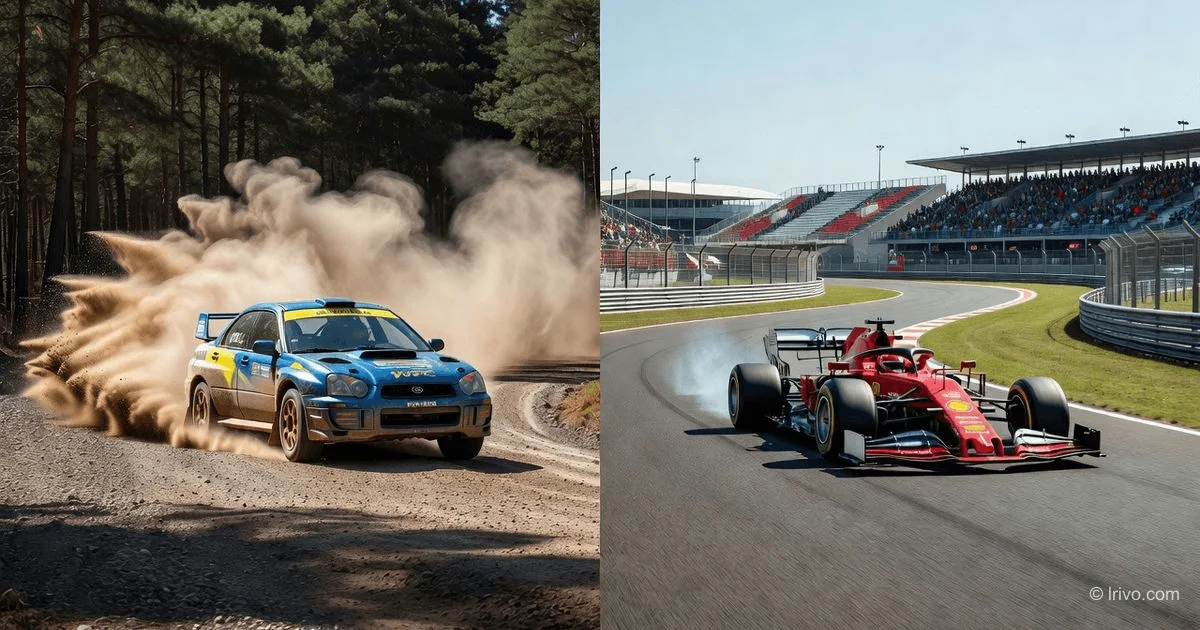
Circuit racing is a head-to-head contest on a closed, paved track where the first car to cross the finish line wins. Rallying is a point-to-point competition against the clock over closed public roads and off-road stages, where the winner is determined by the lowest cumulative time across all stages. Rally drivers use a co-driver and rely on pace notes to navigate, whereas circuit racers memorize a single, predictable track.
At a Glance
The fundamental differences between these two forms of motorsport extend to every aspect of the car, the driver, and the event itself.
| Criterion | Rally Racing | Circuit Racing |
|---|---|---|
| Objective | Lowest cumulative time over multiple special stages . | First to complete a set number of laps or cover the most distance in a set time . |
| Terrain | Varies: gravel, tarmac, snow, and mud, often on closed public roads . | Uniform, smooth, man-made paved surface (asphalt or concrete) . |
| Format | Point-to-point "special stages" linked by untimed transit sections . | Multi-lap format on a closed loop (circuit) . |
| Competition | Against the clock; cars start at intervals (1-3 minutes apart) . | Wheel-to-wheel; cars race simultaneously on the same track . |
| Event Duration | Multi-day event (typically 3-4 days) with 15-25 stages . | Usually a one-day event lasting a few hours . |
| Car Origin | Modified production road cars that are often road-legal . | Purpose-built prototypes with no resemblance to road cars (e.g., Formula 1) . |
| Driver Support | Co-driver reads pace notes to navigate unpredictable terrain . | Solo driver memorizes the track layout; team communicates via radio. |
| Aerodynamics | Less critical due to lower average speeds and side-slip angles . | Crucial; downforce is essential for high-speed cornering . |
| Preparation | Detailed reconnaissance and pace notes are vital . | Focus on qualifying, setup, and data analysis from practice laps. |
| Strategy | Managing risk to avoid damage and penalties across variable stages . | Tire strategy and pit stop timing are key for race-day events. |
Circuit Racing Deep Dive: The Art of Precision
Circuit racing is the most visible and glamorous form of motorsport. Its essence is a battle of man and machine against a known enemy: the clock and the competition. Drivers race head-to-head on a closed, smooth track, navigating a finite number of corners to complete a set distance .
Strengths and Key Characteristics: The primary appeal is the direct competition. The first car across the line wins, allowing spectators to easily follow the action from a single vantage point. The technical specifications of the cars are extreme; for instance, aerodynamic forces are proportional to the square of speed, making downforce a massive differentiator for a circuit car averaging 200 kph compared to a rally car's 100 kph . Precision is paramount. Drivers must execute the same perfect racing line lap after lap, with millisecond-perfect braking and throttle application . A mistake is punished immediately by the loss of position to rivals.
Weaknesses and Challenges: The controlled environment is a double-edged sword. The predictability of the track means the margins for error are razor-thin, and overtaking is often difficult, as the fastest way around a circuit leaves little room for side-by-side racing . The vehicles are also highly specialized, requiring dedicated pit crews and substantial financial backing . Drivers who have come up through karting or single-seaters often possess the exacting mindset needed, as highlighted by WRC driver Esapekka Lappi's background .
Ideal Use Case: Circuit racing is ideal for drivers who thrive on direct, adrenaline-fueled competition and want to compete on a level playing field where setup and precise driving are the primary success factors. It is also the superior spectator sport due to its linear, easy-to-follow format.
Rally Racing Deep Dive: The Art of Chaos
Rallying is a far more organic form of motorsport. A rally is a multi-day event where drivers race against the clock on closed public roads or rugged off-road tracks . The winner is the crew that records the lowest cumulative time across all the timed "special stages" .
Strengths and Key Characteristics: The main appeal of rallying lies in its variety and unpredictability. Drivers must contend with changing surfaces, weather conditions, and the fact they cannot memorize every turn . This makes the role of the co-driver essential, as they read "pace notes" to describe every upcoming corner, hazard, and surface change . The cars themselves are robust, often modified versions of production cars that are still road-legal to allow for transit between stages . This connection to everyday vehicles gives rallying a more "grassroots" feel, making it more accessible to amateur enthusiasts .
Weaknesses and Challenges: The biggest challenge in rallying is the chaos itself. With stages potentially totaling over 300 competitive miles over a weekend, the risk of crashing or mechanical failure is extremely high . Drivers must balance outright speed with survival, as a single puncture can cost a race lead (as famously happened to Jan Kopecký at Rally Deutschland) . Furthermore, the modern sport has evolved to become more data-driven, with drivers spending hours analyzing onboard videos and working on a "circuit racing mentality" for precise pace notes .
Ideal Use Case: Rallying is perfect for drivers who crave adventure and the unknown. It rewards adaptability, mechanical sympathy, and a strong partnership with a co-driver. As one motorsport analyst notes, top rally drivers are considered "some of the best car control experts in the world" due to the need to slide cars at speed on low-traction surfaces .
Cost & Accessibility
The cost of entry and operational expenses vary significantly between the two disciplines.
| Category | Rally Racing | Circuit Racing |
|---|---|---|
| Entry Level | Relatively accessible; a modified road car can suffice to enter national championships . | Higher barrier; begins with karting and progresses through expensive feeder series (e.g., Formula 3) . |
| Vehicle Cost | A used rally car can range from $10,000 - $50,000; a top-tier WRC car costs over $1 million. | A competitive kart costs $5,000-$15,000; a single-seater like F3 costs $700,000+ per season. |
| Running Costs | High wear and tear on suspension, tires, and drivetrain; costs include entry fees and extensive logistics . | High costs for tires, engine rebuilds, and aerodynamic parts; significant travel costs for teams. |
| Team/Support | A small team of mechanics and the co-driver are the backbone . | Requires a large crew of engineers, mechanics, and strategists. |
How to Decide: Choose Your Path
Deciding between circuit racing and rallying is a personal choice based on your temperament and goals.
Choose Circuit Racing if you:
- Thrive on direct, wheel-to-wheel competition.
- Prefer a controlled environment where the variables are minimized.
- Enjoy the data-driven pursuit of shaving milliseconds off a single, perfect lap.
- Want to be a professional driver in a highly visible, glamorous series like Formula 1.
Choose Rally Racing if you:
- Are an adventurer who likes navigating the unknown.
- Prefer a "man vs. nature" challenge where adaptability is more important than pure speed.
- Want to be more involved in the mechanical side of the sport and appreciate the "road car" connection.
- Enjoy the partnership and unique dynamic between driver and co-driver .
Verdict
If you are looking for a pure racing spectacle, circuit racing is the clear winner. It offers direct competition and a test of supreme precision and bravery. Conversely, rally racing offers an unmatched test of endurance, adaptability, and car control under a wider variety of conditions. As one expert noted, the skills required to succeed in the two versions are so different that it is "rare to find the same individual... emerging champion in both" . Your choice depends entirely on whether you want to battle a predictable track with known rivals, or the unpredictable world itself.
Frequently Asked Questions
Is rally racing harder than circuit racing?
Yes, but in different ways. Rallying is arguably harder on the driver mentally and physically due to its longer duration, unpredictable terrain, and the need to react to hazards without ever fully memorizing the track . Circuit racing is harder in its demand for millisecond-perfect precision and consistency on a single, known track where margins are razor-thin .
Do rally drivers race at the same time?
No, rally drivers do not race head-to-head at the same time. They start the special stages at set intervals, typically 1 to 3 minutes apart, racing only against the clock and the ghost of their own previous performance .
Why do rally cars have co-drivers?
The co-driver is essential for navigation. They read "pace notes" that describe every upcoming corner, hazard, and change in surface. This allows the driver to anticipate the road ahead at high speed, especially on blind crests and corners . This partnership is often called "one of the most essential relationships in motorsport" .
Are rally cars street legal?
Yes, many top-tier rally cars are designed to be road-legal. This is a requirement because the cars must drive themselves between timed stages on public roads (transit sections) while obeying normal traffic rules .
Which came first, rally or circuit racing?
While the first formal motorsport competition is often considered the 1894 Paris-Rouen (a "reliability test" similar to rallying), modern circuit racing (like Formula 1) and rallying both developed in the early 20th century . Circuit racing quickly became popular for its spectator-friendly formats, while rallying remained a test of endurance for production cars.
— Editorial Team