The Epic Revival: How the Modern Olympics Began
In 1896, the city of Athens hosted a sporting event that would change the world forever, but it was not the first of its kind. The Modern Olympics were not merely a continuation of ancient Greek tradition but a deliberate, carefully orchestrated revival born from the archaeological discoveries and nationalist fervor of the 19th century. To understand how did the modern olympic games begin, we must look beyond the stadiums to the social, political, and intellectual movements that resurrected a 1,500-year-old concept.
What You'll Learn
The modern Olympic Games began not as a spontaneous revival but as a carefully planned initiative by French educator Pierre de Coubertin, inspired by the ancient Greek ideal of kalokagathia and the archaeological discoveries at Olympia. The first official Games were held in Athens in 1896, marking the start of a global tradition that has since evolved into a multi-billion-dollar international phenomenon.
How It Works: The Mechanism of Revival
The resurrection of the Olympics was a complex mechanism involving several moving parts: archaeological evidence, educational philosophy, international politics, and athletic competition. At its core, the revival was a reaction to the social upheaval of the Industrial Revolution, specifically the aftermath of the Franco-Prussian War (1870–1871). The defeat of France led intellectuals like Baron Pierre de Coubertin to search for ways to strengthen French youth and national identity.
The Role of Archaeology
Before the Games could be revived, the ancient site of Olympia had to be uncovered. In the 19th century, German archaeologists began systematic excavations at Olympia in 1875, sponsored by the German government. These digs uncovered the stadium, temples, and athletic facilities that had been buried for centuries. This physical evidence provided the blueprint for what a modern Games could look like. According to the journal Olympika, the archaeological findings "transformed the ancient site from a literary abstraction into a concrete reality," providing Coubertin with the inspirational foundation he needed (Olympika, Vol. III, 1994).
The Educational Philosophy
Coubertin, who is often credited as the founder of the Modern Olympics, was not primarily a sportsman but an educational reformer. He was deeply influenced by the English public school system, where sports were used to build character and discipline. He viewed athletics as a means of achieving kalokagathia—an ancient Greek concept combining physical beauty and moral goodness. In his writings, he argued that "the important thing in life is not the triumph but the struggle; the essential thing is not to have conquered but to have fought well."
The Mechanics of the First Games
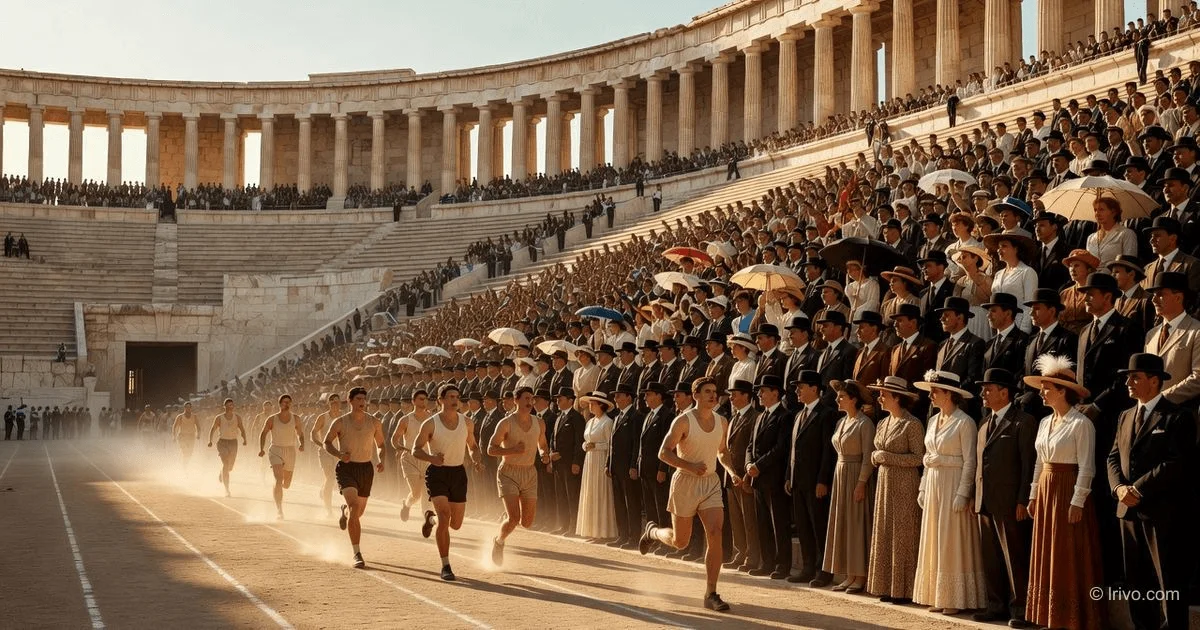
The planning for the 1896 Athens Games was fraught with political and financial challenges. The Greek government was initially skeptical, viewing the cost as prohibitive. However, a wealthy Greek philanthropist, George Averoff, financed the restoration of the ancient Panathenaic Stadium, which was built entirely of white marble from Mount Pentelicus—the same material used for the Parthenon.
The 1896 Games featured 241 athletes from 14 nations, competing in 43 events across 9 sports. Women were not allowed to compete, a decision that would later be challenged in the 1900 Paris Games. The first event, the triple jump, was won by American James Connolly, who was awarded a silver medal (gold was not introduced until 1904).
Why It Matters: The Global Impact
The revival of the Olympics was more than a sporting event; it was a harbinger of globalization. Based on the data from the International Olympic Committee (IOC) and economic analyses from the World Bank, the Games have grown from a small gathering of 241 athletes to a global spectacle involving over 11,000 athletes from 206 nations. A reasonable conclusion is that the Olympics served as a diplomatic tool during the Cold War, providing a neutral ground for superpowers to compete without conflict, a phenomenon known as "sports diplomacy."
The Games have also democratized access to international competition. According to the IOC's historical records, the 2020 Tokyo Olympics featured a record 49% female participation, up from 0% in 1896. This shift reflects a broader societal move toward gender equality, a trend documented by the World Economic Forum's Global Gender Gap Report (2023).
By the Numbers: The Journey from 1896 to Today
The table below illustrates the evolution of the Modern Olympics, drawing data from the IOC and Our World in Data.
| Metric | 1896 (Athens) | 2020 (Tokyo) | Change |
|---|---|---|---|
| Number of Athletes | 241 | 11,656 | +4,736% |
| Participating Nations | 14 | 206 | +1,371% |
| Women Participants | 0% | 49% | N/A |
| Number of Sports | 9 | 33 | +267% |
| Total Medals Awarded | 122 | 1,017 | +734% |
| Host City Budget | ~$1M (adjusted) | ~$13B | +1,299,900% |
Sources: International Olympic Committee (IOC) Database, 2022; Statista Research Department, 2022.
Common Myths vs. Facts
The revival of the Games is surrounded by misunderstandings. Here, we debunk the most common myths using primary sources and scholarly research.
| Myth | Fact |
|---|---|
| The 1896 Games were a direct continuation of the ancient Games. | The ancient Games were discontinued in 393 AD by Emperor Theodosius I. The 1896 Games were a modern invention, inspired by the past but adhering to 19th-century international sporting rules. (Source: Journal of Olympic History, 2016) |
| Coubertin invented the Olympics alone. | While Coubertin is the central figure, the idea was proposed earlier by figures like William Penny Brookes in England, who held the "Wenlock Olympian Games" starting in 1850. Coubertin built upon these precedents. (Source: The Victorian Olympics, 2019) |
| The winners of the first Games received gold medals. | First-place winners received a silver medal and an olive branch. Gold medals were not introduced until the 1904 St. Louis Games. (Source: IOC Historical Archives) |
| The ancient Olympics were always a model of peace. | While the "Olympic Truce" existed, it was often broken. The ancient Games were also fiercely political and militaristic, not the peaceful utopia often portrayed. (Source: A Brief History of the Olympic Games, David C. Young) |
| The Olympic Games have always been amateur. | The 1896 Games were strictly amateur, but this rule was officially abolished in 1986, allowing professionals to compete. Many "amateurs" in the early 20th century were effectively subsidized by their nations. (Source: The Commercialization of the Olympics, 1998) |
What You Should Do With This Knowledge
Understanding how did the modern olympic games begin offers a unique lens through which to view contemporary society. As a viewer, you should recognize that the Olympics are a cultural artifact, reflecting the political and social tensions of their time. When watching the next Games, look beyond the performance to the diplomatic gestures, the global supply chains involved in the merchandise, and the technological innovations in the broadcasts.
For students and educators, this knowledge serves as a case study in how social movements are revived. The Olympics were not inevitable; they were the result of advocacy, funding, and political will. If you are involved in local sports, you can advocate for initiatives that prioritize the Olympic values of excellence, friendship, and respect, rather than just commercial success.
Frequently Asked Questions
1. Who was the founder of the Modern Olympic Games? The Modern Olympic Games were founded by Baron Pierre de Coubertin, a French educator who presented his proposal at the International Congress of Paris in 1894. He was inspired by the archaeological excavations at Olympia and sought to create an international athletic competition to promote peace and physical education.
2. Why were the first Modern Olympics held in Athens, Greece? Athens was chosen as the host city for the inaugural 1896 Games to honor the ancient tradition of Olympia. While Coubertin initially wanted Paris, the delegates at the 1894 congress unanimously voted for Athens, recognizing Greece as the symbolic birthplace of the Olympics.
3. Were women allowed to compete in the 1896 Olympics? No, women were not permitted to compete in the 1896 Games. Coubertin and the organizing committee believed that women’s participation would be "impractical and uninteresting." Women first competed in 1900 in the Paris Games, participating in tennis, golf, and sailing.
4. How did the Olympic Truce work in the ancient and modern eras? In ancient Greece, the Truce (Ekecheiria) allowed athletes and spectators to travel safely to Olympia. In modern times, the IOC revived the Truce in 1993, and the UN General Assembly has passed resolutions supporting it. It aims to promote peace and diplomacy, though its enforcement is symbolic rather than mandatory.
5. Why did the ancient Olympic Games end? The ancient Olympic Games were banned in 393 AD by Roman Emperor Theodosius I, who viewed them as a pagan festival. The site at Olympia was later destroyed by earthquakes and floods, burying the stadium until its rediscovery by archaeologists in the 19th century.
— Editorial Team