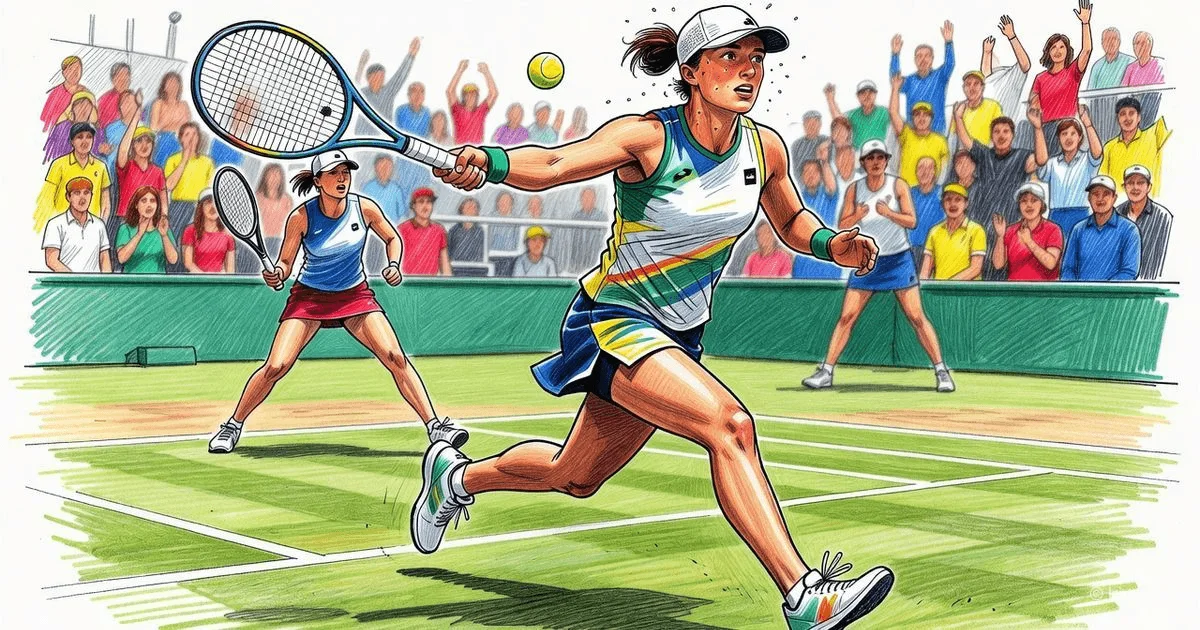
Polish tennis star Iga Swiatek avenges loss to Elena Rybakina in WTA Berlin semifinal
The world No. 1 won 7:5, 6:2. Swiatek will face Aryna Sabalenka in the final.
Royal revenge in Berlin: Iga Swiatek crushes Elena Rybakina to set up final with Sabalenka
Main event
On the grass courts of the prestigious WTA 500 tournament in Berlin, a battle worthy of any Grand Slam final unfolded between two of the greatest tennis players of our time. World No. 1 Iga Swiatek and world No. 5 Elena Rybakina met in the semifinals, and the Polish champion took convincing revenge for her Australian Open defeat, crushing her opponent 7:5, 6:2. This victory sent Swiatek to the final, where she will face Aryna Sabalenka — the world No. 2 and Swiatek's main rival for the top ranking spot.
The match began with incredible tension. Rybakina, dubbed the "Terminator" of women's tennis after her brilliant performance in Melbourne, showed from the first minutes that she would not go down without a fight. Her powerful serve and crisp groundstrokes forced Swiatek to constantly defend. The first set became a true duel of wills: the players traded breaks, and it seemed the set would inevitably go to a tiebreak.
However, at 5:5, the momentum shifted. Swiatek, who in recent years has been considered the queen of clay but feels equally confident on grass (remember her 2025 Wimbledon title), managed to secure a decisive break. Rybakina, in turn, committed a double fault on the most crucial point, gifting her opponent the game and, consequently, the set — 7:5.
The second set turned into a showcase for the Pole. Swiatek seemed to glide across the grass as if it were her beloved Roland Garros clay. Rybakina, mentally broken by the missed opportunity to win the first set, began to make errors. Her shot accuracy dropped, while Swiatek kept retrieving seemingly hopeless balls and turning defense into attack. In the end, the second set was won with a humiliating 6:2 scoreline. The final victory for Swiatek over her arch-rival: 2-0 in sets.
Details and statistics
The match statistics speak volumes about Swiatek's dominance, especially in the second set. Iga converted 4 of 8 break points, while Rybakina managed only 2 of 7. The Pole won 68% of points on her first serve and 52% on her second. Her trademark shot — the powerful crosscourt forehand — earned her 17 winners against just 11 unforced errors.
For Rybakina, this match was her first serious test on grass this season. The Kazakhstani player ended last season with a triumph at the WTA Finals, and at the start of 2026 she won the Australian Open, defeating the same Swiatek in the quarterfinals 7:5, 6:1. At that tournament in Melbourne, she looked absolutely invincible, winning 18 of her last 19 matches and not dropping a single set. The Berlin match, however, showed that the Pole had done her homework and found an "antidote" to the "Terminator's" power.
Let's look at the head-to-head history between the two players:
| Statistic | Iga Swiatek | Elena Rybakina |
|---|---|---|
| Head-to-head wins | 4 | 3 |
| Wins on grass | 1 | 1 |
| Sets won | 10 | 7 |
| Tiebreaks won | 2 | 1 |
Table: Head-to-head statistics between Swiatek and Rybakina as of the 2026 Berlin semifinal
As for prize money and ranking points, reaching the semifinal earned Swiatek 195 WTA ranking points and a check for approximately $57,395. However, for the world No. 1, something else matters more: a victory over a direct title rival ahead of Wimbledon. Rybakina, who settled for a semifinal appearance, received 108 points and about $29,110.
Context and significance
This semifinal was a key preparation stage for both players ahead of the main grass-court tournament of the year — Wimbledon, which starts on June 29. Interestingly, the tournament organizers in Berlin initially did not count on Iga Swiatek's participation. Earlier in the season, the Polish player stated that she planned to skip the Berlin Ladies Open, focusing instead on the later tournament in Bad Homburg. However, plans changed: perhaps the Pole felt the need for more match practice on grass after a not-so-successful clay season (by the standards of the "Queen of Roland Garros").
For Aryna Sabalenka, who is already waiting for Swiatek in the final, the Berlin tournament holds special significance. The Belarusian, who tops the world rankings (Swiatek is ranked third but is formally called "world No. 1" — a nuance due to point recalculation after the Australian Open), has never won this trophy before. Moreover, Sabalenka has yet to win a title on grass in her career, and the Berlin Ladies Open is an ideal opportunity to break that curse before Wimbledon.
The victory over Rybakina has not only tournament but also psychological importance for Swiatek. The Kazakhstani player has become a real curse for the Pole recently. Just recall their quarterfinal at the Australian Open in January 2026, where Rybakina crushed Iga. That match was dubbed an "execution" in the press, and Elena earned the nickname "Terminator." Now Swiatek has proven that she can not only beat Rybakina but do so confidently, outplaying her strongest rival both physically and tactically.
The Berlin tournament featured a star-studded lineup. The main draw included 32 players, among them seven representatives from the world's top 10. The prize fund was €1,206,446, and the defending champion was Czech Marketa Vondrousova. However, Vondrousova was unable to defend her title this year, losing early on, which opened the door for new heroines.
What's next / Match preview
The final of the WTA 500 tournament in Berlin, featuring Iga Swiatek and Aryna Sabalenka, will take place tomorrow, June 15, 2026. The match is scheduled to start at 3:00 PM local time (4:00 PM Moscow time). The match will be held on the center court of the Steffi Graf Stadium — named after the legendary German tennis player.
This will be the 13th meeting between the two great rivals in their careers. Currently, the head-to-head record is tied at 6 wins each. However, they have met on grass only once, and Swiatek came out on top (in the 2025 Wimbledon final). Sabalenka, for her part, is known for her love of fast surfaces: she has won the Australian Open twice (hard court) and came close to winning Wimbledon (final in 2024).
For both players, this final is a crucial preparation step for the third Grand Slam of the season. The winner will receive not only 500 ranking points and €161,310 in prize money but also a massive psychological boost ahead of the start in London. The match is expected to draw over 10,000 spectators, and the broadcast will be carried by major sports channels worldwide. Fans around the globe are gearing up for another chapter in the greatest rivalry in modern women's tennis.
Editorial prediction
Our editorial team believes that Iga Swiatek enters the final as a slight favorite. The victory over Rybakina in the semifinal is not just a step to the next round but a mental breakthrough. The Pole has proven she can outplay the most uncomfortable opponents on any surface. After Melbourne, many experts wrote Swiatek off, claiming her era was over, but the Berlin semifinal showed the opposite.
Nevertheless, Aryna Sabalenka is a "different level" of difficulty. If Rybakina is power and straightforwardness, Sabalenka is power plus incredible versatility. This season, the Belarusian won the "Sunshine Double" (Indian Wells and Miami), confirming her status as the best hard-court player on the planet. The question is how quickly she adapts to grass. Unlike Swiatek, Sabalenka had an extra day of rest and spent less time on court (her quarterfinal and semifinal were relatively easy).
The key factor will be serving. If Sabalenka serves with a first-serve percentage above 65%, Swiatek will face serious problems. However, the Belarusian has a tendency to "meltdowns," where she starts making double faults on crucial points. Swiatek, in turn, will focus on long rallies and variety, trying to wear down her opponent.
We predict a victory for Aryna Sabalenka in three sets — 2:6, 7:5, 6:3. This scenario seems most likely: Swiatek may take the first set on momentum, but Sabalenka's physical power and serve should prevail in the second and third sets. However, if Iga manages to impose her game and make Sabalenka run a lot, the Pole's chances of winning the title increase to 50-50. In any case, we are in for a final of the highest quality, worthy of a "Grand Slam."
— Editorial Team