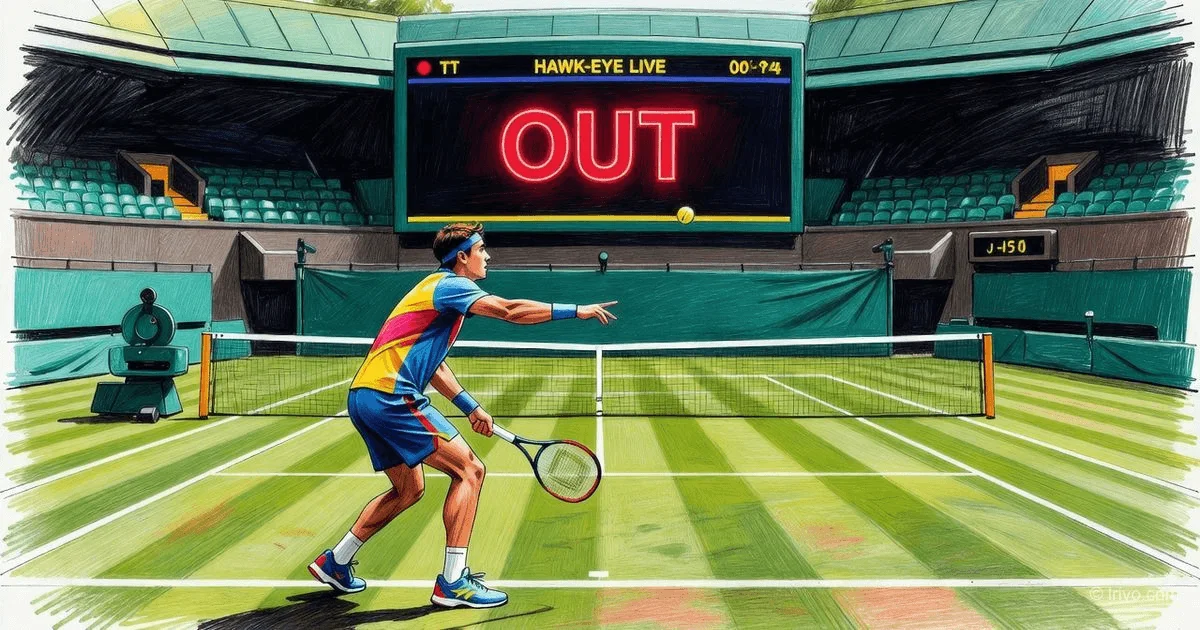
Wimbledon Confirms Removal of Line Judges on All Courts for the First Time in History
The 2026 tournament will fully transition to the Hawk-Eye Live electronic line-calling system. The decision has sparked debate among tennis players: Djokovic called it a 'loss of the sport's soul.'
'End of an Era': Wimbledon Bids Farewell to Line Judges Forever — a First in History
London, All England Lawn Tennis and Croquet Club. The Wimbledon Grand Slam tournament, starting June 29, 2026, will go down in history not only for its sporting battles but also for a technological revolution. Organizers have confirmed: line judges will no longer be present on any court of the championship. The 150-year tradition that made Wimbledon one of the most conservative and recognizable tournaments in the world is now a thing of the past. It has been replaced by the Hawk-Eye Live electronic line-calling system. However, the decision has sparked heated debate: legendary Novak Djokovic called it a 'loss of the sport's soul,' and protest pickets have already taken place at the tournament gates.
London, England. Since the first tennis match was played on Wimbledon's grass courts in 1877, an integral part of the tournament has been the people in strict khaki and cream-blue uniforms by Ralph Lauren. The line judges — 'those who never make mistakes' (or so it's thought) — stood frozen around the court perimeter, ready at any moment to shout their trademark 'Out!'
But 2026 became the point of no return. Last year, in 2025, Wimbledon had already taken the first step toward eliminating human line judges, replacing them with an electronic system. At the time, it was seen as an experiment. Now, it is official policy.
Sally Bolton, Chief Executive of the All England Club, confirmed that from this season, the 300 line judges who annually officiated matches will no longer take to the courts. 'We evaluated the results of testing the electronic line-calling system and concluded that the technology is sufficiently reliable. It is time to take this important step in the pursuit of maximum accuracy,' Bolton stated. 80 of the 300 judges have been offered retraining as 'player assistants' — to accompany players off the court or to substitute for technology in case of failure.
Main Event: Farewell to Tradition and Welcome to Technology
Wimbledon's decision to abandon line judges had been brewing for a long time. As early as 2020, at the US Open due to the coronavirus pandemic, organizers sought ways to minimize contact, and the ELC (Electronic Line Calling) system was first used extensively at a Grand Slam tournament. The Australian Open followed, but Wimbledon, as the most conservative tournament, held out the longest.
In 2024, the technology underwent preliminary testing on the All England Club courts. Then, in 2025, line judges were completely replaced. But last year's experience proved mixed. The system malfunctioned, nearly costing one of the tennis players a victory. At that time, in the fourth round, Russian tennis player Anastasia Pavlyuchenkova was playing against Briton Sonay Kartal. Hawk-Eye Live was mistakenly deactivated for three points. Kartal's ball clearly landed beyond the line, but the automated voice remained silent. The chair umpire did not dare award the point, and Pavlyuchenkova had to replay a crucial rally. 'They took a game away from me,' the Russian complained then.
This incident prompted organizers to reconsider their approach. In 2026, they not only kept the system but expanded its functionality. Now, on the six main courts (Centre Court, Courts No. 1, 2, 3, 12, and 18), players can use the Video Review system to challenge chair umpire decisions — for example, double bounces or net touches. Additionally, visual indicators for 'Out' and 'Fault' will appear on the scoreboard to make it easier for spectators to follow (last year, many complained that the recorded voice from the speakers was too quiet and inaudible on distant courts).
Details and Statistics: How the New System Works and What Players Think
The system that has now replaced live humans is called ELC (Electronic Line Calling) and operates based on cameras and sensors, not just video analysis (like the old Hawk-Eye). It uses infrared lasers and pressure sensors, making it more accurate. However, as the Pavlyuchenkova incident showed, the 'human factor' in system management has not disappeared — the malfunction occurred precisely because an operator forgot to turn on the cameras.
Controversies and Scandals: From Djokovic to Protests at the Gates
The decision has divided the tennis world into two camps.
'For' technology (and organizers' arguments):
- Accuracy. Line judge errors (especially on grass, where the ball leaves an unclear mark) have cost players victories. Organizers claim ELC accuracy reaches 99.9%.
- Speed. No need to waste time on disputes and replays. Tennis becomes more dynamic.
- Uniform standard. Wimbledon catches up with the US Open and Australian Open, where electronic judges are already the norm. Roland Garros remains the only major that still keeps line judges due to the complexity of working on clay.
'Against' (traditionalists' voices):
- Loss of soul. Novak Djokovic, a 24-time Grand Slam champion, called it a 'loss of the sport's soul.' 'Tennis is not robots. It's emotions, disputes, drama. The shout of 'out' with a live voice is part of the show,' the Serb stated.
- Jobs. 300 people lost seasonal work. Protests even took place at the club gates. Students Gabriel Paul and Harry Robson dressed in line judge uniforms and carried signs reading 'AI took my job.'
- Malfunctions. The Pavlyuchenkova incident proved that technology also makes mistakes, and sometimes its 'human errors' look more foolish than those of live officials.
John McEnroe, the legendary rebel who in 1981 yelled at an umpire, 'You cannot be serious!', was brief: 'They've gone crazy. You'll see that chair umpires are next to go.'
American tennis player Frances Tiafoe admitted he will miss the visual flair: 'Line judges in beautiful attire added a sense of ceremony to the tournament.'
Context and Significance: Why This Matters More Than It Seems
Wimbledon is more than just a tournament. For Britain, it is a national treasure, a symbol of the Victorian era, gentlemanliness, and impeccable taste. Here, colored underwear is still banned, players must bow to the royal box, and strawberries and cream are served during breaks.
By removing line judges, Wimbledon has made the most radical break with tradition in the last half-century. Before this, the biggest shocks were the abolition of 'Middle Sunday' (a rest day in the middle of the tournament) and the construction of the roof over Centre Court. Now, the All England Club is betting on 'maximum accuracy.'
Symbolically, this decision coincides with the active integration of artificial intelligence into officiating. The ATP and WTA are already transitioning to ELC at virtually all tournaments, and Wimbledon has simply put the final nail in the coffin. However, club CEO Sally Bolton insists this is not a 'robot takeover': 'This is not pure artificial intelligence. The system requires human control. But we are eliminating errors on the lines.'
What's Next / Wimbledon 2026 Preview
Wimbledon 2026 starts on June 29 and runs until July 12. It will be the first tournament in the new format with no line judges.
What's new for spectators and players:
- Video Review on six main courts. Players can take unlimited challenges on chair umpire decisions (double bounce, net touch, hindrance). Video replays will be shown on big screens.
- Visual cues. The scoreboard will light up with red letters 'OUT' or 'FAULT' so spectators in distant stands can see the automated decision.
- Role of the chair umpire. They remain. They still announce the score, monitor time, and can review incidents on their tablet. But they will no longer shout 'out' — that will be done by a faceless voice from the speakers.
- Alignment with tours. Wimbledon is now unified with most ATP and WTA tournaments, making life easier for players who won't have to switch between technology and live judges.
Editorial Forecast: What Awaits Tennis?
The removal of line judges is an irreversible process. In all likelihood, within 5-10 years, there will be no live humans on the lines at any tournament. Even stubborn Roland Garros will probably cave under pressure from sponsors and television. Technology is advancing, and human errors are becoming less forgivable in an era when any incident can be checked in seconds.
But the loss will be immense. Tennis is losing one of its main aesthetic attributes. The 'impeccable' British judges in perfectly pressed suits, synchronously bending or raising their hands — that was a brand. As former umpire Michael Sadler aptly noted in a BBC interview: 'Players will feel very lonely on the court.'
In the short term, we are likely to see new technical glitches. As the 2025 experience showed, human operators can forget to turn on cameras. However, organizers promise that this incident 'will not happen again' because the system has been refined.
As for player reactions, they will be mixed. The younger generation, raised on computers, will take the technology in stride. But veterans like Djokovic, Muguruza, or Murray (if he plays) will reminisce about the good old days when you could argue with the umpire, put on a show, and hear John McEnroe's legendary 'You cannot be serious!' This 'juice' of tennis will likely have to be bid farewell. But Wimbledon, as always, moves with the times, even if it breaks traditionalists' hearts.
— Editorial Team