The Best Beginner Yoga Routine for Flexibility: A Science-Based Guide to Full-Body Mobility
Flexibility isn't about being able to twist yourself into a pretzel or touch your palms to the floor on day one. It's a trainable physical quality—one that research shows responds to consistent, intelligent practice. A 2023 meta-analysis published in the International Journal of Older People Nursing found that yoga significantly improves flexibility compared to control groups, with a standardized mean difference of 0.38 (95% CI: 0.07–0.68, p = .020) across multiple studies . That's not just statistical noise; it's real, measurable change.
This guide walks you through a 20-minute, evidence-informed beginner routine targeting the three areas that most limit functional movement: hamstrings, hips, and spine. No previous experience required. No expensive equipment needed. Just your body, a clear floor, and consistency.
What the Science Says About Yoga and Flexibility
Before diving into poses, it's worth understanding what actually happens when you stretch. Research demonstrates that yoga improves flexibility in both sexes, with one study noting that male participants showed "greater improvement than females in the flexibility results" despite starting with poorer baseline measurements . A separate study examining the short-term effects of Surya Namaskar (Sun Salutations) found that a single session of ten slow rounds with ten-second holds produced statistically significant improvements (p < 0.00001) in trunk flexion among school children .
What explains these rapid changes? The current understanding involves two mechanisms working in tandem:
- Neural adaptation (your nervous system becoming more tolerant of stretch)
- Viscoelastic changes in muscle connective tissue (stress relaxation and creep)
Based on and , a reasonable conclusion is that beginners see faster initial progress from neural adaptations than from actual tissue lengthening—which is why consistency matters more than intensity. Your nervous system needs repeated, gentle exposure to new ranges of motion before it stops sounding the alarm.
Safety First: Non-Negotiable Guidelines
Yoga is generally safe, but injuries do happen. The U.S. Consumer Product Safety Commission reported over 34,000 yoga-related injuries treated in emergency rooms and clinics in 2019 . Almost all of these are preventable.
⚠️ Important Safety Guidelines
- Get medical clearance first if you have hypertension, glaucoma, sciatica, arthritis, or are pregnant
- Never push through sharp pain — mild sensation of stretch is expected; joint pain is a stop signal
- Start with a qualified instructor if possible, or at minimum watch video demonstrations of each pose
- Warm up thoroughly — cold muscles, tendons, and ligaments are vulnerable to injury
- Use props (blankets, blocks, straps, or towels) without shame — they're not cheating, they're smart training
- Avoid locking your knees in standing poses — keep a microbend to protect the joint capsule
The 20-Minute Beginner Flexibility Routine
Perform this routine 3–5 times per week. Research on detraining effects suggests that complete cessation reverses gains, but incorporating yogic breathing (pranayama) may help preserve flexibility during breaks from physical postures . For now, focus on the movement.
Overview Table: Routine at a Glance
| Phase | Poses | Duration | Primary Target |
|---|---|---|---|
| Grounding (1 min) | Seated Easy Pose | 5 breaths | Hip internal rotation |
| Flowing Warm-up (3 min) | Cat-Cow (3 rounds) | 5 breaths each | Spine articulation |
| Active Stretches (12 min) | 4 poses | 1 min each side | Hamstrings, hips, back |
| Deep Hold (3 min) | 2 seated poses | 90 sec each | Inner thighs, groin |
| Integration (1 min) | Savasana (Corpse Pose) | 1+ min | Nervous system recovery |
Detailed Pose Instructions
1. Seated Easy Pose (Sukhasana) — 5 breaths
Sit on the edge of a folded blanket or firm cushion. Cross your shins in front of you. Your knees should drop below your hips; if they hover above, add more height under your sit bones. Stack your spine tall, relax your shoulders down your back. Close your eyes or soften your gaze.
Why it matters: This position externally rotates the hips while maintaining neutral spine alignment. Sitting propped up opens the groins and reduces strain on the sacroiliac joint .
2. Cat-Cow Stretch (Marjaryasana-Bitilasana) — 3 rounds (5 breaths each)
Start on hands and knees in tabletop position—wrists under shoulders, knees under hips. On inhale, drop your belly, lift your sitting bones and gaze slightly up (Cow). On exhale, round your spine toward the ceiling like an angry cat, tucking your chin to chest (Cat). Move slowly with your breath, not rushing.
Common mistake: Leading the movement from your neck rather than your tailbone. Initiate each motion from the base of your spine.
3. Downward-Facing Dog (Adho Mukha Svanasana) — Hold 30–60 seconds
From tabletop, tuck your toes and lift your hips up and back, forming an inverted V. Press firmly through your hands, spreading fingers wide. Keep a microbend in your knees—straight legs are not the goal. Pedal your feet gently, alternating heels toward the floor. Your ears should be between your upper arms.
Why this pose is essential: A systematic review published in the Journal of Bodywork and Movement Therapies (2024) confirmed that yoga interventions effectively increase spinal flexibility . Downward Dog specifically targets the entire posterior chain—hamstrings, calves, and spine—simultaneously.
4. Standing Forward Fold (Uttanasana) — Hold 30–60 seconds
Stand with feet hip-width apart, knees slightly bent. Hinge from your hips (not your waist) as you fold forward. Let your head hang heavy. Grasp opposite elbows or place palms flat on the floor if possible. If your hamstrings feel like steel cables, bend your knees generously—a forward fold with bent knees still provides 80% of the hamstring stretch without the risk of ischial tuberosity avulsion.
Tip from the research: The principle of "stress relaxation" means that holding a stretch for 30–60 seconds allows muscle connective tissue to gradually elongate without microtearing .
5. Reclined Hand-to-Big-Toe Pose (Supta Padangusthasana) — 1 minute each side
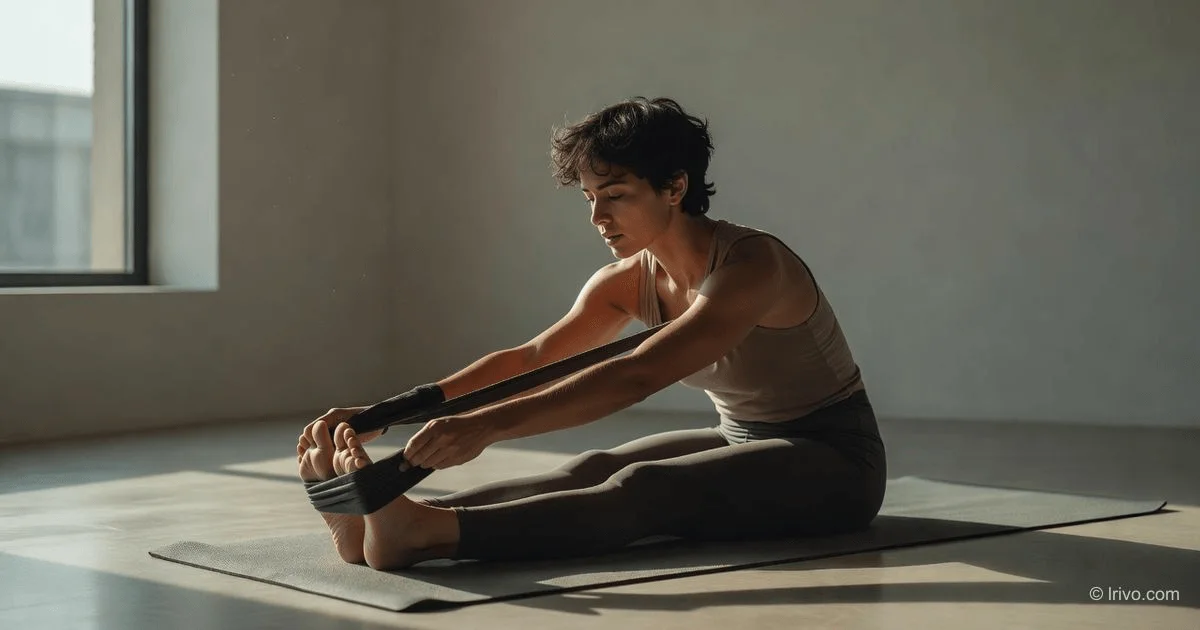
Lie on your back. Loop a yoga strap, belt, or towel around the ball of your right foot. Extend your left leg flat along the floor. Slowly lift your right leg toward the ceiling, keeping it as straight as comfortable (knee soft, not locked). Flex your foot (toes pointing toward your shin) to deepen the hamstring engagement.
How much height is enough? Zero. The benefit comes from the straight leg with flexed foot, not how high the leg rises. If your hamstring protests, bend the knee slightly or lower the leg—effectiveness is not compromised by range of motion.
6. Pigeon Pose (Eka Pada Rajakapotasana) — 1 minute each side (modified)
From tabletop, slide your right knee forward toward your right wrist. Position your right foot somewhere between your left hip and left hand—exactly where depends on your hip anatomy. Extend your left leg straight back, keeping the top of the left foot on the floor. Square your hips to the front of your mat (both hip bones pointing forward). If your right glute floats off the floor, place a block or folded blanket under it.
Critical warning: If you feel sharp pain on the outside of your front knee, come out immediately. This indicates the pose is torquing the lateral knee capsule. Use the reclined figure-four stretch instead (cross ankle over opposite knee while lying on back).
7. Seated Wide-Legged Fold (Upavistha Konasana) — 90 seconds
Sit on the floor with legs spread wide into a V. Sit tall first, then hinge forward from the hips. Walk your hands forward as far as comfortable without rounding your lower back. If your fingertips barely leave your thighs, that's fine. If your chest rests on the floor between your legs, also fine. Do not bounce—static hold only.
Based on the principle of creep (a time-dependent property of connective tissue), longer holds of 90 seconds are particularly effective for the adductors (inner thigh muscles) .
8. Bound Angle Pose (Baddha Konasana) — 90 seconds
From seated, bring the soles of your feet together, allowing knees to fall open. Clasp your feet or ankles. Sit up straight—if your spine rounds, sit on a folded blanket. You can stay upright or fold forward gently. Hold for up to five minutes for deep groin release .
9. Corpse Pose (Savasana) — minimum 1 minute
Lie flat on your back, arms relaxed at your sides with palms up, feet falling open naturally. Close your eyes. This is not optional—it's the integration phase where your nervous system shifts from sympathetic (stretch response) to parasympathetic (repair and recovery).
How Long Until You See Results?
Individual response varies based on starting flexibility, consistency, age, and genetics. However, a reasonable evidence-based timeline:
- Immediate effects (single session): Increased trunk flexion and hamstring range of motion
- 4–8 weeks of consistent practice (10–20 minutes daily): Noticeable improvement in typical individuals
- 12 weeks of structured practice (6 days/week): Statistically significant improvements in flexibility, balance, and strength
The 2023 study on yoga training in young adults found that flexibility improvements occurred regardless of sex, with measurable changes appearing within the first five sessions .
Modifications for Common Limitations
| If you have... | Do this instead... |
|---|---|
| Tight hamstrings | Bend knees in all forward folds; use a strap for reclined stretches |
| Lower back sensitivity | Skip deep forward folds; emphasize cat-cow and supported backbends |
| Knee issues | Avoid Pigeon Pose; use reclined figure-four stretch |
| Wrist pain | Perform Downward Dog on forearms or against a wall |
| Difficulty sitting upright | Elevate hips on firm cushions/blocks in all seated poses |
When to See a Doctor
Stop yoga and consult a healthcare provider if you experience:
- Acute joint pain (especially knee, hip, or shoulder) that persists after practice
- Numbness or tingling radiating down legs or arms
- Sharp, stabbing back pain (as opposed to diffuse muscular soreness)
- Dizziness, nausea, or headache that begins during or after specific poses
Individuals with known glaucoma, retinopathy, or uncontrolled hypertension should avoid inverted poses (including Downward Dog) unless cleared by an ophthalmologist or cardiologist .
Key Takeaways
Consistency beats intensity. A 10–20 minute daily routine produces better flexibility gains than a 90-minute weekly class. Based on the research, neural adaptations require frequent repetition, not heroic single sessions.
Science supports yoga for flexibility across all ages and sexes. Meta-analyses show significant, measurable improvements in spine and hamstring flexibility with regular practice .
Pain is not gain. Sharp or joint pain means stop. Mild, tolerable stretch sensation means you're in the right zone. Over 34,000 yoga-related injuries occur annually—almost all are preventable by respecting your current limits .
The three priority areas for functional flexibility are hamstrings, hips (external rotation and flexion), and spine. This routine targets all three in under 20 minutes.
Props are essential for beginners, not optional luxuries. A strap, two blocks, and a folded blanket transform poses from impossible to accessible.
Frequently Asked Questions
How many times per week should a beginner do yoga for flexibility?
3–5 sessions per week is optimal based on training studies . Daily practice (even 10 minutes) produces faster results than intermittent longer sessions, due to the neural adaptation principle . Rest days are fine—flexibility does not require daily training like strength or endurance.
Can I become flexible if I've been tight my whole life?
Yes. The 2023 study on yoga training explicitly concluded that yoga "was effective in improving flexibility among healthy young adults of both sexes" regardless of baseline . Age-related stiffness is not a permanent barrier; while older adults show smaller effect sizes (SMD = 0.38 versus larger gains in younger populations), improvements remain statistically significant .
Is it better to stretch before or after a workout for flexibility?
After is safer and more effective. Cold muscles have reduced viscoelasticity, making them more injury-prone . For pure flexibility gains, perform this routine after a light warm-up (5 minutes of walking or marching in place) or at the end of your day when body temperature is naturally elevated.
Which poses are most effective for hamstring tightness?
The evidence points to reclined hand-to-big-toe pose (with strap), standing forward fold, downward-facing dog, and pyramid pose as the most effective . The critical element across all four is maintaining a relatively straight knee with a flexed foot (dorsiflexion).
How long should I hold each pose for maximum flexibility?
30–60 seconds for active poses (like Downward Dog). 90 seconds to 2 minutes for seated passive poses (like Wide-Legged Fold or Bound Angle). These durations align with the physiological principle of creep and stress relaxation in connective tissue—shorter holds train neural tolerance, longer holds affect tissue compliance .
This guide is for informational purposes and does not constitute medical advice. Always consult a healthcare provider before beginning a new exercise program, particularly if you have pre-existing medical conditions or injuries.
— Editorial Team