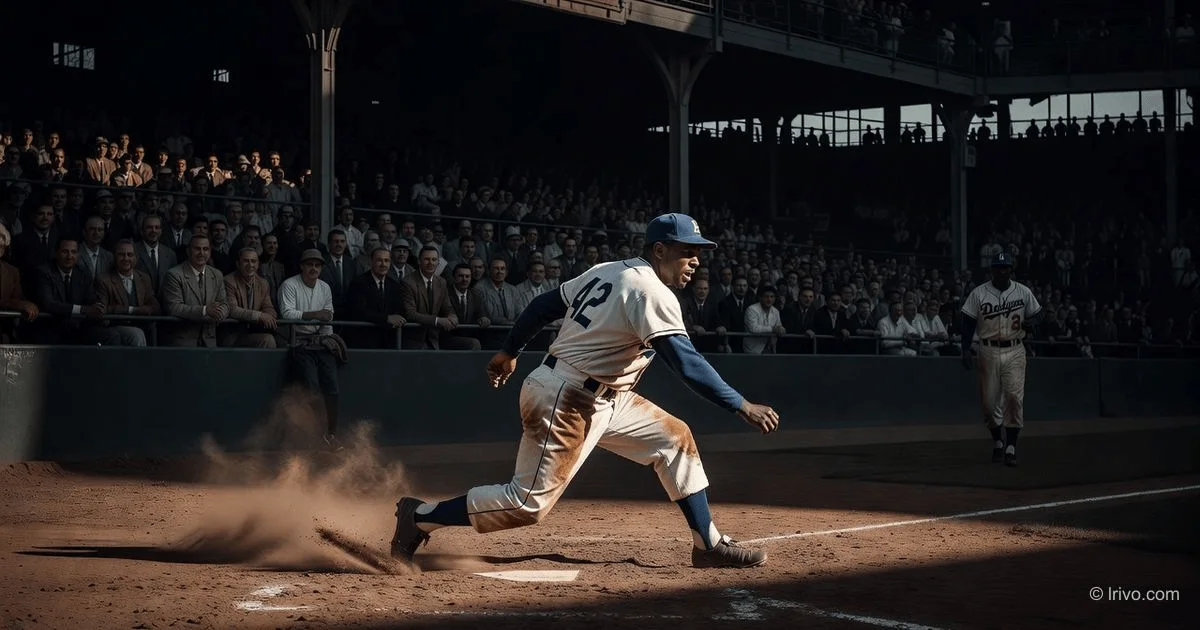
The Jackie Robinson Effect: How One Man Desegregated Baseball
On April 15, 1947, Jack Roosevelt Robinson stepped onto Ebbets Field as a Brooklyn Dodger, shattering Major League Baseball's color barrier and fundamentally altering the course of American history. The question of how did jackie robinson change baseball forever is not merely a matter of sports trivia, but a profound exploration of social change, economic forces, and moral courage. Robinson's integration of the national pastime served as a critical event, a "test of strength" that provided the proving ground for most US citizens to envision a desegregated nation and reoriented public culture on a massive scale .
What You'll Learn
By the end of this article, you'll understand the intricate mechanics behind baseball's integration, from the economic incentives that made it viable to the strategic planning that ensured its success. You'll grasp why Robinson's achievement was a watershed moment that predated and catalyzed the modern civil rights movement, and you'll walk away with a clear understanding of how a single event can act as a crucible for sweeping social change. The most crucial takeaway is that Robinson's legacy is not just about baseball, but about proving the rightness and viability of integration to a skeptical nation.
How It Works: The Mechanism of Desegregation
The desegregation of baseball was not a spontaneous act of goodwill but a calculated and courageous decision driven by a confluence of factors. Understanding how did jackie robinson change baseball forever requires examining the economic and social mechanisms at play.
The Invisible Hand and the Profit Motive
Branch Rickey, the president of the Brooklyn Dodgers, was motivated by a complex mix of moral conviction and economic self-interest. He recognized a massive, untapped pool of talent in the Negro Leagues. In a competitive market, the incentive to win and earn a profit is a powerful force. As Adam Smith famously noted, "It is not from the benevolence of the butcher, the brewer, or the baker, that we expect our dinner, but from their regard to their own self-interest" . By integrating his team, Rickey could hire excellent African American players for lower salaries than many white players, gaining a competitive advantage on the field and at the box office . This pursuit of profit, guided by the "invisible hand" of the market, worked in tandem with Robinson's personal courage to break down a discriminatory barrier that had stood for over half a century .
The Crucible of White-Hot Competition
The integration of baseball was framed as a "Noble Experiment," a high-stakes test in the crucible of national competition. As journalist Joe Bostic articulated, it was an experiment that could only prove its "rightness" in the "white-hot competition" of Major League Baseball . Robinson's success was not just about his batting average; it was about proving that a black man could excel, endure, and be accepted in a previously all-white arena. Every time he stepped onto the field, he was a living, breathing example of integration's promise, forcing players, fans, and the media to confront their prejudices .
Strategic Stoicism
Robinson's role was as much psychological as athletic. Branch Rickey famously chose him not only for his exceptional talent but also for his temperament. He knew Robinson would face horrific abuse and required him to endure it with stoic silence for the first few years . This strategy of non-retaliation was crucial. It disarmed opponents and forced the public to see the injustice of the treatment he received, building sympathy and support for the cause of integration. As event theorists note, critical events are "expressions and potential resolutions of crisis," and Robinson's controlled suffering was a key part of that resolution .
Why It Matters: Concrete Impact on Lives and the Nation
The impact of Robinson's breakthrough resonated far beyond the baseball diamond. It was a pivotal moment in the struggle for civil rights that directly shaped the lives of millions and the trajectory of the nation. The story of how did jackie robinson change baseball forever is, in reality, a story of how he changed America.
A Precursor to the Civil Rights Movement
Robinson's integration of baseball happened years before the modern civil rights movement gained momentum. Before Martin Luther King Jr., before the 1954 Brown v. Board of Education decision, and before the Civil Rights Act of 1964, there was Jackie Robinson . He was, in many ways, the first black American known intimately to white America. His struggles were observed, understood, and embraced by millions, helping to reorient public culture and make the broader fight for equality more palatable . As Dr. Martin Luther King Jr. himself stated, "Jackie Robinson made my success possible. Without him, I would never have been able to do what I did" .
A Template for Integration
Robinson's success created a template for integration in other areas of American life. Within a year of his debut, the National Football League and the forerunner to the National Basketball Association also broke their color lines . More significantly, the Dodgers as an organization challenged segregation on bus and train lines, in hotels, and in restaurants, becoming a living example of desegregation in action and forcing families across the country to grapple with the issue of race .
A Life of Post-Baseball Activism
Robinson understood that his impact could not end with his playing career. He used his fame as a platform for social justice, becoming a prominent corporate executive, a political activist, and a key figure in black economic development . He helped found the Freedom National Bank in Harlem, served as an aide to Governor Nelson Rockefeller, and corresponded with presidents to advocate for civil rights . His life was a testament to the belief that he "won't have it made until the humblest black kid in the most remote backwoods of America has it made" .
By the Numbers: Key Stats, Dates, and Milestones
The integration of baseball can be measured in moments and milestones. These figures illustrate the rapid and profound change Robinson set in motion.
| Year | Event | Significance |
|---|---|---|
| 1944 | Army Court-Martial | Robinson is arrested and acquitted for refusing to move to the back of a segregated bus, foreshadowing his courage . |
| 1945 | Signed by Branch Rickey | The Brooklyn Dodgers select Robinson to integrate Major League Baseball . |
| 1946 | Montreal Royals Season | Robinson leads the International League with a .349 average and 40 stolen bases, proving his major-league caliber . |
| April 15, 1947 | Major League Debut | Robinson breaks the color barrier, becoming the first African-American player in the major leagues in the 20th century . |
| 1947 | Rookie of the Year | Robinson wins the inaugural MLB Rookie of the Year Award . |
| 1949 | National League MVP | Robinson wins the MVP award, leading the league with a .342 average and 37 stolen bases . |
| 1949 | NFL & NBA Integration | Within two years, other major sports follow Robinson's lead and integrate . |
| 1955 | World Series Title | Robinson leads the Dodgers to their first World Series championship . |
| 1962 | Hall of Fame Induction | Robinson is elected to the Baseball Hall of Fame in his first year of eligibility . |
| 1972 | Passing | Robinson dies at the age of 53, leaving an indelible legacy on and off the field . |
| 1997 | Number 42 Retired | MLB universally retires Robinson's number 42 across all teams . |
Common Myths vs. Facts
Dispelling common misconceptions is crucial to understanding how did jackie robinson change baseball forever. The reality is more nuanced than a simple tale of goodwill.
| Myth | Fact |
|---|---|
| Myth: Baseball integrated because team owners were simply benevolent. | Fact: While morality played a role, the primary driver was the economic incentive to win and earn a profit by hiring the most talented players . The "invisible hand" of the market worked alongside moral conviction. |
| Myth: Robinson was the first black player in Major League Baseball. | Fact: Robinson was the first African American player in the modern era (post-1900) . There were a handful of Black players in the 19th century before a "gentlemen's agreement" created the color barrier . |
| Myth: Robinson faced only mild resistance from fans and players. | Fact: Robinson endured horrific racism, including death threats, pitchers throwing at his head, players spiking him, and fans yelling vicious insults . He was widely hated for his skin color. |
| Myth: The integration of baseball was a sudden, overnight event. | Fact: It was the culmination of a carefully planned "Noble Experiment" that began years prior, involving a strategic choice of player, a minor league apprenticeship, and a calculated media strategy . |
| Myth: The effect of Robinson's integration was limited to baseball. | Fact: His integration had a profound and immediate effect on American society at large. It served as a precursor to the civil rights movement and opened doors in other sports and industries . |
What You Should Do With This Knowledge
Understanding how did jackie robinson change baseball forever is more than an academic exercise; it provides a powerful lens through which to view leadership, social change, and economic forces. Here is how you can apply this knowledge:
- Recognize the Power of Economic Incentives: When analyzing social issues, consider how market forces and individual self-interest can be powerful allies for change, sometimes more effective than legislation alone. Robinson's story shows that discrimination is often bad for business .
- Value Strategic Courage: True leadership often requires immense personal sacrifice. Robinson's willingness to endure abuse for a greater cause is a model of strategic courage. He understood that he was a symbol and used his platform to create change.
- See Athletes as Potential Agents of Change: Robinson's legacy challenges the notion that athletes should "shut up and play." He used his fame as a platform for activism, both during and after his career, demonstrating that athletes can be powerful voices for social justice .
- Understand the "Critical Event" Concept: One singular event can act as a catalyst for sweeping change. Robinson's debut was such an event, a "test of strength" for a new, integrated America . Look for such pivotal moments in history and the present to better understand how societies evolve.
- Look Beyond the Surface: Robinson's story is often reduced to a feel-good tale of integration. In reality, it was a complex, painful, and calculated campaign that was part of a larger struggle for racial justice. Always seek to understand the deeper context and the often-overlooked forces, like the profit motive, that drive historical change.
Frequently Asked Questions
How did Jackie Robinson change baseball forever?
Jackie Robinson changed baseball forever by breaking the sport's color barrier on April 15, 1947, becoming the first African American to play in Major League Baseball in the modern era. His presence and success paved the way for the integration of thousands of black and Latino players, transforming the game from a segregated, lily-white institution into a diverse, multi-cultural sport .
Was Jackie Robinson the first black player in MLB history?
No, Jackie Robinson was the first African American player in the modern era (post-1900). There were a small number of Black players in the major leagues during the 19th century. However, an unwritten "gentlemen's agreement" created a color barrier in 1887 that stood until Robinson broke it in 1947 .
What role did the economy play in integrating baseball?
The profit motive and competition were critical forces. Branch Rickey signed Robinson because he knew integrating his team would give the Brooklyn Dodgers a competitive advantage on the field and increase revenue. Other owners soon followed suit to avoid being left behind, proving that the incentives of the free market can work against discrimination .
How did Jackie Robinson's military service foreshadow his baseball career?
In 1944, while serving as a U.S. Army lieutenant, Robinson was arrested and court-martialed for refusing to move to the back of a segregated bus. He was acquitted and received an honorable discharge. This event demonstrated his long-standing commitment to fighting racial injustice and his personal courage, which he later displayed in baseball .
What is the "Jackie Robinson effect"?
"The Jackie Robinson effect" is a term used by scholars and commentators to describe the phenomenon where a singular event or breakthrough by a pioneering figure acts as a catalyst, spurring growth and opening doors for others. It's the idea that Robinson's integration of baseball launched a massive social migration in sports and society, including the integration of other sports leagues .
Sources
- Academic Paper: "Integrating America: Jackie Robinson, critical events and baseball black and white," Taylor & Francis Online (Peer-reviewed Journal)
- News Article: "Jackie Robinson Fought For Justice in Baseball and in America," Los Angeles Times (Reprint from The Washington Post)
- Academic Journal: "How Jackie Robinson and Adam Smith Worked Together to Desegregate Major League Baseball," The Journal of Private Enterprise
- Educational Resource: "Civil Rights and Baseball," McGraw Hill
- News Article: "AN ENDURING LEGACY," New York Post
- Think Tank Analysis: "Jackie Robinson's Legacy: It Was the Incentives of the Free Market That Ended Racial Segregation in Baseball," American Enterprise Institute
- News Article: "TITLE IX, 40 YEARS LATER: The Jackie Robinson effect," San Gabriel Valley Tribune
- Official Source: "Jackie Robinson," National Baseball Hall of Fame and Museum
— Editorial Team