7 Proven Drills to Improve Your Tennis Serve
The tennis serve is the most complex stroke in the game, yet it's the only shot you fully control. Mastering it can transform your game, turning a point's opening from a nervous routine into a powerful weapon. By breaking down the serve into its core components—toss, technique, and placement—you can use targeted drills to build consistency and power .
What You'll Learn
You'll discover a series of proven drills designed to systematically dismantle and rebuild your serve. By the end, you'll understand how to practice with a clear purpose, fixing common errors and building a reliable, powerful serve from the ground up. You'll be able to step up to the baseline with a consistent, repeatable motion you can trust.
Why You Must Master the Toss First
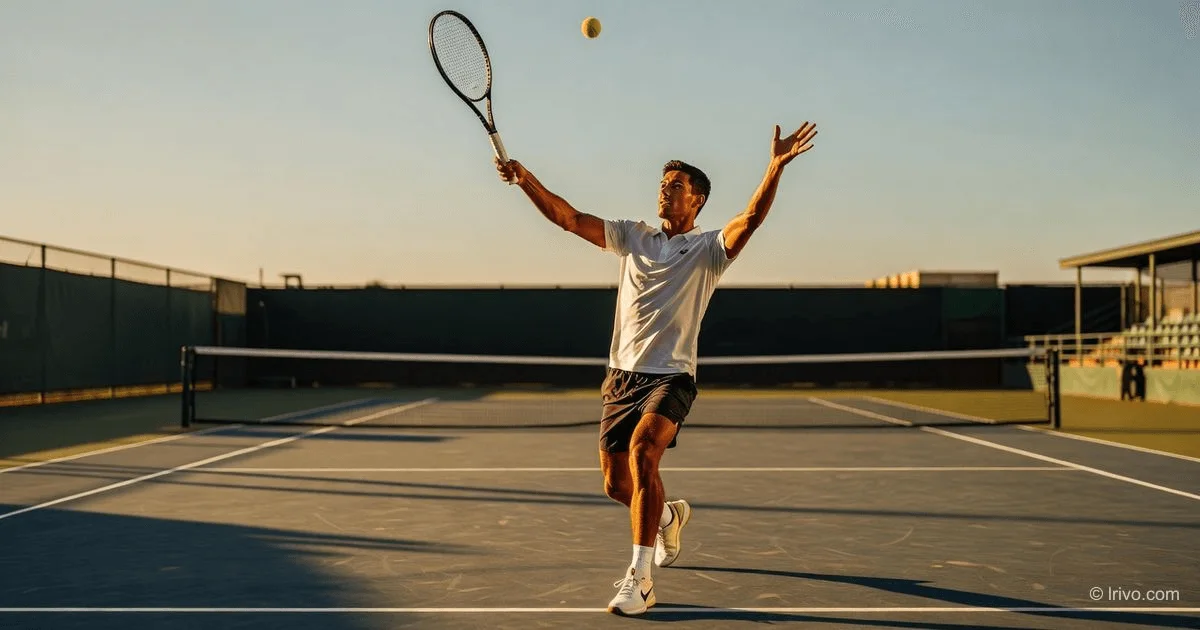
Before you can hit a powerful serve, you need a consistent toss. A flawed toss is the root of most serving problems, as it forces you to adjust your swing mid-motion, ruining your timing and accuracy . The following drill isolates the toss so you can build a solid foundation.
Drill 1: Target Tosses
This drill is the starting point for anyone looking to improve their serve. It removes the swing from the equation and focuses purely on the ball toss.
The Drill: Stand behind the baseline in your serving position. Extend your arm and racket up and forward to gauge the proper height. Practice tossing the ball 10 consecutive times without swinging. Let the ball drop to the court, and count how many times it lands just inside the baseline . To increase the difficulty, place a small towel or a target (like a tennis ball can) on the court a few inches inside the baseline and aim for it .
Success Check:
- Begin the tossing movement from your shoulder joint.
- Extend your fingers with the toss and follow the ball with your hand and eyes .
- Focus on a consistent height and trajectory.
Developing the Correct Swing Path
Once your toss becomes reliable, you can work on integrating a technically sound swing. Many players develop bad habits in their swing path, which leads to mishits, lost power, and a lack of control. These drills will help you build the correct muscle memory.
Drill 2: The "Punch" (Wrist Pronation)
This drill focuses on the snap or pronation of the wrist at contact, which is essential for generating effortless power . Many players underestimate the importance of this whip-like motion.
The Drill: Stand in your regular serving position. Toss the ball up, catch it at its peak height, and immediately snap your wrist down through your follow-through. The goal is to bounce the ball hard on your side of the court, somewhere between you and the service line. This forces you to get your wrist loose and relaxed to generate power through the snap .
Why It Works: Pronating the wrist—turning the thumb down and away—on contact is key to generating racket-head speed. This drill helps you ingrain that feeling of a loose, fast wrist without the complexity of a full swing .
Drill 3: Service-Line Serves
This classic drill is one of the best ways to learn to hit "up" at the ball and generate topspin, a crucial technique for consistent second serves . It forces you to focus on the upward swing path.
The Drill: Move to a position behind the service line on your side of the court. Serve 10 consecutive balls into the proper service court across the net, using your full serving motion. The shortened court reduces the area you need to aim for, allowing you to focus on technique, specifically the high-to-low swing path .
- To Increase Difficulty: Move back to a position halfway between the service line and the baseline.
- To Decrease Difficulty: Move forward to a position inside the service line .
Success Check: Reach as high as possible to make contact with the ball. Your arm and racket should be fully extended at the point of contact. Keep your head up and watch the ball as you hit .
Drill 4: Shadow Swings
This is a foundational drill for building a repeatable serving motion. It’s a way to practice the full movement without the distraction of a ball, allowing you to focus purely on the sequence of your swing .
The Drill: Stand on the baseline and perform your serve motion without actually hitting a ball. Slow the motion down, paying close attention to the "back-scratching" position, the upward swing, and the follow-through. For an advanced element, use a resistance band attached to a pole. Mimicking your serve against the band's tension builds strength in the exact muscles used in your service motion .
Building Placement and Consistency
A powerful serve that lands in the same spot every time is a significant advantage. These drills are designed to help you improve your serve's accuracy and build the consistency needed to win matches.
Drill 5: Target Practice (Area 51)
This drill turns your serve into a precision shot. It improves your ability to direct the ball to different parts of the service box, making you a more unpredictable and formidable player.
The Drill: Place a piece of tape across the service court to divide it into two halves—front and back. From the baseline, serve 10 balls aiming for the deep half (the "Area 51") between the tape and the service line .
- To Increase Difficulty: Divide the back half of the service court further into two parts and serve alternately into each corner target.
- To Decrease Difficulty: Move the tape closer to the net to create a larger target .
Drill 6: Target Practice with Cones
The LTA's expert coach, Matt Smith, offers a direct and effective variation of this target practice. This drill helps you practice both placement and calling your shot, simulating a match situation .
The Drill: Start by dividing the service box in half. Before each serve, say aloud if you are serving to the forehand or backhand of an imaginary opponent and then aim for that respective box. Once you are comfortable, divide the box into three sections—down the 'T', through the middle, or out wide. Call out your target before you serve, and practice hitting it consistently. Make sure to practice both your first and second serves .
Putting It All Together in a Match
Practicing technical elements is crucial, but you must also practice the psychological aspects of serving. This drill simulates match pressure and helps you execute your technique when it matters most.
Drill 7: Serve and Return Games
This drill moves you away from rote practice and into a more game-like scenario. It is a fantastic way to practice your serve technique under pressure.
The Drill: Play 10 points against a practice opponent where you only use the serve and the return of serve. The server earns 1 point for every serve that lands in the service box. The receiver gets a point for every successful return .
- To Increase Difficulty (for the server): Give yourself only one serve (no second serve) to put the ball in play .
- To Decrease Difficulty (for the server): Stand one step inside the baseline to serve .
Frequently Asked Questions
Can I improve my serve by practicing alone?
Yes, absolutely. The serve is the only shot in tennis that you have complete control over, making it the best shot to practice on your own. You can work on your ball toss, technique, and placement without a partner. Many drills, such as shadow swings and target practice, are designed for solo practice .
How do I stop double-faulting so often?
Focus on developing a reliable second serve. A common strategy is to practice your second serve more than your first. This builds trust in your "safe" serve, which often has more topspin, making you more confident on your first serve. Also, prioritize consistency over power by aiming for a big target area .
Why is my serve inconsistent even when I practice a lot?
The most common cause of inconsistency is a variable ball toss. Even minor changes in the toss height, direction, or location can cause you to alter your swing path, leading to errors. A reliable ball toss is the foundation of a consistent serve .
Where should I aim my serve?
A good strategy is to target different areas of the service box to keep your opponent off balance. Start by dividing the box in half and aiming for your opponent's forehand or backhand. More advanced players can aim for the "T," the middle, or out wide. In practice, call out your intended target before you serve to focus your placement .
How do I get more power on my serve?
Power in a serve comes from a kinetic chain, not just the arm. It involves a coordinated effort from your legs, core, and shoulder. Drills like overhead medicine ball throws and rotational slams can build explosive power. On the court, focus on the "snap" or pronation of your wrist, as this whip-like action generates significant racket-head speed .
Sources
- Sportplan. (n.d.). How can I improve the consistency of my serve?
- LTA. (2025). How to practice tennis alone and improve fast.
- Punjab Digital Library. (n.d.). Tennis Drills.
- Stony Stratford Lawn Tennis Club. (2024). Elevate Your Game: Top Tips for Serving Success.
- Analytics for Athletes. (2025). 7 Drills To Build Explosive Tennis Serve Power And Dominate The Court.
- Lodsworth Tennis Association. (2015). Tennis Serving Secrets – Our Tips.
— Editorial Team