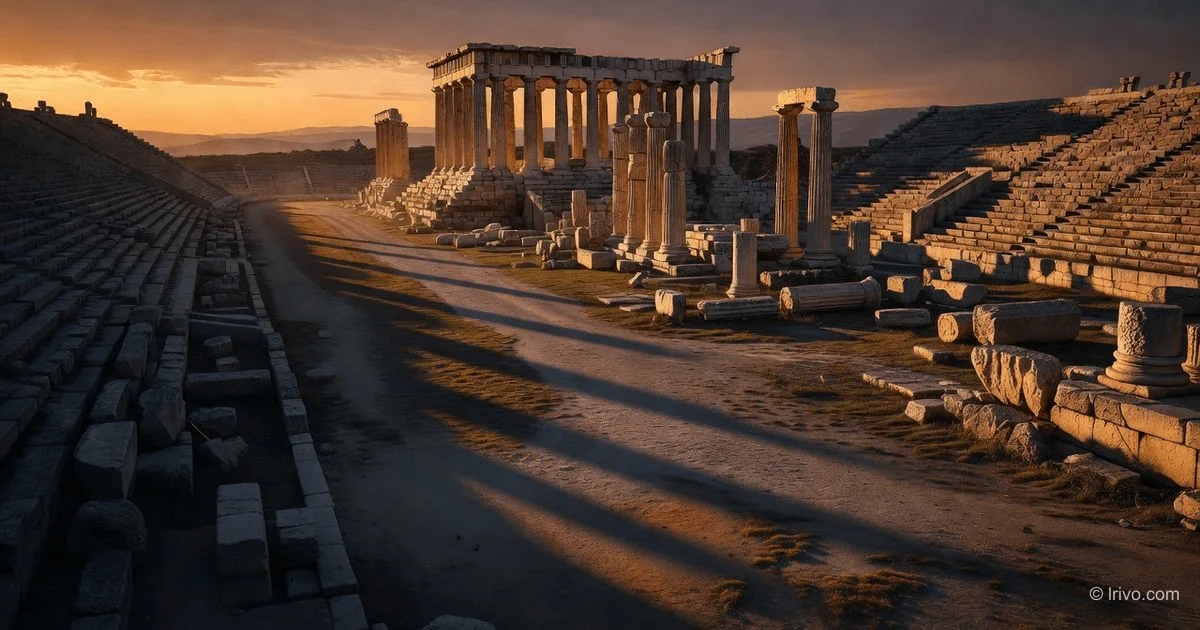
Ancient Origins to Modern Glory: The Complete Olympic History
The Olympic Games stand as humanity's most enduring sporting tradition, a spectacle that has captivated the world for nearly three millennia. To understand what is the history of the olympic games and how it began is to trace a remarkable journey from ancient religious festivals to a global movement that transcends borders, politics, and generations. This story, stretching from the sacred grounds of Olympia to the world's greatest modern cities, reveals not just the evolution of sport but the enduring human drive for excellence and unity.
What You'll Learn
By the end of this article, you'll have a clear and authoritative grasp of the Olympic Games' full history, from their mythological and religious origins in ancient Greece to their modern revival and evolution into a global phenomenon. You'll understand the key events, figures, and traditions that have shaped the Games, and be able to distinguish historical facts from common myths. The single most important takeaway is that the Olympics were a deeply religious festival for over a millennium before becoming the secular, international celebration of athleticism we know today.
How It Began: The Ancient Olympic Games in Greece
The origins of the Olympic Games are rooted in both history and mythology, set in the sanctuary of Olympia in the western Peloponnese. This site, dedicated to Zeus, the king of the Greek gods, was the spiritual and athletic heart of the ancient world .
The First Recorded Games
While legends attribute the founding of the Games to the hero Heracles (Hercules), the first historically documented Olympic Games took place in 776 BC. The victor of the sole event, a footrace called the stadion (approximately 192 meters), was a cook named Coroebus of Elis . The stadion is the origin of the modern word "stadium" . This date, recorded by the philosopher Hippias, marks the beginning of the official Olympic record and the start of the "Olympiad" as a four-year unit of time measurement in ancient Greece .
A Religious Festival for Zeus
To truly answer the question of what is the history of the olympic games and how it began, one must recognize that the ancient Games were primarily a religious festival . The entire event was held in honor of Zeus, and a core part of the celebration was a massive sacrifice—on the third day, 100 oxen were killed and burnt on the Altar of Zeus . The sacred truce (ekecheiria) was declared before each Games, ensuring a cessation of all hostilities so that athletes and spectators could travel safely to Olympia . This profound religious context contrasts sharply with the secular nature of the modern Games.
Events and Evolution of the Ancient Games
Initially a one-day, one-race affair, the ancient Olympics expanded over the centuries. By the 5th century BC, the Games had grown into a five-day festival featuring a variety of events .
- Footraces: The stadion was joined by the diaulos (a two-length race, similar to a 400m) and the dolichos (a longer distance race) .
- Combat Sports: Wrestling was added in 708 BC, boxing in 688 BC, and the brutal pankration—a no-holds-barred combination of boxing and wrestling—in 648 BC . The pankration was a dangerous sport where only biting and eye-gouging were forbidden, and matches often ended in unconsciousness or even death .
- Pentathlon and Chariot Racing: The pentathlon, an all-around competition featuring a footrace, long jump, discus, javelin, and wrestling, was introduced in 708 BC . Chariot racing and horse racing, which required significant wealth to participate, were added in 680 BC and became some of the most prestigious events .
Athletes and Participation
Participation in the ancient Games was restricted to freeborn Greek men who had not committed a crime or heresy . Athletes competed in the nude, a practice that was seen as a celebration of the human body and had no shame associated with it . While married women were prohibited from watching the Games, unmarried girls could attend, and women could and did own victorious horse teams in the chariot races . Princess Cynisca of Sparta became the first woman to win an Olympic event in 396 BC as the owner of a chariot team .
The Decline and Abolition of the Ancient Games
The ancient Olympic tradition, which had flourished for nearly 1,200 years, did not end with a single dramatic event but rather a gradual decline. As the Roman Empire absorbed Greece, the religious and cultural significance of the Games faded. The Romans viewed athletics differently, seeing public nudity and competition as degrading compared to their own spectacles like gladiatorial combat .
The final blow came in 393 AD, when Emperor Theodosius I, a Christian, outlawed all "pagan" festivals, effectively banning the Olympic Games . A subsequent decree by Emperor Theodosius II in 426 AD led to the destruction of the sanctuary's monuments . With this, the ancient flame was extinguished for over 1,500 years.
The Revival and the Modern Olympic Games
The story of the modern Olympics is a testament to the enduring power of an idea. The revival was not a single event but the culmination of centuries of interest and the relentless dedication of one man.
The Role of Pierre de Coubertin
The key figure in the modern revival was a French aristocrat and educator, Baron Pierre de Coubertin . Deeply concerned by France's lack of physical education, which he saw as a cause for their defeat in the Franco-Prussian War, Coubertin envisioned sport as a tool for building stronger, more resilient individuals and fostering international peace . Inspired by the ancient ideals and archaeological discoveries at Olympia, he formally proposed the revival of the Olympic Games in 1892 . His vision was to bring the youth of the world together in friendly competition, rather than in war .
The First Modern Olympics in Athens 1896
Coubertin's efforts culminated in a congress at the Sorbonne University in Paris in 1894, where he founded the International Olympic Committee (IOC) . Despite his initial preference for Paris, the delegates chose Athens as the symbolic host for the first modern Games . In 1896, the Games of the I Olympiad opened in Athens with 280 male athletes from 13 nations competing in 43 events . Though modest in scale compared to today, the event was a success and marked the rebirth of the Olympic tradition .
By the Numbers: Olympic Milestones
| Milestone | Date/Location | Key Figures & Facts |
|---|---|---|
| First Recorded Ancient Games | 776 BC, Olympia, Greece | Winner: Coroebus of Elis in the stadion race |
| Ancient Games Peak | 6th-5th Century BC | Expanded to 5 days, 18 events; religious festival for Zeus |
| First Woman to Win | 396 BC, Olympia | Princess Cynisca of Sparta won the chariot race as an owner |
| Games Abolished | 393 AD | Emperor Theodosius I banned pagan festivals |
| IOC Founded | 1894, Paris, France | Baron Pierre de Coubertin founded the International Olympic Committee |
| First Modern Games | 1896, Athens, Greece | 280 athletes, 13 nations, 43 events; all male |
| First Winter Olympics | 1924, Chamonix, France | Inaugural Winter Games featuring ice hockey, figure skating, and more |
| First Olympic Flag Use | 1920, Antwerp, Belgium | The five interlocking rings symbol debuted |
| Paralympics First Held | 1960, Rome, Italy | Extended Olympic ideals to athletes with disabilities |
| Modern Scale (2024) | Paris, France | Over 10,000 athletes from over 200 nations; 329 events |
Common Myths vs. Facts
| Myth | Fact |
|---|---|
| The Olympic rings and torch relay are ancient traditions. | The five interlocking rings, representing the unity of continents, were designed by Coubertin in 1913. The modern torch relay was first introduced at the 1936 Berlin Olympics . |
| Ancient Olympic winners received gold medals. | Champions were awarded a wreath made from a branch of a sacred wild olive tree (kotinos) . |
| Women were entirely excluded from the ancient Olympics. | While married women were barred from watching and competing, unmarried women had their own festival, the Heraean Games, in honor of Hera. Women could also win equestrian events as horse owners . |
| The ancient Olympics were an amateur competition. | Ancient athletes were often professionals who trained full-time and won substantial prizes at other festivals. The "amateur" ideal was a construct of the modern Games . |
| The modern Olympics have been held every four years since 1896. | The Games were canceled in 1916, 1940, and 1944 due to World Wars I and II . |
What You Should Do With This Knowledge
Understanding the full sweep of Olympic history enriches the experience of watching the Games. You can appreciate the ancient roots behind each modern event and recognize the profound transformation from a religious festival to a global movement. When you next see the Olympic flame or the five rings, you'll know these are modern symbols, not ancient relics . Consider sharing the true story of the Games' origins with others, helping to preserve the historical facts and honor the legacy that stretches back to 776 BC.
Frequently Asked Questions
How did the ancient Olympic Games begin? The ancient Olympic Games began as a religious festival in Olympia, Greece, dedicated to the god Zeus. The first historically recorded Games were in 776 BC, featuring a single footrace, but they likely existed for centuries before this date, rooted in mythology and local traditions .
Why did the ancient Olympic Games end? The ancient Olympics were officially abolished in 393 AD by the Roman Emperor Theodosius I. He outlawed all pagan festivals as part of his campaign to establish Christianity as the official religion of the Roman Empire, effectively ending the 1,200-year tradition .
Who started the modern Olympic Games? The modern Olympic Games were revived by Baron Pierre de Coubertin, a French educator. His vision was to promote international peace and physical education through sport. He founded the International Olympic Committee (IOC) in 1894, leading to the first modern Games in Athens in 1896 .
What was the first event in the ancient Olympics? The first and only event at the inaugural recorded Games in 776 BC was the stadion, a short footrace of about 192 meters (210 yards). The word "stadium" is derived from this ancient race, making it the direct ancestor of all modern track events .
What is the difference between the ancient and modern Olympics? The key difference is that the ancient Olympics were a religious festival in honor of Zeus, featuring a limited number of events and restricted to free Greek males as competitors. The modern Olympics are a secular, international multi-sport event open to all nations, featuring the Paralympics and Winter Games, and governed by the International Olympic Committee .
Sources
- Ashmolean Museum, University of Oxford. "The History of the Olympic Games." Ashmolean Web.
- BBC Bitesize. "The history of the Olympic Games." BBC.
- Road Scholar. "History of the Olympics: 7 Facts About the Origins and Evolution." Road Scholar.
- Ministry of Culture and Sports, Greece. "The Olympic Games." ote.gr.
- De Gruyter. "Some Important Dates." A Brief History of the Olympic Games.
- Government of Canada Web Archive. "Olympic Games." Wikipedia (archived).
- History.com Editors. "The Olympic Games." HISTORY, A&E Television Networks.
- The Editors of Encyclopaedia Britannica. "ancient Olympic Games." Encyclopedia Britannica.
- Ministry of Youth Affairs and Sports, India. "Olympic Games." MyGov (PDF).
- International Olympic Committee. "What is the origin of the Olympic Games?" Olympics.com.
— Editorial Team