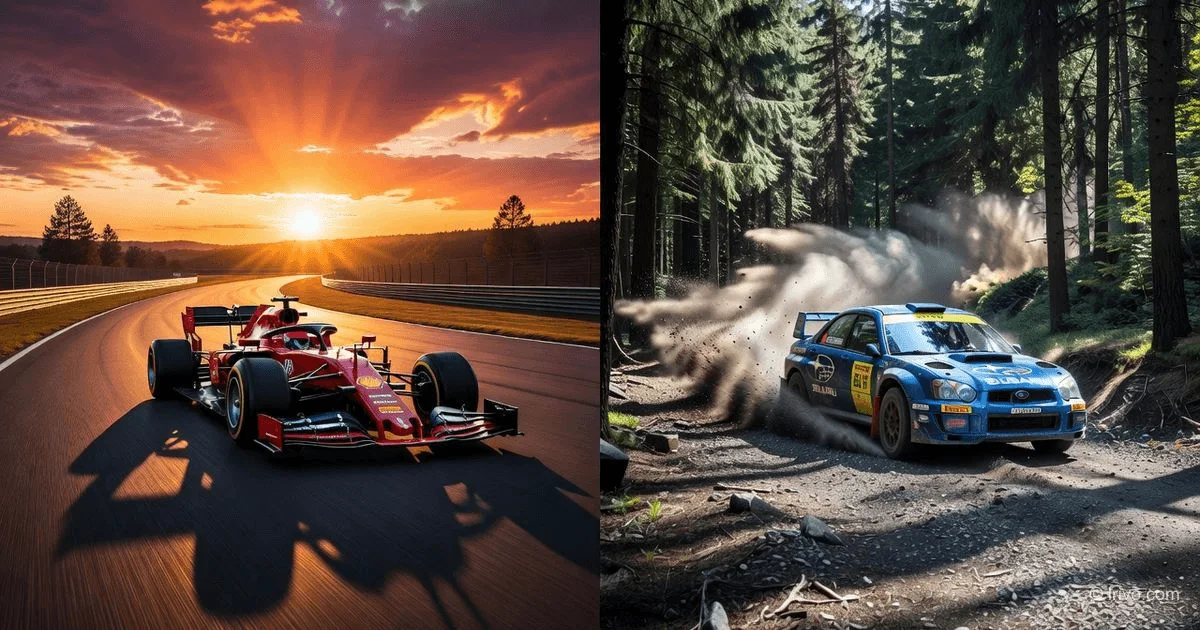
Rally vs. F1: Key Differences in Racing
Formula 1 and the World Rally Championship represent two very different pinnacles of motorsport, yet both demand extraordinary skill from their drivers. While F1 is a battle of precision on closed circuits with cars that produce immense downforce, rallying is a war of attrition against unpredictable terrain and changing conditions. To understand what is the difference between rally and formula 1 racing, you must look beyond the surface to compare engineering philosophies, driver skill sets, costs, and the very nature of competition itself.
What You'll Learn
You'll gain a clear understanding of the core differences in car design, track environments, and the physical and mental demands placed on drivers in each discipline. By the end, you will be able to articulate the unique challenges of both sports and understand why a champion in one might struggle to adapt to the other. The single most important takeaway is that while both are top-tier motorsports, they require completely different mindsets: F1 is about optimizing a predictable environment, while rally is about conquering the unpredictable.
At a Glance
| Criterion | Formula 1 | World Rally Championship (WRC) |
|---|---|---|
| Racing Surface | Paved, smooth, closed-circuit tracks | Diverse: gravel, dirt, snow, tarmac, and mixed surfaces |
| Car Design | Open-wheel, single-seater with massive aerodynamic wings | Production-based, two-seater with closed bodywork |
| Engine | 1.6L V6 turbo-hybrid, producing ~1000+ HP | 1.6L turbocharged four-cylinder, producing ~300-380 HP |
| Drivetrain | Rear-wheel drive | Four-wheel drive |
| Aerodynamics | Critical; generates immense downforce for high-speed cornering | Relatively low downforce; focus is on mechanical grip and suspension travel |
| Race Format | Grand Prix weekend: practice, qualifying, and a single race | Multi-day event divided into timed special stages on closed roads |
| Driver Aids | Highly regulated; uses complex steering wheel controls for power delivery | Relies heavily on driver skill to manage car over varied surfaces |
| Physical Demand | High G-forces (lateral) for 1.5-2 hours; intense neck and upper body workout | Endurance over 3-4 days; managing concentration for 8-10 stages per day in varying conditions |
| Financial Scale | Extremely high; top team budgets exceed $150 million annually | Lower; a top WRC team budget is around $20 million, and a car costs ~€500,000 |
| Spectator Experience | Watching from grandstands; seeing cars lap at high speed on a circuit | Standing in forests or mountains; seeing cars fly past on narrow roads |
Rallying Deep Dive: The Art of the Unpredictable
Rallying is a motorsport that takes place on real-world roads. Races are held on closed public roads that can be gravel, tarmac, snow, or ice, often featuring jumps and dramatic elevation changes . A rally is not a single race but a series of timed "special stages" spread over several days, with drivers covering hundreds of kilometers at racing speed while relying on a co-driver to read pace notes .
Strengths and Appeal
The primary appeal of rallying is its raw connection to the real world. The cars, while highly modified, are based on production models, making them more relatable to automotive enthusiasts . The sport is a true test of adaptability. As driver Robert Kubica noted, in rallying, "you never know what’s going to happen" as you approach each corner . The ability to drive on the edge over a long period, often alone in the wilderness, creates a "down-to-earth" and gritty atmosphere that many fans find more authentic than the glitz of F1 .
Weaknesses and Challenges
The very nature of rallying is also its biggest weakness for broadcasting. Because cars start one by one on a stage, it’s difficult to follow the "wheel-to-wheel" action that television audiences are accustomed to in F1 . The preparation and commitment involved are immense. A driver spends seven days on-site for a single event, including recce (course reconnaissance), making it mentally exhausting . The physical effort is more of an endurance marathon than a sprint, with drivers managing their energy over stages that can be up to 50 kilometers long .
Ideal Use Case
Rallying is the ultimate test for a driver who craves adventure, variety, and a pure connection to the car and road. It is ideal for those who are masters of car control on any surface and can maintain a high level of concentration for extended periods while managing the high risk of crashing out .
Formula 1 Deep Dive: The Pinnacle of Precision and Technology
Formula 1 is a global championship featuring single-seater, open-wheel race cars on purpose-built closed circuits . Grands Prix are 3-day events consisting of practice sessions, qualifying to determine starting positions, and one race of approximately 300 kilometers.
Strengths and Appeal
F1 is the pinnacle of automotive technology and engineering. The cars are designed with immense downforce, allowing them to corner at incredible speeds that produce high lateral G-forces . The sport is a glitzy, high-budget spectacle with massive global audiences . As former F1 driver Robert Kubica described, F1 is a world of extreme attention to detail; if there is a problem, "there is a person responsible to fix it" . The professional, highly-organized environment, and the sheer speed of the cars makes it a magnet for the best engineers and drivers in the world.
Weaknesses and Challenges
The high levels of downforce and grip mean the cars are less physically dynamic than rally cars, as they don't move around as much on their suspension . While the physical effort is intense, the race is a relatively short sprint of about two hours, compared to a multi-day rally event . The "circus" atmosphere can also be highly political and stressful, with intense rivalries and constant scrutiny . The sport’s reliance on expensive hybrid technology has also faced challenges, and the on-track action can sometimes lack the raw, unpredictable drama of rallying .
Ideal Use Case
F1 is the best fit for a driver who excels in a highly structured, data-driven environment where margins are measured in thousandths of a second. It's for drivers who can work closely with engineers to fine-tune a setup for one specific track and push the absolute limit of adhesion in a predictable setting, lap after lap.
Cost & Accessibility
The financial barrier to entry is a defining difference between these two sports. While both are expensive, the scale of investment is vastly different.
| Cost Aspect | Formula 1 | World Rally Championship (WRC) |
|---|---|---|
| Championship Team Budget | > $150 million per year | ~ $20 million per year (for top teams) |
| Cost of a Top-Tier Car | Not sold; development costs are astronomical. | ~ €500,000 |
| Cost for a Single Event (Privateer) | Formula 1 is not accessible to privateers. | €40,000 - €60,000 for a WRC2 car; >€100,000 for a Rally1 car |
| Testing Costs | Unlimited budgets for simulation and track time. | A single test day can cost €10,000 - €30,000 |
| Tire Costs (per event) | Included in massive team budgets. | Top drivers use 10 sets of tires costing ~€16,000 total |
| Fuel (per event) | Highly specialized; cost is part of a vast operational budget. | ~€24,000 worth of fuel from Europe is used over a rally weekend |
How to Decide: Choose Your Racing Adventure
Understanding what is the difference between rally and formula 1 racing is crucial for deciding which sport to follow or even pursue. Here is a framework to help you choose:
Choose F1 if:
- You are fascinated by cutting-edge engineering, aerodynamics, and high-tech hybrid systems.
- You prefer a structured, glitzy, and highly organized sporting spectacle.
- You want to witness drivers pushing the absolute limits of speed and G-forces in a controlled, predictable environment.
- You have a massive budget backing you, as F1 is the ultimate financial arms race.
Choose Rally if:
- You appreciate car control, adaptability, and driver skill over raw, top-speed power.
- You love the idea of racing on real, varied roads in challenging, unpredictable weather conditions.
- You are drawn to a more "spartan," down-to-earth, and authentic motorsport culture.
- You are looking for a more cost-effective (though still expensive) path into top-level professional racing.
Verdict
The answer to what is the difference between rally and formula 1 racing lies in a fundamental philosophical divide. Formula 1 is a 100-meter sprint that is highly choreographed in a pristine environment; rallying is a cross-country marathon through a chaotic wilderness. If your passion is for absolute precision, technological perfection, and the gladiatorial combat of wheel-to-wheel racing, then F1 is the undisputed king. However, if your heart beats for raw, visceral driving skill, endurance, and the ultimate battle against the unknown, the World Rally Championship is the true test of a driver's soul. Neither is superior to the other; they are simply two magnificent, yet completely different, forms of the same art.
Frequently Asked Questions
1. Is a rally car faster than an F1 car? No, an F1 car is significantly faster than a rally car on a paved circuit. F1 cars produce immense downforce and have more power, allowing for much higher cornering and top speeds. A Group B rally car from the 1980s was once rumored to match F1 lap times, but this is widely debated and likely not accurate for dry conditions .
2. Why do rally drivers sit so close to the front? Rally drivers sit in a more central position in the car compared to the open-wheel cockpit of an F1 car, but the view is very different. The co-driver sits close to the driver to read pace notes. The seating position is higher and more upright to allow the driver to see the road ahead over the hood, which is crucial on narrow, undulating roads .
3. What is the main difference between Formula 1 and rally racing? The main difference is the racing environment. F1 takes place on smooth, closed-circuit tracks where the focus is on perfecting a predictable lap. Rally racing occurs on closed public roads with diverse, unpredictable surfaces like gravel, snow, and tarmac, often over several days .
4. Who is richer, F1 or rally drivers? Top F1 drivers generally earn significantly more than rally drivers. The most highly-paid rally drivers have earned around $2.5 million a year, whereas top F1 drivers can earn tens of millions annually. The overall financial scale of F1 is much larger than the WRC .
5. Which is harder on a driver's body, F1 or rally? It depends on the physical demand. F1 is extremely hard on the body for a short period due to high G-forces, requiring immense neck and upper body strength . Rallying is an endurance marathon; drivers must maintain intense concentration for 8-10 stages a day across 3-4 days, which is mentally and physically draining over a longer period .
— Editorial Team