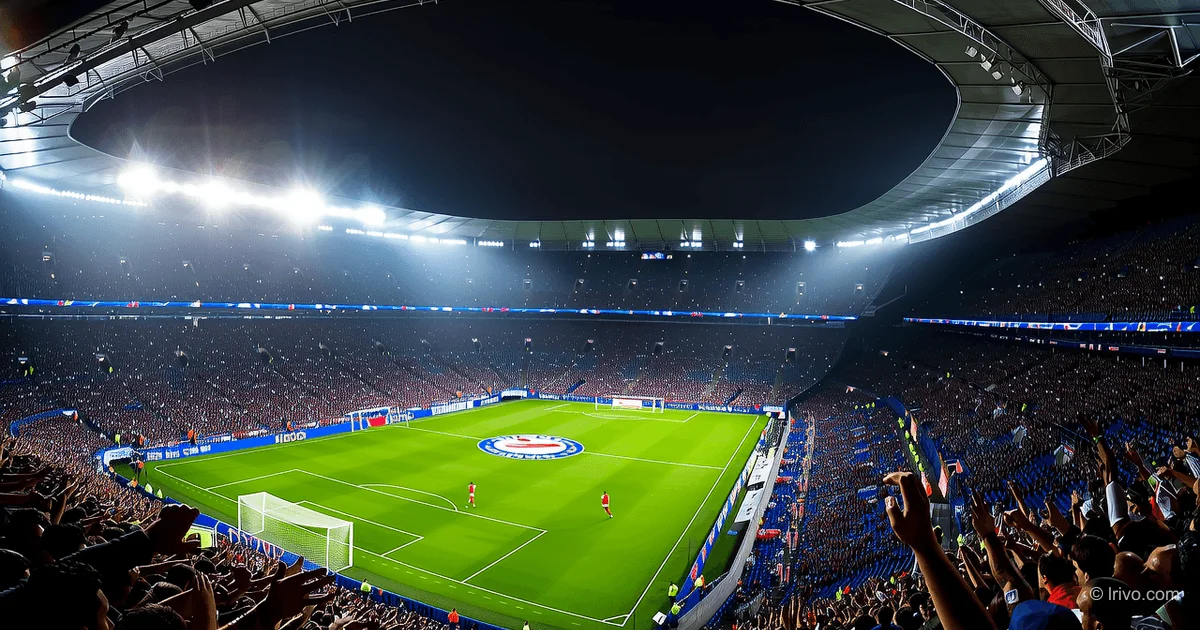
Announcement: Barcelona vs. Real Madrid in Champions League Semifinal
The second leg of the Champions League semifinal takes place on Wednesday after the Catalans' 2-0 victory in the first Clásico at Camp Nou. Can Real Madrid mount a comeback at the Bernabéu?
Main Event
On Wednesday, May 13, 2026, the football world will turn its eyes to Madrid. The Santiago Bernabéu Stadium will host the UEFA Champions League semifinal second leg between Real Madrid and Barcelona — a match that will determine the first finalist of Europe's premier club competition. The Catalans approach this fixture with a comfortable 2-0 advantage earned in the first Clásico at Camp Nou last week.
The situation for Real Madrid is close to critical. Álvaro Arbeloa's team needs to score at least twice to force extra time, and three times to reach the final in regular time. At the same time, they cannot afford to concede: any Barcelona goal would make Los Blancos' task nearly impossible, requiring them to score four times. The second-leg semifinal at the Bernabéu promises to be either the greatest comeback in the history of this rivalry between the two Spanish giants or a triumphant march for the Catalans into the final.
Details and Statistics
The first match at Camp Nou was a tactical triumph for Hansi Flick. His team converted their scoring chances with surgical precision, netting a goal in each half. The scorers were Robert Lewandowski, who opened the scoring in the 34th minute after a pass from Fermín López, and Ferran Torres, who doubled the lead in the 67th minute following a solo run and a perfect pass from Lamine Yamal.
Barcelona held 57% possession, took 14 shots, 7 of which were on target. Real Madrid responded with 11 shots, but only 3 posed a real threat to Catalan goalkeeper Wojciech Szczęsny. The blaugrana defensive line, led by Pau Cubarsí and Jules Koundé, delivered an outstanding performance, completely neutralizing Kylian Mbappé and limiting Jude Bellingham to minimal scoring opportunities.
Head-to-head statistics in the Champions League favor Real Madrid. Of the eight previous knockout-stage meetings in European competitions, Madrid has won five, Barcelona three. The teams have met twice in Champions League semifinals: in the 2001/2002 and 2010/2011 seasons. In 2002, Real Madrid advanced; in 2011, Barcelona did, eventually winning the tournament. The current clash could tip the historical scales in favor of either side.
The financial context adds drama to the match. The Champions League prize fund for the 2025/2026 season is €3.3 billion. Reaching the final guarantees a club an additional €20 million plus revenue from ticket sales for the decisive match. For Real Madrid, enduring a turbulent season with internal conflicts and the resignation of Xabi Alonso, reaching the final would be a lifeline; for Barcelona, it would confirm their return to the European throne.
Context and Significance
This Clásico has multiple layers of context that make it unique even by the standards of the greatest football rivalry on the planet.
First, this is an unprecedented case in Champions League history. Two matches between Barcelona and Real Madrid take place three days apart in the same city, effectively deciding the fate of two trophies. This has never happened before — usually, European Cup semifinals are spaced out on the calendar and do not overlap with decisive domestic league matches. Players from both teams find themselves in a unique situation of a triple Clásico, where they first contested the Spanish league title and now determine the Champions League finalist.
Second, the psychological state of the teams is diametrically opposed. Barcelona — fresh from celebrating their 29th La Liga title — is at the peak of confidence. Flick's team has lost only four league matches all season. Just hours after the final whistle of Sunday's Clásico, when blaugrana shirts reading "Camp Nou, 10 May 2026 — Champions" were already flying off the shelves, the realization that they must face the same opponent again on Wednesday created a unique atmosphere of focus.
Real Madrid, by contrast, approaches the match in a state of organizational chaos. The team has lost Federico Valverde due to a head injury sustained in a locker-room altercation with teammate Aurélien Tchouaméni — both players were fined €500,000 each. Dani Carvajal, Éder Militão, Rodrygo, Arda Güler, and Ferland Mendy are also sidelined due to injuries. Kylian Mbappé's form remained a question mark until Sunday's match.
Third, the tactical duel between Flick and Arbeloa. The German coach has won all six Clásicos against Real Madrid as Barcelona's head coach. Arbeloa, who took over the team mid-season in February after Xabi Alonso's resignation, has yet to find an antidote to Flick's system — his Real Madrid has already lost to the Catalans in three matches this season.
What's Next / Next Match Preview
The winner of this tie will face the winner of the other semifinal between Paris Saint-Germain and Bayern Munich in the Champions League final on May 31, 2026, at Old Trafford in Manchester (the first leg between them also ended 2-0 in favor of the Parisians).
If Real Madrid manages to come back from 2-0 down, it will be only the fifth time in tournament history that a team reaches the final after losing the first semifinal leg by two goals. The last time this happened was Liverpool in 2019 — the Reds came back against Barcelona (0-3 in the first leg, 4-0 in the second). The irony has not been lost on fans — now Barcelona is on the opposite side of the barricades, hoping history does not repeat itself.
If Barcelona holds on to their lead, they will reach the Champions League final for the first time since the 2014/2015 season, when the Catalans last won the tournament. For a new generation of fans who grew up during the Lionel Messi era and then endured years of European disappointment, this final will be a moment of truth. Flick's team has already proven itself domestically, and now it is time to confirm their class on the European stage.
— Editorial Team