Arsenal's Tactical Puzzle Ahead of Crucial Manchester City Match
Mikel Arteta faces a defining tactical challenge as Arsenal prepare for a pivotal clash against Manchester City. Recent performances have exposed some vulnerabilities in the Gunners' usual fluid system, prompting questions about how they will adapt for the final stretch of the season. The pressure of the title race is palpable, and every strategic decision now carries immense weight.
Analyzing Arsenal's Recent Struggles
Arsenal's form has dipped noticeably in key matches against Manchester City, Bournemouth, and Southampton. These losses highlighted specific problems in their build-up play and ball progression. Opponents have found ways to disrupt Arsenal's rhythm, forcing them into less comfortable patterns.
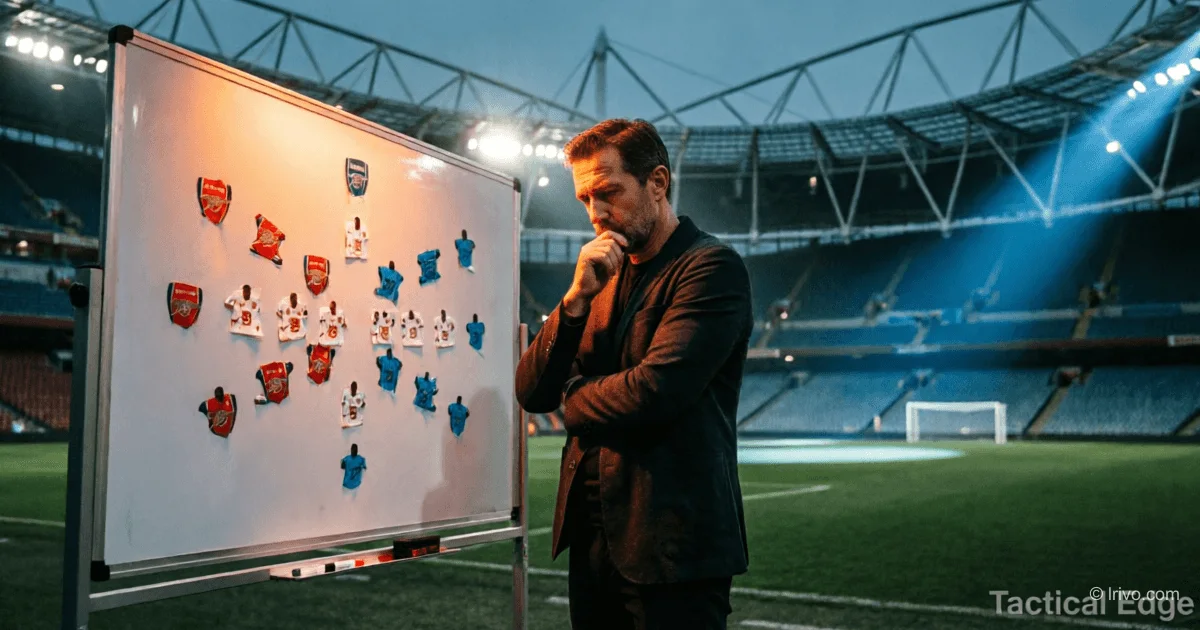
Manchester City's approach in their recent meeting was particularly effective. Guardiola deployed a 4-2-4 defensive block designed to cut off Arsenal's central passing lanes. By positioning forwards to press the center-backs and angle their bodies to block passes to the full-backs, City successfully funneled Arsenal's play. This tactic encouraged Arsenal to resort to longer passes, which City's organized defense was ready to intercept.
Bournemouth employed a different, more aggressive pressing strategy. Their left-sided midfielder moved centrally to support the press, especially when Kai Havertz dropped deep. This left Arsenal's right-back Ben White free, but Bournemouth's striker cleverly curved his runs to block passes to that side. Both City and Bournemouth shared a key principle: they forced Arsenal's play towards their left flank, challenging Gabriel to dictate play from deep—a role his partner William Saliba typically excels in.
Potential Solutions and Adjustments
When play is forced down the left, opponents can lock on in man-to-man situations. Arsenal's response has often been to look for long passes towards striker Viktor Gyokeres. However, Gyokeres has struggled in individual duels against Premier League defenders, limiting Arsenal's ability to retain possession and advance. His strengths are more evident in channel runs and ball-carrying.
A promising shift was observed in the match against Sporting. Kai Havertz operated as a striker, showing a better ability to make the ball stick. Eberechi Eze played behind him, and the duo combined effectively, with long passes finding Havertz before bouncing into spaces for Eze to attack. This focus on central play and partnership could be a template Arteta uses more frequently to improve ball progression.
Arsenal have also experimented with other build-up methods:
- Using goalkeeper David Raya in deep build-up to shift the ball and outnumber pressing forwards.
- Having Havertz drop from his number 10 role into midfield, attracting markers and freeing Ben White to combine and bypass the press.
- Central midfielders making sudden, deep drops to receive passes from center-backs, creating moments of unmarked possession against man-marking systems.
While these patterns have worked conceptually, execution has been flawed. Overhit passes and sloppy individual actions have prevented Arsenal from capitalizing on these good ideas.
Key Defensive Concern: Nico O'Reilly
A specific defensive headache for Arsenal will be Manchester City's versatile 21-year-old, Nico O'Reilly. He has been instrumental in City's recent resurgence, scoring against both Arsenal and Chelsea. His unusual positioning makes him exceptionally difficult to track; he operates between traditional roles, arriving briefly in spaces as a left-back, winger, or attacker.
Arsenal previously alternated between Bukayo Saka and Martin Zubimendi to mark him, but both lost him for goals. Chelsea tried a near-man-marking approach with Andrey Santos, but O'Reilly eventually overpowered him to score. Arsenal must devise a more coherent plan to handle his unpredictable movement.
The Impact of Absences and Pressure
The absence of Bukayo Saka due to injury has significantly dampened Arsenal's ability to pin teams back and dominate in the final third. His presence in the starting lineup was a key component of their attacking dominance.
Furthermore, a more cautious approach on the ball from some players suggests the physical and mental toll of the title race is becoming evident. Arteta has emphasized the psychological aspect of competing with a Manchester City side that is currently in the ascendancy. Balancing mental resilience with precise tactical tweaks game-by-game presents a formidable final challenge.
Key Takeaways:
- Opponents have successfully disrupted Arsenal's build-up by funneling play left and pressing centrally.
- The Havertz-Eze central partnership showed promise for improving ball progression.
- Defending against Nico O'Reilly's unconventional movement requires a specific plan.
- Bukayo Saka's injury has reduced Arsenal's final-third dominance.
- The mental strain of the title race is influencing player confidence and decision-making.
Despite the recent setbacks and evident challenges, Arsenal remain in a strong position with a six-point lead. The solutions are within their repertoire, but consistency in execution is now the critical requirement. Arteta's task is to galvanize his squad mentally while implementing the subtle tactical adjustments needed to secure a historic campaign.
— Editorial Team