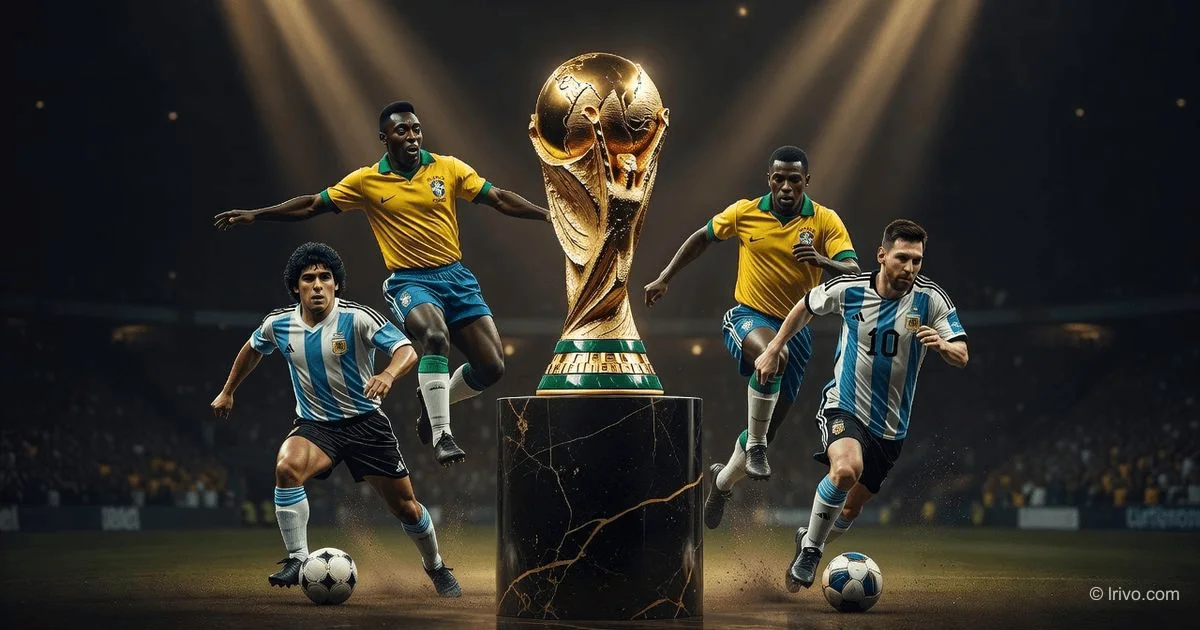
Complete History of the FIFA World Cup
Complete History of the FIFA World Cup
The history of the FIFA World Cup is a story of how a 13-team invitational tournament in Uruguay grew into the world's most watched sporting event, a quadrennial festival that transcends sport to become a global cultural phenomenon. This journey, marked by geopolitical tensions, tragic setbacks, and moments of individual brilliance, charts the globalization of football itself.
From its origins as a vision of FIFA president Jules Rimet to the upcoming 48-team edition in 2026, the tournament's evolution reflects changes in geopolitics, media, and the sport's ever-expanding reach. This article provides a comprehensive overview of that history, covering its legendary champions, its format changes, and the unforgettable moments that have defined it.
What You'll Learn
By the end of this article, you'll understand the complete timeline of the World Cup, from its inception to its modern format. You'll be able to identify the key eras, the dominant teams, and the major rule and structure changes that have shaped the tournament. Most importantly, you'll have a clear, narrative-driven history that explains why the World Cup is the most popular sporting event on the planet.
The Birth of a Global Tournament (1930-1938)
The genesis of the World Cup lay in the success of Olympic football tournaments, which were amateur-only competitions. Inspired by this, FIFA president Jules Rimet championed the creation of a separate, open international championship. In 1928, FIFA approved the plan, and Uruguay, as two-time Olympic champions and celebrating its centenary of independence, was chosen to host the first tournament in 1930 .
The Inaugural Tournament: Uruguay 1930
The first World Cup was a logistical challenge. The long and costly trip across the Atlantic deterred many European nations, and it was only through Rimet's personal persuasion that Belgium, France, Romania, and Yugoslavia made the journey . Ultimately, 13 teams participated: seven from South America, four from Europe, and two from North America .
On July 13, 1930, the first two World Cup matches were played simultaneously, with France and the United States securing victories . France's Lucien Laurent scored the first goal in World Cup history . The tournament culminated in a final at the Estadio Centenario in Montevideo, where hosts Uruguay defeated Argentina 4-2 in front of a crowd of 93,000 to become the first world champions .
The European Era and Italy's Dominance
The 1934 tournament in Italy was the first to feature a qualification stage, with 16 teams competing in a pure knockout format . This format, which lasted for two tournaments, remains unique in the competition's history . The 1934 World Cup was marked by political undertones, with host Italy, under Benito Mussolini's regime, winning their first title after a controversial 2-1 final victory over Czechoslovakia .
Four years later, the tournament was held in France. This edition saw defending champions Italy and the host nation receive automatic qualification . However, the tournament was overshadowed by the Anschluss, the annexation of Austria by Nazi Germany. Austria had qualified, but its team was disbanded and its players were absorbed into the German squad . Despite these political tensions, Italy retained their title, defeating Hungary 4-2 in the final and becoming the first team to win back-to-back World Cups .
Wartime, Resurgence, and the Maracanazo (1942-1950)
The World Cup's momentum was brought to a halt by the Second World War. The tournaments planned for 1942 and 1946 were canceled as the world plunged into conflict, leaving a 12-year gap between tournaments .
The Return: Brazil 1950
When football returned in 1950, it was to a Brazil that had built the iconic Maracanã Stadium in Rio de Janeiro, hoping to celebrate its growing power on the world stage. This World Cup was the first to include British participants; the home nations had rejoined FIFA in 1946 after a long-standing dispute . The tournament had a unique format, with a final group stage instead of a single final match .
In one of the most shocking upsets in sports history, the "Maracanazo," Uruguay defeated the heavily favored hosts Brazil 2-1 in the decisive final match of the group stage . The loss plunged the nation into mourning and established a folklore that would define the tournament's emotional power . Uruguay had won their second World Cup, having boycotted the previous two European tournaments .
The Age of Icons and a New Trophy (1954-1978)
The post-war era saw the World Cup mature into a truly global television spectacle, driven by the talents of legendary players and the tactical evolution of the game.
The Miracle of Bern and the Rise of Pelé
The 1954 World Cup in Switzerland is remembered for the "Miracle of Bern," where a West German team, still recovering from the war, defeated the dominant Hungarian "Golden Team" – featuring Ferenc Puskás – in the final, 3-2 . It was a result that symbolized the nation's post-war resurgence. This tournament was also the first to be televised .
The 1958 World Cup in Sweden was the tournament that introduced the world to a 17-year-old Pelé. The young prodigy scored two goals in the final as Brazil won their first World Cup, becoming the first team to win a tournament outside their home continent . He was joined by the brilliant Garrincha, and together they formed the core of a Brazilian team that would dominate for the next decade.
Brazil, with Pelé now a global superstar, followed up their 1958 triumph with another title in Chile in 1962 . England then hosted and won the 1966 tournament, with Geoff Hurst scoring a hat-trick in a legendary 4-2 final victory over West Germany . The 1970 World Cup in Mexico saw the crowning of the greatest team of all time. Brazil, featuring a dazzling array of talent including Pelé, Jairzinho, Gerson, and Tostão, stormed to a third title, beating Italy 4-1 in the final to win the Jules Rimet Trophy permanently .
Total Football and a New Era
With the Jules Rimet Trophy retired to Brazil, a new trophy was commissioned for the 1974 World Cup. This tournament in West Germany was defined by the "Total Football" of the Netherlands, led by the brilliant Johan Cruyff . Their revolutionary, fluid style captivated the world, but they fell to the hosts, West Germany, in the final, who won their second title .
The 1978 tournament in Argentina was held under the shadow of a brutal military dictatorship . Argentina, led by Mario Kempes, won its first World Cup on home soil, defeating the Netherlands 3-1 in the final after extra time .
Expansion and Globalization (1982-2022)
As football's popularity boomed in Africa, Asia, and North America, the tournament expanded to reflect its growing global nature .
The 24-Team Era
In 1982, the World Cup expanded from 16 to 24 teams in Spain . Italy, inspired by Paolo Rossi, who had returned from a match-fixing ban, won their third title . The tournament featured a second group stage, a format that was simplified in 1986, when a round of 16 was reintroduced after the group stage .
The 1986 tournament in Mexico was defined by the genius of Diego Maradona. His "Hand of God" goal and the stunning "Goal of the Century" in the quarter-final against England encapsulated a tournament he single-handedly inspired Argentina to win . Four years later in Italy, West Germany won their third title in a tournament marred by negative tactics and a lack of goals . The 1994 World Cup in the USA was a commercial success, with Brazil winning a record fourth title on penalties after a tense final against Italy .
The 32-Team Era
France 1998 saw the expansion to 32 teams, a format that would endure for seven tournaments . The host nation, France, inspired by Zinedine Zidane, won their first world title, defeating Brazil 3-0 in the final . The 2002 tournament, co-hosted by South Korea and Japan, was the first in Asia. A resurgent Ronaldo scored two goals in the final to lead Brazil to an unprecedented fifth World Cup, avenging their loss to France four years earlier .
In 2006, Germany hosted a vibrant tournament. Italy emerged as champions, defeating France in the final, a match famously remembered for Zinedine Zidane's headbutt on Marco Materazzi . The 2010 tournament in South Africa was a landmark, being the first on African soil. Spain won its first World Cup, defeating the Netherlands 1-0 in an ill-tempered final . Germany won a fourth title in 2014, defeating Argentina 1-0 in the final, with Mario Götze scoring the decisive goal in extra time . France secured their second title in 2018, defeating Croatia 4-2 in a thrilling final .
The final 32-team tournament was held in Qatar in 2022, an edition that generated immense discussion around its timing and host nation. On the pitch, Lionel Messi cemented his legacy by leading Argentina to victory over France on penalties, winning his first World Cup and completing his illustrious career .
A New Era: The 48-Team World Cup (2026)
The history of the FIFA World Cup enters its next chapter in 2026. The tournament will be co-hosted by the United States, Canada, and Mexico, and will be the first to feature 48 teams. The new format involves 12 groups of four, followed by a 32-team knockout round, increasing the total number of matches to 104 . This expansion reflects FIFA's commitment to growing the game and providing opportunities for nations from all confederations to compete on the world's biggest stage .
Sources
- BBC Sport. "The story of every Fifa World Cup." BBC, 18 May 2014.
- Wikipedia. "History of the FIFA World Cup."
- FIFA. "How the FIFA World Cup format has evolved." FIFA.com, 7 June 2026.
- Wikipedia. "FIFA World Cup."
- The Hindu. "The history of FIFA." 9 June 2010.
— Editorial Team