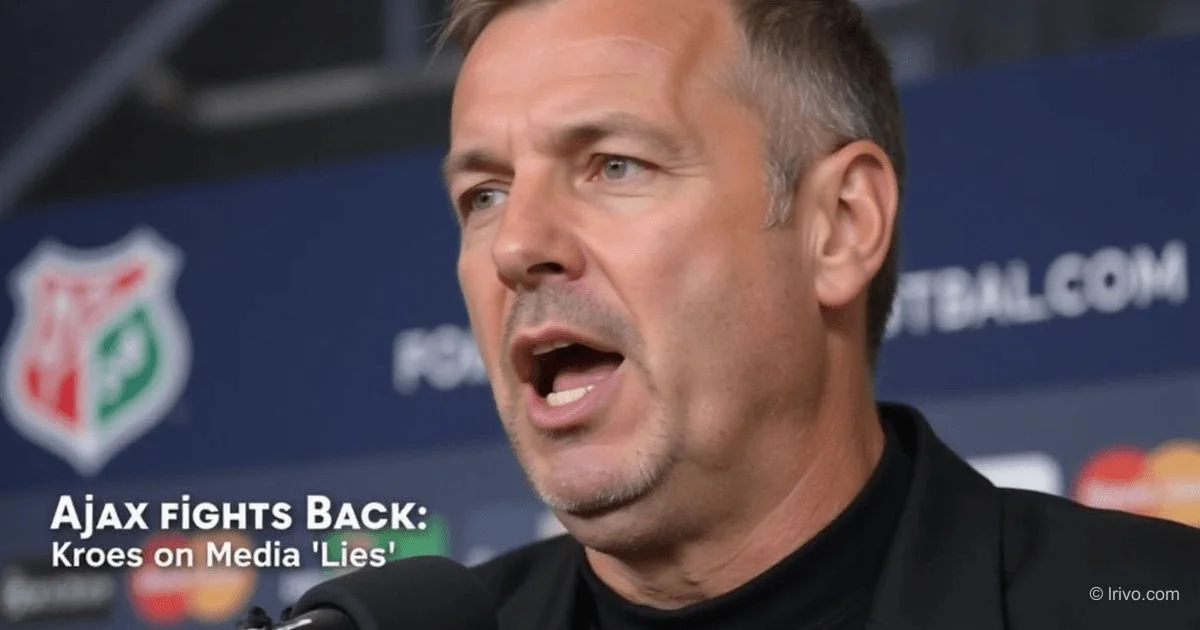
Ajax Technical Director Alex Kroes Blasts Media Over "Little Lies" About Loaned Players
Alex Kroes, the outgoing technical director for Dutch football giant Ajax, has publicly expressed his frustration with what he describes as an inaccurate and overly negative media narrative surrounding the club. His primary concern centers on reports claiming a lack of communication between Ajax and its players currently out on loan. Kroes firmly refutes these allegations, labeling them as "little lies" while acknowledging that, like any large organization, there's always room for operational improvement.
Kroes's contention is rooted in statements reportedly made by various loaned-out players, which suggest they receive little to no contact from their parent club. He insists that communication with these athletes does indeed take place. While he concedes that the process might not always be flawless, he emphasizes that the situation is far from the complete absence of contact often portrayed in the media. According to Kroes, the picture painted is often too stark and negative.
The director also highlighted the significant internal impact such media stories can have. He explained how a single interview, even if based on partial truths, can quickly spread through the club's internal communication channels, leading to questions and concerns among staff and teammates. Kroes stated that in such instances, he has often been able to provide immediate evidence of contact with the player in question, directly countering the negative reports.
Setting the Record Straight
Recent reports have specifically mentioned players such as Gerald Alders, Tristan Gooijer, Dies Janse, Nick Verschueren, and Ahmetcan Kaplan, alleging minimal or no contact from Ajax during their respective loan spells. Kroes directly challenged this impression, arguing that the media often presents an overly simplistic, black-and-white view that fails to capture the full reality of the club's efforts.
Despite his strong defense of the club, Kroes was candid about the operational realities at Ajax. He openly admitted that not every aspect of the club's functioning is perfect and that there are undoubtedly areas where improvements could and should be made. However, he stressed that the overall situation is generally not as dire or negative as it is frequently depicted in the media, suggesting a disproportionate focus on perceived shortcomings.
Kroes extended his critique to a broader observation about Ajax's constant presence under the media microscope. He lamented that for a high-profile club like Ajax, even minor issues are often inflated into significant problems, transforming "every molehill into a mountain"—specifically, a "negative mountain." This intense and often critical scrutiny, he believes, creates an environment of perpetual noise that can be counterproductive to the club's objectives.
Beyond the Headlines
The outgoing technical director also shed light on the club's efforts in supporting its players, including new signings. He pointed out that dedicated individuals within Ajax are working diligently on various support initiatives. These include crucial aspects like language development programs to help foreign players integrate, as well as assistance with accommodation arrangements. While acknowledging that these processes may not always run perfectly smoothly, Kroes asserted that significant and consistent effort is being made to organize them effectively and provide a supportive environment for players.
Looking ahead, Kroes expressed a clear desire for Ajax to navigate towards calmer waters. He conceded that the club's dynamic will likely never match the relative tranquility often found at rivals like PSV Eindhoven and Feyenoord, given Ajax's stature and global interest. Nevertheless, he believes that the incessant negative noise surrounding Ajax is ultimately detrimental, hindering the club's progress and potentially preventing it from performing at its best potential on and off the field.
Here are some key points from Alex Kroes's recent statements regarding Ajax and media coverage:
- He strongly refutes claims of no contact with loaned players, calling these reports "little lies" that create a false impression.
- Communication with loaned players does occur, though Kroes admits there is always room for improvement in these processes.
- Media reports, even single interviews, can quickly cause significant internal disruptions and create unnecessary concern within the club.
- Kroes believes Ajax is under constant and intense scrutiny, where minor issues are frequently exaggerated into major problems.
- Despite media portrayals, dedicated efforts are being made by the club to support players with language development and accommodation.
- The continuous negative media attention is seen as a hindrance to Ajax's overall progress and its ability to perform optimally.
Key Takeaways:
- Alex Kroes, Ajax's outgoing technical director, is openly critical of media reports regarding the club's communication with loaned players.
- He directly denies claims of a lack of contact, asserting that "little lies" are being spread, although he acknowledges that perfection is not always achieved.
- Kroes believes Ajax faces disproportionate media scrutiny, leading to minor issues being inflated into significant negative narratives.
- The club is actively working on player support, including language training and accommodation, despite media portrayals.
- He argues that constant negative media attention ultimately impedes Ajax's progress and its ability to achieve its full potential.
Alex Kroes's outspoken criticism highlights the ongoing tension between major football clubs and the media narratives that shape public perception. His firm defense of Ajax's internal dealings, while candidly acknowledging areas for improvement, underscores the complex challenge of managing a high-profile club's image in a relentlessly scrutinized environment. As he prepares to transition his role, his final remarks serve as a plea for a more balanced portrayal, hoping to foster a more stable and constructive environment for Ajax's future endeavors.
— Editorial Team