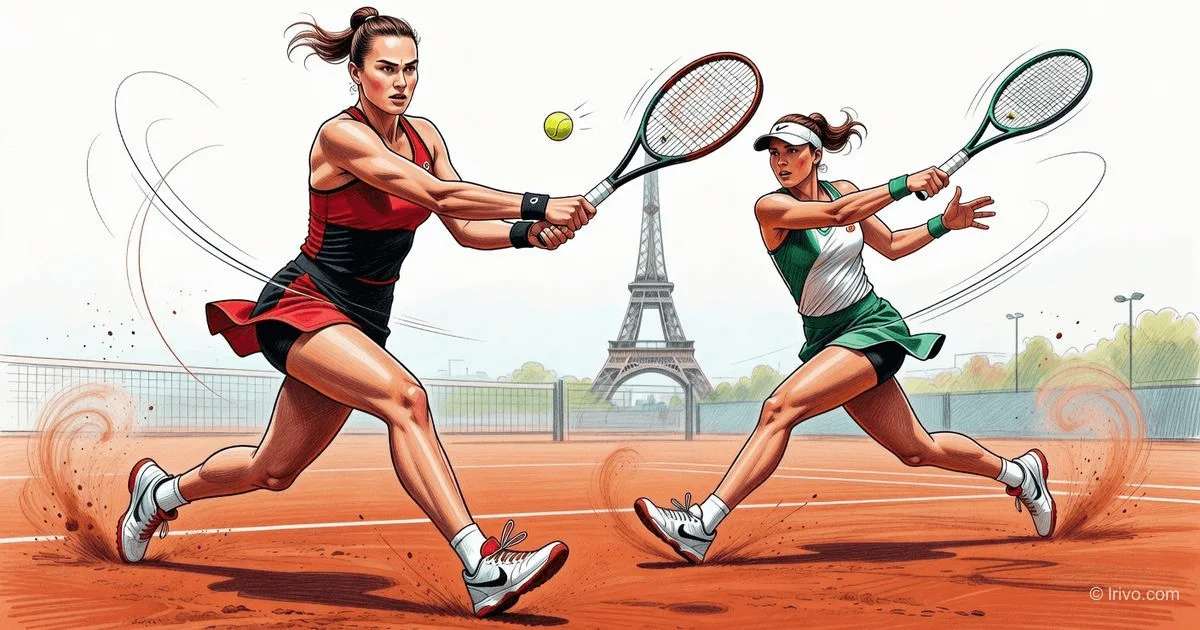
Roland Garros: Aryna Sabalenka Set to Face Diana Shnaider in the Quarterfinals
The world No. 1 will meet the world No. 23 for the first time in her career. The match is scheduled for June 3, and the winner could face Mirra Andreeva in the semifinals.
Roland Garros: Aryna Sabalenka to Face Diana Shnaider in the Quarterfinals — A Clash Between the "Tiger" and the "Lefty"
World No. 1 and four-time Grand Slam champion Aryna Sabalenka will meet 23rd-ranked Russian Diana Shnaider in the quarterfinals of the French Open. The match is set for June 3 on Court Philippe Chatrier, marking the first career meeting between the two. The winner will likely face fellow Russian Mirra Andreeva in the semifinals, as Andreeva has already advanced to the final four.
Main Event
Both players took different paths to the quarterfinals, but their routes have now converged in Paris. Aryna Sabalenka continues her dominant run at Roland Garros 2026, dropping not a single set so far. In the fourth round she defeated former world No. 1 Naomi Osaka of Japan 7-5, 6-3. This marks the Belarusian’s 14th consecutive Grand Slam quarterfinal — a feat achieved by only a handful of players in the Open Era.
Diana Shnaider, meanwhile, produced a major upset in the round of 16. The 22-year-old Russian, for whom this French Open is only her second major, ousted 2025 Australian Open champion Madison Keys. The match lasted one hour and 46 minutes and ended 6-3, 3-6, 6-0, with Shnaider dropping just 15 points in the deciding set to complete a bagel. It is her first career Grand Slam quarterfinal.
Details and Statistics
Aryna Sabalenka arrives in peak form. Across four matches on the Parisian clay she has surrendered only 18 games, comfortably beating Jessica Bouzas Maneiro (6-4, 6-2), Elsa Jacquemot (7-5, 6-2), Daria Kasatkina (6-0, 7-5) and Naomi Osaka (7-5, 6-3). Her numbers against Osaka were striking: 12 aces, 39 winners and four converted break points. Her powerful serve and aggressive baseline game have become her calling card at this tournament.
Diana Shnaider, by contrast, has shown remarkable mental resilience. Her match against Keys served as a true test: after dropping the second set, the Russian stayed composed and won the third 6-0. Notably, Keys had led their head-to-head 3-0 before this encounter, but Shnaider turned the tables on clay. She converted six of seven break points and made only one double fault, while landing 81 percent of first serves in the deciding set.
Context and Significance
For Aryna Sabalenka, Roland Garros remains the only major she has yet to win. Last year she fell to Coco Gauff in the final (6-7, 6-2, 4-6); the year before she lost in the semifinals to Karolina Muchova. This season the draw has opened up nicely: defending champion Coco Gauff, four-time Paris winner Iga Swiatek and Karolina Muchova have all exited early. Sabalenka now has perhaps her best chance yet to claim the title.
For Diana Shnaider, reaching the quarterfinals is more than a tournament breakthrough — it is a career milestone. Just three years ago the 22-year-old was outside the top 100; she has now established herself among the game’s elite. Her signature weapon is a heavy left-handed topspin forehand that creates problems even for the most experienced opponents on the slow clay of Paris. She also excels at changing pace, mixing aggressive drives with lobs and drop shots.
Shnaider became the third Russian in the Roland Garros 2026 quarterfinals, joining Mirra Andreeva and Anna Kalinskaya. Such a strong Russian presence at this stage of a major has not been seen since the early 2010s, signaling a generational shift and the arrival of a new wave of Russian talent.
What’s Next / Match Preview
The quarterfinal between Aryna Sabalenka and Diana Shnaider will take place on June 3 on the main Philippe Chatrier court, starting at 12:00 Moscow time. It will be the first meeting between the two, adding extra intrigue as neither player holds a tactical edge based on prior knowledge.
If Sabalenka wins she will face Anna Kalinskaya or Maja Chwalinska in the semifinals on June 5. Should Shnaider pull off the biggest upset of the tournament and defeat the world No. 1, her semifinal opponent would be either Kalinskaya (WTA No. 22) or Polish qualifier Maja Chwalinska (No. 114).
The top half of the draw presents a unique situation: three of the four quarterfinalists are Russian (Andreeva already in the semifinals, Shnaider and Kalinskaya in the quarters), with only one non-Russian standing in the way of a potential all-Russian final. This gives Sabalenka’s match added weight — she is the main obstacle to a possible triumph for the new generation of Russian tennis on Parisian clay.
Editorial Prediction
On paper the favorite is clear — Aryna Sabalenka. Fourteen straight Grand Slam quarterfinals against a debutant at this stage is an enormous advantage. The Belarusian is not merely winning; she is dominating, conceding not a single set and playing at an exceptionally high level. Her powerful forehand, booming serve and aggressive return game are elements Shnaider has never faced in such volume.
Yet it would be a mistake to underestimate Diana Shnaider. First, her left-handedness can disrupt even the most seasoned opponent; the heavy spin sends the ball in the opposite direction, an effect magnified on clay. Second, she has shown mental toughness, as evidenced by her comeback against Keys. Third, she has nothing to lose — she has already exceeded expectations and can now play with complete freedom.
The key factor will be Shnaider’s first serve. If she lands it consistently (as she did at 73 percent in the first set against Keys), she can make the match competitive. If Sabalenka repeatedly pressures her on return and forces her into a defensive role, the contest could end quickly.
The editorial team expects Sabalenka to win, but not without resistance. The first set is likely to be tight and could go to a tiebreak or be decided by a single break; after that, experience and power should prevail. Predicted score: 7-6, 6-3 for the world No. 1. Shnaider has a chance at an upset, but she would need to play nearly perfectly with maximum aggression and minimal errors. Given Sabalenka’s current form, that probability sits at 20-25 percent. Either way, fans are in for an exciting clash of generations and styles.
— Editorial Team