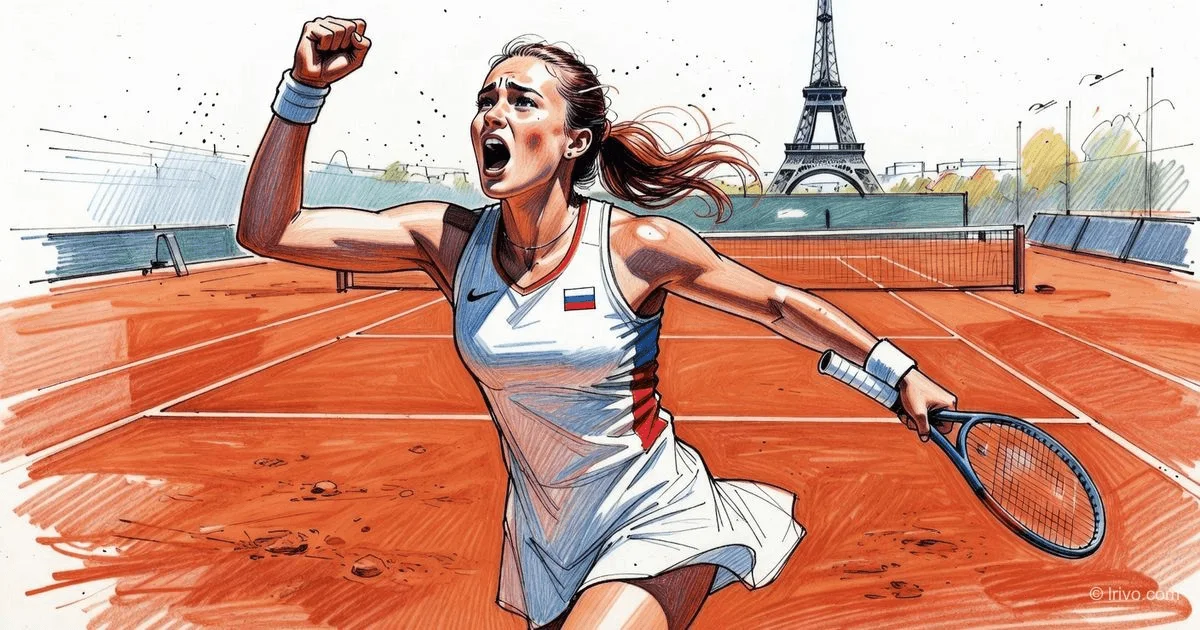
Mirra Andreeva Crushes Sorana Cirstea and Reaches Roland Garros Semifinals
19-year-old Russian tennis star Mirra Andreeva defeated the Romanian 6-0, 6-3. In the semifinals, Andreeva will face Ukraine's Marta Kostyuk, who has not lost in 17 straight matches.
Mirra Andreeva Crushes Sorana Cirstea and Charges into the Roland Garros Semifinals: A New Era for Russian Tennis
19-year-old Russian tennis phenom Mirra Andreeva continues her dominant run across the Paris courts, sweeping aside veteran Romanian Sorana Cirstea in the quarterfinals of the French Open. Played under the closed roof of Court Philippe Chatrier due to rain, the match ended 6-0, 6-3 in favor of the world No. 8 in just 57 minutes. In the semifinals, the Russian will meet Ukraine's Marta Kostyuk, who at the same time won the all-Ukrainian derby against Elina Svitolina and extended her winning streak on clay to an astonishing 17 matches in a row.
Main Event
From the opening points it was clear that the 36-year-old Romanian, for whom this Roland Garros is one of her final tournaments, had almost no chance against the young Russian. Mirra stepped onto the court in a state of total focus that she later described as "being in the zone." By the 24th minute of the first set the scoreboard already read 6-0 — Andreeva had not dropped a single game.
Cirstea, known for her powerful and aggressive game, looked completely lost. She kept making errors coming out of defense, and her trademark flat shots either sailed long or became easy pickings for Andreeva, who seemed to be everywhere. The Russian played with relentless intensity, giving her opponent no time to think. "I knew it wouldn't be easy and that I'd have to go at 200 percent intensity and concentration because she would try to pressure me whenever she could," Mirra admitted afterward.
The second set began with an exchange of breaks. Cirstea finally managed to hold serve and evened the match. At 3-3 it looked as though the Romanian had seized the initiative. But the surge proved short-lived. Andreeva immediately regained control, winning the next three games in a row. The final point came on a thunderous forehand that left Cirstea watching helplessly.
The emotional conclusion of the match became a display of sportsmanship. Mirra walked to her defeated opponent, gave her a warm hug and whispered something in her ear. For Cirstea this Roland Garros was her swan song — she is retiring at the end of the season, and a semifinal berth remained an unreachable dream. The Romanian did not hide her admiration after the match: "I love Mirra and her team. She's a wonderful girl, a true blessing for the sport. An amazing person. I really hope she wins Roland Garros."
Details and Statistics
The victory over Cirstea marked Mirra Andreeva's 16th win at Roland Garros in the main draw. The figure made her the outright record holder among teenagers of the 21st century on the Parisian clay courts. No girl under 20 has won as many matches here as the Russian. Given that Mirra is only 19, the record is likely to be broken again in the coming years.
The numbers speak for themselves. 57 minutes on court is fast even by first-round standards, let alone a Grand Slam quarterfinal. The opening set was over in 24 minutes, during which Mirra made very few errors. The gap in class was so obvious that even the Parisian crowd, which had booed the Russian last year after she beat local favorite Loïs Boisson, this time applauded her mastery.
Interestingly, before the match Mirra experienced an unusual psychological moment. "I had an incredible warm-up, I felt like I couldn't miss. Then I got a little nervous because usually after a great warm-up you don't play as well. But today I just stepped into the zone," Andreeva told Reuters. The admission shows how much her mental resilience has grown compared with last year.
As for this season's statistics, this semifinal is Andreeva's second at a Grand Slam (the first came two years ago, also in Paris). She is confidently moving toward her goal of becoming world No. 1, and her results on clay confirm it. With Coco Gauff and Iga Świątek already out of the draw, bookmakers now list Andreeva among the leading contenders for the title.
Context and Significance
Two years ago Mirra already reached the Roland Garros semifinals, but that success then felt more like a flash than a pattern. Last year came a painful disappointment: in the quarterfinals she lost in front of a hostile crowd to France's Loïs Boisson. The psychological blow was so severe that many experts spoke of a "sophomore slump." Yet the current breakthrough feels entirely different.
"Last year I collapsed in the quarterfinals under the closed roof, and today when I saw the roof closed again I had flashbacks," Mirra admitted at the press conference. "But I told myself: 'Flashbacks only about the roof, not about the loss.' It was important for me to rewrite the story." The remark is a clear sign of the player's growing maturity. She no longer fears the ghosts of the past; she comes to defeat them.
The upcoming semifinal against Ukraine's Marta Kostyuk adds not only sporting but also political tension, although both players strive to remain professional. Kostyuk, commenting on her semifinal appearance, avoided direct remarks about her Russian opponent and instead dedicated her win to the Ukrainian people after the tragic events in Kyiv: "We had another very difficult night in Ukraine. I want to dedicate this match to the Ukrainian people and their resilience."
Notably, Andreeva herself stressed in her press remarks that her opponent's nationality does not matter to her. "Both girls (Kostyuk and Svitolina) are incredible fighters," Mirra said before their match concluded. "It doesn't matter who wins. There are no easy opponents in a Grand Slam semifinal. I play against the ball, not against the flag." The approach has earned respect and demonstrates a high level of sportsmanship.
What's Next / Preview of the Next Match
In the semifinal, scheduled for June 5 or 6 depending on the organizers' schedule, Mirra Andreeva will face Ukraine's Marta Kostyuk. For the 23-year-old Kostyuk this is also a historic occasion: she became the first Ukrainian woman in the Open Era to reach the Roland Garros singles semifinals.
Kostyuk arrives in superb form. Her winning streak on clay now stands at 17 matches, achieved with titles in Stuttgart and the final of the prestigious Madrid Masters 1000. Interestingly, it was Kostyuk who claimed the Madrid title, defeating Mirra in a tight final earlier this May.
The head-to-head record still favors the Ukrainian. The pair met twice this season, and Kostyuk won both times — first in the Brisbane quarterfinals (7-6, 6-3) and then in the Madrid final (6-3, 7-5). However, a Roland Garros quarterfinal is a very different proposition from a Madrid Masters final — a different level of pressure and responsibility.
For Andreeva the match offers a chance not only to avenge the season's earlier defeats but also to reach her first Grand Slam final. Given the draw (the other semifinal will feature either an experienced American or a surprise debutante), the winner of Andreeva-Kostyuk will have an excellent shot at the title.
Editorial Forecast
The Andreeva-Kostyuk semifinal promises to be a highlight of Roland Garros and possibly the start of a great rivalry for years to come. Both players are in their prime (Kostyuk is 23, Andreeva 19) and are playing tennis of the highest quality. In short, this is a matchup between two of the best players on the current clay-court swing.
Form and current state. Marta Kostyuk may enter the match with the more impressive résumé — 17 straight wins and the Madrid title are serious credentials. Yet Mirra holds a powerful advantage: she has hit an incredible stride right here in Paris, and her win over Cirstea was a display of total dominance. On the other hand, Kostyuk played a grueling three-set battle against Elina Svitolina, expending considerable emotional and physical energy. Andreeva dispatched her opponent in straight sets in under an hour and stayed fresh.
Tactical outlook. Much will depend on serving and returning. Kostyuk is an aggressive baseliner who likes to dictate and shorten rallies. That aggression broke Andreeva in Madrid. However, Mirra, judging by her matches in Paris, has added stability and defensive skills. If Andreeva can weather the early onslaught and extend rallies, forcing Kostyuk to take risks and miss, her chances will rise sharply.
Psychology. Here Mirra holds a slight edge. She has already been to the Roland Garros semifinals (albeit with a negative outcome in the next match), while for Kostyuk this is her first Grand Slam semifinal. Nerves could play tricks, especially on tie-breaks. Moreover, Mirra has publicly stated that she has learned to handle crowd pressure and past flashbacks.
Prediction. Despite the 0-2 head-to-head, bookmakers and experts lean slightly toward Mirra Andreeva. The "home" factor (Andreeva trains in France) and the easier path to the semifinals could prove decisive. A straight-sets win for Kostyuk looks unlikely given the level of dominance Mirra has shown. The editorial team expects a three-set battle lasting around two and a half hours. Mirra will avenge the Madrid defeat and reach her first Grand Slam final. To do so she must hold serve in the opening three or four games and make Kostyuk run rather than hit winners. If the Russian can impose a grinding, attritional game full of lobs and drop shots, victory will be only a matter of time. Predicted score: 2-1 (4-6, 6-3, 6-2) for Andreeva.
— Editorial Team