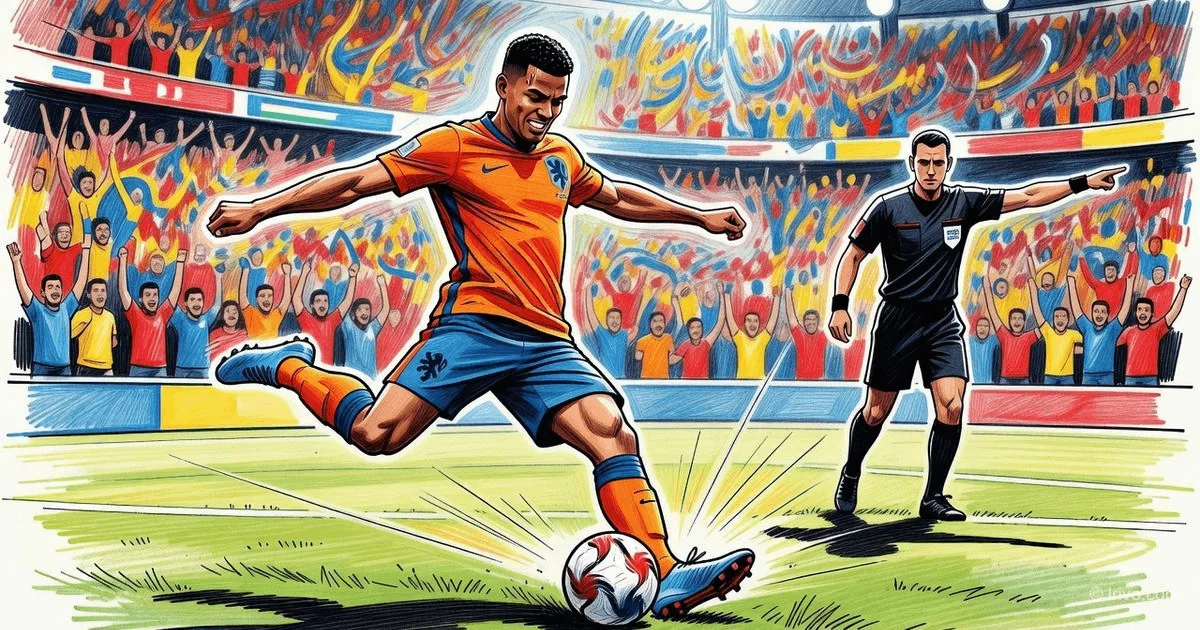
Netherlands snatch last-gasp victory over Uzbekistan (2:1)
The Netherlands vs. Uzbekistan match ended in drama: Cody Gakpo scored a brace from two penalties, the second of which was converted in the 90+8th minute. Uzbekistan managed to equalize in the second half but could not hold on for a draw.
Drama in New York: How the Netherlands snatched victory from Uzbekistan in the 90+8th minute
Main event
The Icahn Stadium in New York witnessed one of the most dramatic friendly matches in international football history. On June 8, 2026, the Netherlands played their final dress rehearsal before the World Cup against tournament debutants Uzbekistan. What was supposed to be a formality for the Oranje turned into a real thriller, featuring a red card, a last-second goal, and two penalties converted by the same player under incredible pressure.
The first half began with total dominance by the European giants. The Netherlands, ranked eighth in the FIFA rankings, methodically dismantled the defense of the 50th-ranked team from the opening minutes. Early on, Donyell Malen managed to miss from a prime position, sending the ball over the bar from a few meters out. But in the 32nd minute, the pressure paid off: Jakhongir Urozov committed a careless foul on Crysencio Summerville in his own penalty area, and referee Alyssa Pennington pointed to the spot without hesitation.
Cody Gakpo, for whom this match was a milestone—his 50th appearance for the national team—stepped up and struck the ball with his left foot into the bottom left corner. Goalkeeper Utkir Yusupov guessed the direction and even got a touch, but the power of the shot was enough to send it into the net. It was the 20th goal for the 25-year-old Liverpool forward in a national team shirt—a significant achievement on a milestone evening.
The second half began with continued pressure on Uzbekistan's goal. Virgil van Dijk headed dangerously from a corner—the ball went centimeters wide of the post. Then Brian Brobbey found the net, but the Dutch celebration was cut short by the linesman's flag for a marginal offside. It seemed the winner was decided, and all that remained was to wait for the final whistle.
But football is unpredictable, and in the 87th minute, an incident turned the match on its head. Substitute Gus Til, attempting to break up an Uzbekistan attack, handled the ball at the edge of the box. Referee Pennington, after a lengthy VAR consultation, made a controversial decision: a straight red card and a free kick, not a penalty, as the referee deemed the infringement began outside the area. The Netherlands were reduced to ten men, and it immediately affected the game.
Uzbekistan, sensing their opponent's weakness, threw everything forward. And in the second minute of added time—90+2—the unthinkable happened, silencing the 17,500 spectators. A defensive error by the Dutch allowed the ball to fall to 34-year-old veteran Igor Sergeev, who calmly slotted it past Mark Flekken. The score was 1-1, and it seemed a historic draw for the Asian debutants was inevitable.
However, with the clock showing 90+7, another twist followed. From a corner kick, Jan Paul van Hecke was brought down in the penalty area—Ural defender Abdukodir Khusanov pulled his opponent's shirt. The referee pointed to the spot again. The entire stadium held its breath.
Cody Gakpo took the ball once more. The psychological pressure was immense: he had already scored one penalty, but this second one—in the 90+8th minute, with the score 1-1, and the risk that a miss would cost his team victory—was a test of the strongest nerves. Gakpo ran up and again struck to the same left corner, sending Yusupov the wrong way. 2-1—the Netherlands snatched victory at the death.
Details and statistics
The numbers from this match clearly show how one-sided the Oranje's dominance was and how inefficiently they converted it. The Netherlands controlled 69% of possession, while Uzbekistan had just 31%. The Dutch expected goals (xG) reached an astronomical 4.62—meaning with normal finishing, they should have scored at least four or five goals. Uzbekistan's xG was just 0.85.
Cody Gakpo's individual statistics in this match and overall this season deserve special attention. Two penalties converted under pressure in his milestone 50th appearance for the national team is a moment that will go down in Dutch football history. Gakpo now has 21 goals for the national team (including the goal against Uzbekistan—some sources call it his 20th, but the overall trend is clear: he is entering the top scorers in Oranje history).
Possession and expected goals figures for the Dutch national team in friendlies before major tournaments are traditionally high, but efficiency often lets them down. In this game, the Netherlands had 23 shots, 9 on target. Uzbekistan, by contrast, had only 4 shots, with just 1 on target—but that shot was a goal.
Notably, the match was officiated by a female referee, Alyssa Pennington, which generated additional interest and media discussion. Her decision to send off Gus Til for handball on the edge of the box, as well as the two penalties awarded, were subjects of debate after the game. However, video replays confirmed that both fouls in Uzbekistan's box were clear, and Til's red card was in line with the spirit of the rules—the player deliberately interrupted a dangerous attack with his hand.
We must also mention the closed additional match the teams played after the main game. It consisted of two 30-minute halves and ended in a 2-1 victory for Uzbekistan, with goals from Azizbek Amonov and Avazbek Ulmasaliev. This win, albeit in an unofficial match, provided some moral consolation for the Asian team, showing they can compete on equal terms with a top opponent when that opponent is not at full strength.
Context and significance
This friendly was the final test for both teams before the 2026 World Cup, which will be held from June 11 to July 19 in the USA, Canada, and Mexico. For the Netherlands, the game had special significance: a week earlier, the Oranje had unexpectedly lost to Algeria, and that defeat had shaken the team's confidence ahead of the tournament. The last-gasp victory, however controversial and hard-fought, was meant to restore psychological stability to Ronald Koeman's squad.
The Netherlands were drawn into Group G at the World Cup, where they will face Japan, Tunisia, and Sweden. This is far from the toughest group—Sweden and Japan are solid mid-tier teams, while Tunisia represents African football, which is traditionally unpredictable. However, the problems exposed in the match against Uzbekistan should concern the coaching staff. The inability to convert chances despite total ball control and defensive vulnerability when down to ten men are worrying signs ahead of meetings with more experienced opponents.
For Uzbekistan, this match was a historic event regardless of the result. The team qualified for the World Cup for the first time in its history, and the friendly against one of Europe's strongest sides was invaluable experience. In the group stage, Uzbekistan will face formidable opponents: Portugal, Colombia, and the Democratic Republic of Congo. The game against the Netherlands showed that Uzbekistan can take a punch and punish favorites for the slightest mistakes—Sergeev's goal in the 90+2nd minute and the incredibly resilient defense for most of the match are proof.
The psychological impact of this game for Uzbekistan cannot be overstated. Despite being outclassed in terms of quality and possession, the team not only kept their heads up but also managed to secure a draw, only losing it at the very end due to a controversial penalty. For a World Cup debutant, such a performance against a top opponent is the best cure for pre-tournament jitters. If Uzbekistan plays with the same commitment against Portugal and Colombia, they could well spring a surprise and pick up points.
What's next / Preview of the next match
For both teams, the most crucial moment is approaching—the start of the 2026 World Cup. Only days remain until the first match, and each team will head to their training camps for final preparations.
The Netherlands will begin their tournament campaign on June 16, 2026, against Japan. This match will be key to determining the leader in Group G—a win over the Asian side would allow the Oranje to lay the foundation for topping the group. Then, on June 21, the Netherlands will face Tunisia, and on June 25, Sweden. Ronald Koeman's main task is to improve finishing: an xG of 4.62 against Uzbekistan with only two penalty goals is a worrying sign that must be corrected before the tournament starts.
Uzbekistan, meanwhile, faces an even tougher test. On June 18, the Central Asian team will take the field against Colombia, one of South America's football powerhouses. Then, on June 22, they face Portugal, one of the tournament favorites, and on June 26, they meet DR Congo, which will likely be decisive in the battle for third place and a possible knockout stage berth. For Uzbekistan, simply reaching the World Cup is already historic, but the team intends not just to make up the numbers but to play meaningful football that can surprise the world.
Notably, immediately after the official friendly, the teams played another closed-door match, consisting of two 30-minute halves, in which Uzbekistan took revenge with a 2-1 win. Although this game was purely training in nature and likely involved reserve squads, it demonstrated that the contest was more than even and that Koeman's team has issues with squad depth and concentration in the closing stages. This additional match may have given the coaching staffs more food for thought than the main game.
Editorial prediction
Although the match is already over, its lessons for the Netherlands ahead of the World Cup cannot be overstated. If the Oranje intend to challenge for group advancement and possibly a deeper playoff run, they must drastically improve their finishing. 69% possession and an xG of 4.62 are statistics of a dominant team, but two penalty goals against modest Uzbekistan is not the kind of result that inspires confidence before matches against Sweden or Colombia if they advance from the group.
The main positive for the Netherlands is the presence of Cody Gakpo, who proved he can take responsibility in decisive moments. Two coolly converted penalties under pressure in the 90+8th minute is a sign of leadership qualities that are so necessary for the team in the absence of injured or departed stars. Gakpo will likely be the team's primary penalty taker at the tournament, and his psychological resilience is a huge plus.
However, Gus Til's red card and the subsequent defensive disarray should alarm Koeman. Playing with a numerical disadvantage is an inevitable reality in tournaments, especially when referees become stricter and VAR catches every infringement. The Netherlands need to practice playing with ten men to avoid repeating the scenario against Uzbekistan, where 10 minutes with a man down nearly cost them the win.
For Uzbekistan, this match was, on the contrary, a triumph of character. A team considered a clear underdog that could not even regularly keep possession managed to create chances and score a consolation goal, and then even won the second, unofficial match. The prediction for Uzbekistan at the World Cup is a fight for third place in the group and, possibly, a historic victory over DR Congo. With the same commitment shown in New York, Uzbekistan can leave the tournament with their heads held high and, in the long term, lay the foundation for the development of football in the country for years to come.
In summary: the Netherlands won the battle but may have lost in terms of psychological confidence. Uzbekistan lost the match but won respect and invaluable experience. The coaching staffs will draw their main conclusions in the coming days when they announce their starting lineups for the first round of the World Cup. One thing is clear: football at this tournament will be unpredictable, and surprises should be expected from those who are not expected—like the Uzbekistan national team in New York.
— Editorial Team