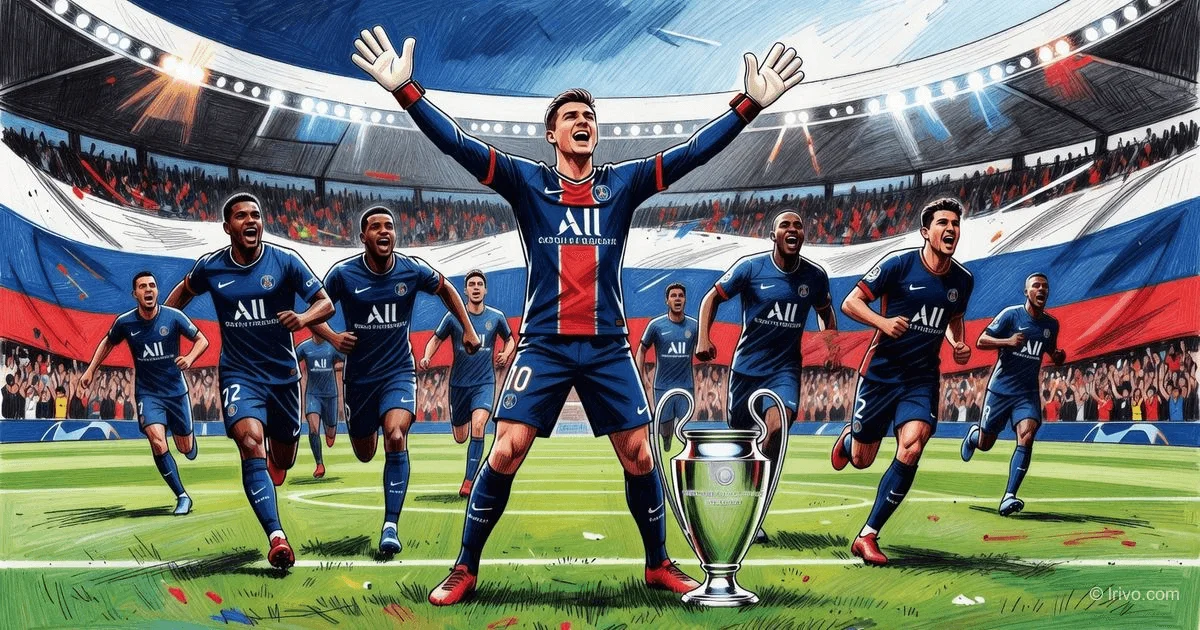
Matvey Safonov becomes first Russian goalkeeper to win Champions League final
Paris Saint-Germain's Russian goalkeeper Matvey Safonov contributed to his team's victory over Arsenal in the Champions League final. He became the first goalkeeper from Russia to claim this trophy.
Matvey Safonov made history: first Russian goalkeeper to win the Champions League
Paris Saint-Germain's Russian goalkeeper Matvey Safonov has etched his name into the annals of world football. In a dramatic Champions League final at Budapest's Puskás Aréna, the Parisians beat London's Arsenal on penalties (1-1, 4-3), and the 27-year-old goalkeeper from Krasnodar became the first Russian goalkeeper in history to conquer Europe's top club trophy. Moreover, Safonov is now the only Russian to have won the Champions League twice.
Main event
The 2025/26 Champions League final at the Puskás Aréna in Budapest drew 68,000 spectators and delivered a drama worthy of Shakespeare. Defending champions Paris Saint-Germain faced London's Arsenal, for whom this final was the first in 20 years. The outcome was decided only in a penalty shootout, where PSG proved more accurate, winning 4-3.
Matvey Safonov started for PSG and played all 120 minutes from first to last whistle. This was the Russian goalkeeper's second Champions League final: a year earlier, he was also in the Parisian squad for the victorious match against Inter (5-0), but remained on the bench. This time, Luis Enrique entrusted the Russian with the starting spot in the most important match of the season.
Interestingly, the final unfolded for Safonov in an unusual way. Already in the 6th minute, Kai Havertz opened the scoring, and that goal was Arsenal's only shot on target for the entire match. The Londoners never hit the target again, sparking a wave of jokes on social media: British fans quipped that Safonov could have set up a deck chair and sipped tea in goal — the match outcome would not have changed.
Amusingly, in the penalty shootout itself, the Russian goalkeeper did not make a single save: both Arsenal misses — Bukayo Saka and Gabriel Magalhães — went wide. Safonov himself, with his characteristic composure, wrote on his Telegram channel after the final: "By the way, an interesting fact: I didn't make a single save in the entire final. Not in regular time, not in the shootout. But I still won the Champions League final."
Details and statistics
The numbers from the 2025/26 season show that Safonov earned his place in PSG's goal. In 10 Champions League matches, the Russian goalkeeper conceded 12 goals from 43 shots on target, with a save percentage of an impressive 74.4%. In the French league, his stats are even better: 15 matches, 14 goals conceded, 53 saves, and a 73.6% save rate, with a goals-against average (GA90) of just 0.93.
However, the path to this triumph was rocky. Safonov moved to PSG in the summer of 2024 from Krasnodar and immediately faced stiff competition. Initially, Gianluigi Donnarumma was ahead of him; then, after the Italian left, newcomer Lucas Chevalier, bought for €40 million, became his rival. The Russian goalkeeper found himself as the third choice and did not play for 197 days — from June 2025 to January 2026.
"Transfer turmoil" at the Parisian club worked in Safonov's favor. Donnarumma was sold, Chevalier began to lose his position, and Luis Enrique, impressed by the Russian's work in training, chose him. From January 28, 2026, Safonov became PSG's undisputed number one, playing all remaining matches of the season without substitution.
The key moment that changed the coaching staff's attitude toward the Russian goalkeeper was the FIFA Club World Cup final on December 18, 2025. In the match against Brazil's Flamengo, regular time ended in a draw, and the trophy was decided on penalties. Safonov, who came on as a substitute for Chevalier, saved four consecutive penalties, breaking a finger on the third but playing to the end. Parisians won the trophy, and Safonov became a national hero in France.
After the Champions League final, the authoritative French publication L'Equipe published an article analyzing Safonov's role in the victory. Despite zero saves, the newspaper concluded: "PSG owes its victory over Arsenal largely to the 27-year-old goalkeeper. During the penalty shootout, he played a notable role and made a significant contribution to his team's ultimate success."
Context and significance
Matvey Safonov's victory in the Champions League final is a historic event for Russian football. He became the first goalkeeper from Russia to win this trophy. Before him, only Stanislav Cherchesov (with Tirol in 1989, though the tournament was then the European Cup) and Dmitri Kharin (with CSKA London in 1995 in the Cup Winners' Cup) had played in finals among Russian goalkeepers.
But Safonov's main achievement is even more impressive: he became the first Russian in history to win the Champions League twice. Previously, Igor Dobrovolsky with Marseille (1993), Vladimir But with Borussia Dortmund (1997), Dmitri Alenichev with Porto (2004), and Denis Cheryshev with Real Madrid (2018) each won one trophy. None managed to repeat the success. Safonov did it at age 27, with perhaps several more top-level seasons ahead.
Notably, the Russian goalkeeper, long considered merely a backup for Donnarumma and Chevalier, managed to break into the starting lineup and become a key player for a team that won two European trophies in a row. As Chinese analysts write, "his career is a story of how a footballer who experienced ups and downs, at the most important moment of his life, proves to everyone who didn't believe in him that he is a true champion."
Safonov's path is also unique because he is the only Russian footballer at a top club who consistently starts. At a time when many Russian legionnaires have left Europe or get little playing time, the success of the Krasnodar academy graduate has become a symbol that the Russian goalkeeping school can still produce world-class goalkeepers. Recall that it was Russian goalkeepers — Akinfeev, Gabulov, Dzhanaev — who led the Russian national team to the quarterfinals of the 2018 home World Cup. Safonov, then a backup, has now surpassed all his predecessors in club achievements.
Paradoxically, it was the "zero" contribution in saves in the final that made Safonov's image even more popular. Fans on social media joked: "He could have brought a chair, a drink, and popcorn," "Technically, PSG didn't need a goalkeeper at all." But behind this humor lies recognition that Safonov organized PSG's defense so well that Arsenal simply could not create chances. As one British fan noted: "The only shot Safonov should have saved, he didn't. But you can't stop a ball heading to the moon."
What's next / Next match preview
For Matvey Safonov, the 2025/26 season ended on a high note, but in just two and a half months, Parisians face a new challenge. On August 11, PSG will play in the UEFA Super Cup against the Europa League winner, Spain's Real Sociedad. The match will take place at the Karaiskakis Stadium in Piraeus, Greece. If Parisians win, Safonov will add another European trophy to his collection.
Additionally, the World Cup in the USA, Canada, and Mexico kicks off in June-July 2026. The Russian national team, suspended from international tournaments since 2022, will still not participate, which is a great loss for Safonov, who could have been the starting goalkeeper at the quadrennial showpiece. However, according to Russian media, FIFA is considering a gradual return of Russian teams to international tournaments, and perhaps by 2027, Safonov will again wear the national team jersey.
Regarding his club career, Safonov's contract with PSG runs until summer 2029 with a salary of about €70,000 per week. These figures seem modest for a goalkeeper of his level, and after winning the Champions League, his Russian agent may initiate negotiations for a pay raise. According to expert estimates, Safonov's market value could rise from the current €25-28 million to €40-45 million, making him one of the most expensive goalkeepers in the world.
However, Safonov himself does not seem preoccupied with financial matters. In one interview, he admitted that his main hobbies outside football are mathematics and board games with his wife. "I don't go to nightclubs or waste money on nonsense. I'd rather solve a couple of equations or play a game of chess. It keeps my brain sharp, and a goalkeeper needs that as much as reflexes."
Interestingly, Safonov and his fellow goalkeeper, Carolina Hurricanes' Pyotr Kochetkov, are currently the only Russians to have won the top club trophies in their sports (the Champions League in football and the Stanley Cup in hockey — the latter is still in the final process, but Kochetkov is already a 2023 Stanley Cup winner). This achievement underscores that the Russian goalkeeping school remains one of the strongest in the world.
Editorial forecast
Although the match is over, it can be said that winning the Champions League final opens new horizons for Safonov. If he continues in the same vein, he could enter the nominations for UEFA Goalkeeper of the Year next season and also contend for the Ballon d'Or (though goalkeepers rarely win this award, after the successes of Lev Yashin and Manuel Neuer, barriers for goalkeepers have lowered).
Importantly, Safonov is not just "the right man at the right place at the right time." His journey from 197 days on the bench to two Champions League titles is a story of character, perseverance, and intelligence. He is not only physically gifted (height 192 cm) but also intellectual — his method of analyzing penalties by studying angles and trajectories has been dubbed the "mathematical approach" in the French press.
If Safonov retains his starting spot next season and PSG again competes for top honors, the Russian goalkeeper could become the first player from Russia in a long time to be recognized on the streets of Paris and around the world. His face has already appeared on the covers of L'Equipe and in Sky Sports reports — for a Russian footballer in the current geopolitical conditions, that is an achievement in itself.
The main challenge for Safonov lies ahead: to maintain the high standard. Competition at PSG is always fierce, and the club may buy another goalkeeper in the summer. However, as the Chevalier story showed, the Russian knows how to win competition not through agents and loud statements, but through work in training and composure in decisive moments. Perhaps in the UEFA Super Cup match on August 11, we will see the same Safonov — calm, calculating, and ready for new feats.
— Editorial Team