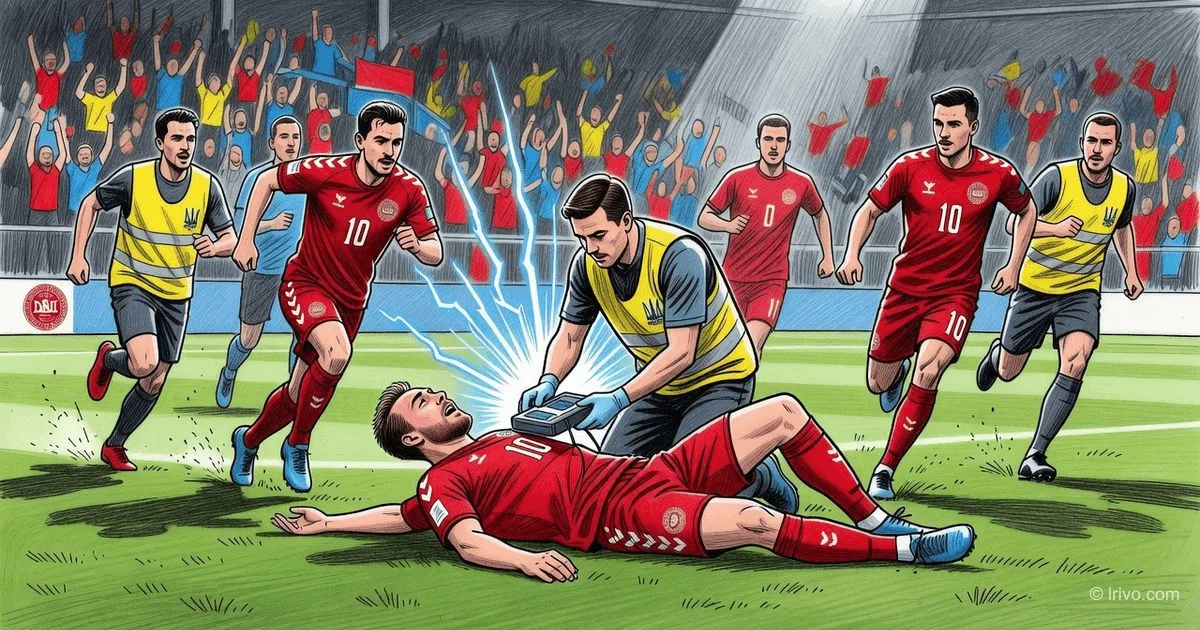
Christian Eriksen collapses on the pitch in Denmark friendly, but quickly recovers
The incident occurred in the 65th minute of the match against Ukraine: Christian Eriksen's implanted defibrillator was triggered. Fortunately, this time the consequences were quickly contained, and the 34-year-old midfielder left the pitch on his own.
Once again, his heart stopped in the 65th minute: Christian Eriksen endured a second nightmare on the pitch, but the defibrillator saved his life again.
Main Event
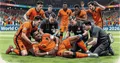
On June 7, 2026, the stadium in Odense witnessed a scene the world had hoped never to see again. In the 65th minute of a friendly match between Denmark and Ukraine, with the score 2-1 in favor of the hosts, 34-year-old midfielder Christian Eriksen suddenly clutched his chest and collapsed onto the turf. Thousands of fans, players from both teams, and the referees froze in horror — the Euro 2020 nightmare was replaying before their eyes.
The moment of collapse was eerily similar to what happened in Copenhagen five years earlier. Eriksen, who had just made a pass, lost consciousness and lay motionless on the grass. However, this time the medical staff reacted even more swiftly, and crucially, the lifesaving device was already inside the player's body. The implantable cardioverter-defibrillator (ICD), which had been fitted after the 2021 incident, activated instantly.
Denmark captain Pierre-Emile Højbjerg, who was nearby at the time of the collapse, later told Danish TV channel TV2: "There was a throw-in, I stepped aside, turned around, and saw Christian falling to the ground." His reaction and the entire team's response were lightning-fast — players surrounded Eriksen, called for doctors, and ensured the medical team had space to work, mindful of how critical every second is in cardiac arrest.
The most astonishing and hopeful part came in the following minutes. Denmark team doctor Morten Boesen later explained: "He lost consciousness briefly, but came to very quickly." Relatively quickly — a matter of seconds. After the defibrillator delivered a shock that restored normal heart rhythm, Eriksen opened his eyes and, to the amazement of everyone present, managed to get to his feet.
The most powerful symbol of the event was when he walked to the ambulance on his own. It was a triumph of modern cardiology over seemingly insurmountable odds. The match was immediately stopped and never resumed, but the question of the winner became secondary. The main victory was won on the green turf — in the fight for life, which Eriksen won for the second time in his career.
Details and Statistics
The incident on June 7 differed medically from the 2021 tragedy. Back then, during the Euro 2020 match against Finland, Eriksen's heart stopped completely and had to be restarted with an external defibrillator and chest compressions on the pitch. This time, it was a so-called "electrical storm" or the onset of a pathological (ventricular) rhythm that the defibrillator deemed threatening.
Sports physician Dmitry Babeliuk explained the mechanism: "Christian's collapse was a reaction to the pacemaker's action, which did work as intended. That is, there was indeed a cardiac arrest or the appearance of a pathological rhythm, to which the defibrillator responded with a shock." The shock, felt like a strong blow to the chest, was necessary to "reset" the heart muscle — similar to rebooting a frozen computer.
How does an ICD work? It is a device about half the size of a mobile phone, implanted under the skin, usually near the armpit or collarbone. Professor Anil Malhotra, a sports cardiologist at Manchester Metropolitan University, explains: "The ICD works 24/7, constantly monitoring the heart rhythm. If the heart develops a dangerous rhythm that could lead to sudden cardiac arrest, the device quickly detects it and delivers an electric shock to restore normal rhythm. This eliminates the human factor."
Statistics from recent years show that Eriksen continued to perform at the highest level despite the implant. From 2022 to 2025, he played 73 matches for Manchester United in the Premier League, scoring 3 goals and providing 12 assists. In the 2025/26 season, he was already playing for German club Wolfsburg, making 30 Bundesliga appearances, scoring 2 goals and providing 4 assists. In total, he has 151 caps for Denmark and over 40 goals.
The most important statement came from Eriksen himself the day after the incident. On his Instagram, he wrote: "I want to let everyone know that I'm fine, I'm at home with my family. The shock from my ICD affected me and my family greatly, but this was a completely different situation than in 2021. My ICD did exactly what it was designed to do: protected me when it was necessary."
Context and Significance
June 2021 will forever remain in football history as the month when death retreated before the professionalism of doctors. Then, in Copenhagen, Christian Eriksen suffered a cardiac arrest in front of the world. He needed emergency resuscitation, and his teammates formed a human shield to hide the life-saving process from TV cameras. After that incident, he was fitted with an ICD, but Italian law (Serie A) prohibits players with such devices from playing, so his contract with Inter was terminated by mutual agreement.
The road back to top-level football took eight months. Eriksen signed with Brentford in January 2022 and returned to the pitch in a friendly against Newcastle in February. His comeback was considered one of the most inspiring events in sports history. Eriksen himself said at the time: "I don't see any risk. I have an ICD, and if something happens, I'm safe." And he was right — the device worked exactly as intended.
Denmark's team doctors, led by Morten Boesen, confirmed: "The pacemaker worked as it should." Unlike 2021, Eriksen did not need such a long recovery this time. In an interview with the BBC, Professor Malhotra explained: "Because he had an ICD, he didn't have to wait. The device worked instantly. It took a fraction of a second." Studies show that about 10% of ICD patients receive a shock from the device after detecting an abnormal heart rhythm. This means the device is working, not the opposite.
The incident triggered an immediate reaction across the football world. Denmark head coach Brian Riemer gathered players from both teams in the center of the pitch and thanked everyone for their quick response. "The most important thing is that Christian is okay. He left the pitch and sent his regards to the players. Now it's important to stand together and make sure everyone has a shoulder to lean on." The Ukrainian national team, which was the opponent in that match, also expressed full support and understanding of the decision to stop the game.
What's Next / Next Match Preview
For Christian Eriksen, immediate plans are clear — recovery and time with family. He himself reported that he has been discharged from the hospital, is at home, and has already begun the recovery process. "Now I'm focused on recovery, time with family, going on vacation, and playing football with the kids," he wrote. For him, this is a time of healing, both physical and mental — an electric shock, even a life-saving one, is always a shock to the body.
As for his playing career, it is too early to draw any conclusions. Neither Denmark nor Ukraine qualified for the 2026 World Cup in the USA, so Eriksen has no urgent need to return for a specific tournament. His club, Wolfsburg, recently left the Bundesliga at the end of the 2025/26 season, adding uncertainty to his club future. His contract with the "Wolves" runs until summer 2027, but his medical future will now be reassessed.
Doctors will need to conduct additional tests to determine why Eriksen's heart rhythm disrupted at that moment and whether there are ways to make a recurrence less likely. Professor Rachel Lampert, a sports cardiologist at Yale School of Medicine, explains: "Shocks from the device can happen at any time. Eriksen's doctors will need to figure out why his heart rhythm changed during the match." Until this investigation is complete, a return to the pitch is out of the question.
Eriksen himself is philosophical. As early as 2022, he acknowledged that he knew a similar event could happen again. "There was always a chance this could happen," his entourage quoted him as saying. In his letter to fans, he emphasized the main point: "Thanks to their professionalism (the doctors), my ICD did exactly what it was designed to do: protected me when it was necessary." This statement is not just to reassure fans but an acknowledgment of a life-saving system that works.
Editorial Forecast
Should Christian Eriksen end his career? This question is now on everyone's mind, from fans to sports officials. Doctors have already warned that the effects of an electric shock are hard to predict, and the impact on the body was severe. However, there is one important "but": in 2021, Eriksen survived clinical death and returned to football. In 2026, he survived an ICD shock, which was a planned intervention of a device implanted precisely for such cases.
Professor Lampert notes that even if Eriksen ends his career, it does not guarantee that shocks won't recur. "People who are not athletes also live with ICDs. Stopping play does not mean it won't happen again." The key question is not about leaving football but understanding the cause of the rhythm disturbance. Eriksen is in the hands of Europe's best cardiologists, and if they give the green light, continuing his career is possible.
However, the incident may have far-reaching consequences for football regulators. Italy already has a strict ban on players with ICDs. This match could reignite discussions at the UEFA level about the permissibility of players with implanted defibrillators participating in official matches. If doctors find a progressive heart disease, Eriksen will likely be advised to retire. If the cause is random and correctable, he may continue.
The editorial board leans toward the following forecast: Eriksen will be out of football for at least 3-4 months. He will undergo a series of cardiac examinations, and possibly have his ICD replaced or reprogrammed. A return to the pitch in the calendar year 2026 is unlikely, but if he decides to continue, he could be back in early 2027. His story has already become a symbol of how modern medicine can extend athletic life even after cardiac arrest. But most importantly, he remains alive and healthy for his family. Football can wait.
— Editorial Team