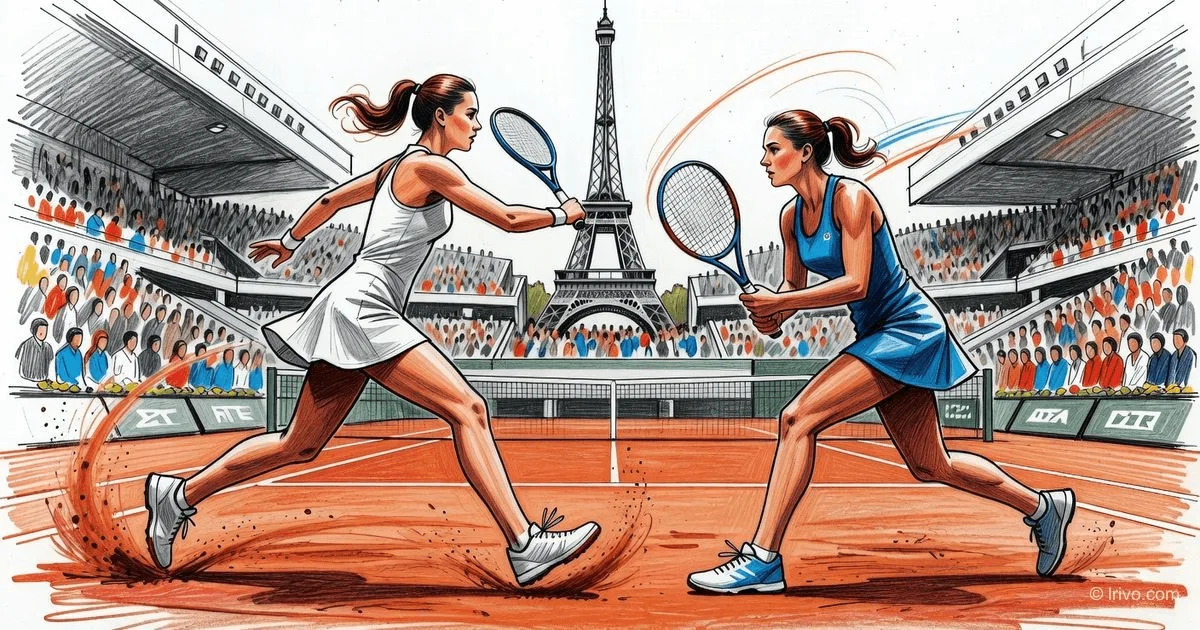
Roland Garros Final: Andreeva vs. the Qualifying Phenomenon
Today, June 6, 19-year-old Russian Mirra Andreeva will face Poland's Maja Chwalińska in the final of the French Open. For Andreeva, this is her first Grand Slam final; for her opponent, it's a historic event.
Two Stories of Greatness: Young Russian and Polish Cinderella Meet in the Roland Garros Final
Paris, June 6. Court Philippe-Chatrier holds its breath. Tonight, on the legendary clay of the French Open, two players whose paths to the final could not be more different will face off. On one side of the net: 19-year-old Russian prodigy Mirra Andreeva, world No. 8, tipped as a future great champion. On the other: 24-year-old Polish player Maja Chwalińska, ranked 114th, who started the tournament in qualifying and became the biggest sensation of the decade.
"It's like a dream, honestly, I don't know what's happening," Chwalińska admitted after the semifinal, collapsing to her knees on the red clay. Her opponent was far more composed: "I saw the little hairs on the ball when I tossed it. I was really very focused today." These two different personalities, two different paths, and two different playing styles promise a final that will go down in history regardless of the outcome.
Main Event: The Road to the Biggest Match of Their Lives
Mirra Andreeva's path to the final was that of a favorite. The eighth seed left no stone unturned against her opponents. Particularly impressive was the semifinal against world No. 15, Ukraine's Marta Kostyuk. The match lasted just 1 hour 17 minutes and ended 6-1, 6-3. The Russian lost only four games in the entire match, while Kostyuk, who had won 17 consecutive matches before this, was completely demoralized.
Throughout the tournament, Andreeva lost only one set — in the third round, when world No. 42 from Czechia, Marie Bouzková, managed to take a set off her. In all other matches, the Russian dominated unequivocally. In the quarterfinals, she dispatched 20th seed Liudmila Samsonova without dropping a set. On average, Andreeva loses fewer than six games per match — a phenomenal statistic for a Grand Slam tournament.
Maja Chwalińska's story is a completely different fairy tale. The 24-year-old Pole, whose name was known only to the most devoted tennis fans before this tournament, began her journey three weeks before the final. First, three rounds of qualifying, where she nearly lost her chance to make the main draw. Then, a string of upsets that no one could have predicted.
In the first round of the main draw, she sent home 2024 Olympic champion Zheng Qinwen of China (6-4, 6-0). Then came wins over Belgium's Elise Mertens (23rd seed) and Greece's Maria Sakkari. In the quarterfinals, she defeated Russian Anna Kalinskaya. In the semifinals, she faced 25th seed Diana Shnaider. And again, victory — 7-6 (7-4), 6-4.
"Nothing has changed for me. I'm just playing tennis," Chwalińska said after reaching the final, but added with a smile: "Let's not pretend anyone expected this. I was outside the top 100, and now I'm in a Grand Slam final. It's hard to process."
Details and Statistics: Numbers That Amaze
The Andreeva-Chwalińska final has already made history long before the first point. The achievements of both players deserve special attention.
Chwalińska's Path: The Qualifying Phenomenon
Maja Chwalińska became the first player in the Open Era to reach the Roland Garros final through qualifying. Only the second time in 58 years a qualifier has reached any Grand Slam final — after Emma Raducanu at the 2021 US Open. Moreover, the Pole became the third player in history to reach the final of the Paris tournament on her main-draw debut, joining legends Evonne Goolagong (1971) and Chris Evert (1973).
Before this tournament, Chwalińska had never beaten a top-50 player in her career. In Paris, she did it four times in two weeks. In six main-draw matches, she lost only one set. She has wins over the 1st, 23rd, and 25th seeds of the tournament.
Andreeva's Path: The Prodigy's Rise
At 19, Mirra Andreeva became the third youngest Roland Garros finalist in the 21st century, after Kim Clijsters (17 in 2001) and Coco Gauff (18 in 2022). She also became the youngest player to reach a Grand Slam final since Gauff's achievement four years ago.
The Russian became the eighth Russian representative to reach a Grand Slam final in women's singles. Before her, it was achieved by Maria Sharapova (10 finals), Svetlana Kuznetsova (4 finals), Dinara Safina (3 finals), Vera Zvonareva (2 finals), Elena Dementieva (2 finals), Anastasia Myskina, and Anastasia Pavlyuchenkova.
With 16 wins on the Roland Garros courts before turning 20, Andreeva surpassed stars like Coco Gauff (15), Kim Clijsters (14), and Maria Sharapova (11). In the semifinal against Kostyuk, the Russian committed just 22 unforced errors with 14 winners, hitting 2 aces.
Prize Money: The Financial Side of a Historic Final
For Chwalińska, this tournament has changed her life not only sportingly but also financially. Before Roland Garros, her career prize money was $864,030. By reaching the final, she has already guaranteed €1.4 million (about $1.6 million). That means in two weeks in Paris, she has earned nearly twice as much as in her entire previous career.
A telling moment came after her fourth-round win. Chwalińska admitted to journalists: "It was hard for me to pay for the hotel because we only get the check after the tournament." Her accommodation was paid for by Polish company OSHEE, a sports drink manufacturer, whose patch appeared on her outfit from the quarterfinals onward.
The championship title will bring the winner $3.3 million. But even in defeat, Chwalińska is guaranteed to enter the top 30 of the world rankings. If she wins, she will rise to 14th place.
Context and Significance: A Changing of the Guard in Women's Tennis
This final is not just a match for the title. It is a manifesto of a new era. The tournament made history even before the final: only three of the eight seeded women reached the quarterfinals, and in the men's draw, only two of eight. The total number of seeds (five) reaching the quarterfinals was the lowest at Roland Garros since 2005.
Women's tennis is undergoing a tectonic shift. The dominance of Serena Williams and the long hegemony of Iga Świątek (who lost at Roland Garros 2026 already in the third round) are in the past. New faces are emerging, and the 2026 final is the best proof.
For Andreeva, this match is a chance to become the youngest Roland Garros champion since Monica Seles in 1992. For Chwalińska, it is an opportunity to achieve the impossible and complete the most beautiful fairy tale in the tournament's history.
"Chwalińska with the trophy would be the perfect culmination of this chaotic Roland Garros," write analysts at Sportico. And it's hard to disagree.
What's Next / Final Match Preview
The women's singles final will take place today, June 6, 2026, on the center court Philippe-Chatrier. The match is scheduled to start at 4:00 PM Paris time.
This will be the first official meeting between Andreeva and Chwalińska. They have never crossed paths on the WTA Tour. Fans can expect a clash of two completely different styles: the powerful, attacking game of the Russian against the inventive, gritty tennis of the Pole, built on counterattacks and the ability to wear down opponents.
For Andreeva, this final is a debut at such a high level. But judging by her composure in the semifinal, nerves are unlikely to be an issue. "I was really very focused. I'm getting closer to the goal," she said after her win over Kostyuk.
For Chwalińska, every next match is already a victory. But the Pole herself has no intention of stopping: "I just want to win any match I play. That's all."
Editorial Prediction
The formal favorite is clear — Mirra Andreeva. The world No. 8, who confidently navigated the tournament losing only one set, is a class above her opponent in ranking and skill. Bookmakers rate the Russian's chances at around 1.25 compared to 4.00 for the Pole. However, this final is unique in that the psychological pressure is distributed diametrically opposite between the players.
Chwalińska carries no burden of responsibility. She has already achieved the impossible. Her game is free, relaxed; she steps on court to enjoy herself. Andreeva, on the other hand, plays for status, for confirmation of her greatness, to not let "her" title slip away. That is where the main danger lies for the Russian.
The key factor will be how Andreeva starts the match. If she immediately turns on full throttle and makes an early break, Chwalińska might crumble. But if the Pole withstands the initial onslaught and extends rallies, forcing Andreeva into errors, the intrigue could last a long time.
Another important point is Chwalińska's physical condition. The Pole has played nine matches compared to Andreeva's six. Clay is the most grueling surface. However, Chwalińska plays energy-saving tennis: she rarely sprints for unreachable balls, preferring to steer the game into a gritty, tactical direction.
Our prediction: Mirra Andreeva wins in three sets. Chwalińska will take one set, most likely the second, when the Russian, after a fast start, slightly loses concentration. But class, power of serve, and a higher level of volleys will ultimately prevail. Score: 6-3, 4-6, 6-2.
However, regardless of who lifts the Suzanne Lenglen Cup, this final will forever remain in tennis history. A final where a young genius met a true Cinderella. A final that proved: in big sports, there is always room for a miracle.
— Editorial Team