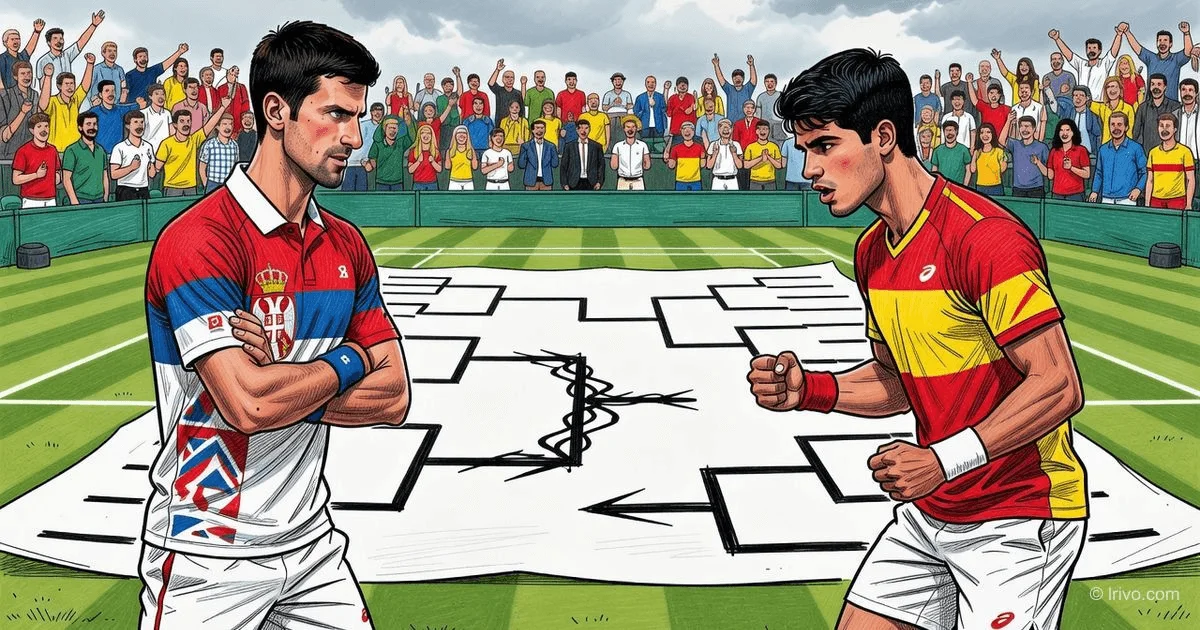
Djokovic and Alcaraz Land in Same Half of Wimbledon Draw
The 2026 Wimbledon draw threw a surprise: top favorites Novak Djokovic and Carlos Alcaraz ended up in the same half of the bracket. This means their potential clash could happen in the semifinals rather than the final, as in previous years.
Tennis Thriller in London: Why the Wimbledon Draw Gave Us the Semifinal of the Century Ahead of Time
London, June 6. Swiss cottages, strawberries and cream, and the immaculate green grass of the All England Lawn Tennis and Croquet Club. Some things seem unchanged for decades. But today, when the draw for the 2026 Wimbledon Championships took place at the tournament headquarters, traditional British etiquette cracked. Organizers, players, and millions of fans worldwide realized: we are in for not just a tournament, but a drama whose climax may come long before the final.
The draw for the championship, which starts on June 29, delivered a surprise that many called a "gut punch" for fans of final showdowns. The two top favorites in the men's singles — 39-year-old veteran Novak Djokovic and 23-year-old prodigy Carlos Alcaraz — ended up in the same half of the draw.
This means only one thing: if both players get past their opponents, their meeting will take place in the semifinals, not the deciding match as in past years. But there is a nuance that makes the situation even more intriguing. Its name is injury. The 2026 clay season has already reshuffled the tennis map, and the draw in London merely set the pieces on the chessboard before the final game.
Main Event: A Swap of Favorites or a System Error?
The draw ceremony at tournament headquarters proceeded normally, but when the balls with names were distributed across the bracket, silence fell in the room. According to seeding rules, Novak Djokovic (currently world No. 3) was supposed to be placed in the opposite half from top seed Jannik Sinner. Carlos Alcaraz, ranked No. 2, logically should have been in the same part of the draw as the Italian.
However, draw systems are unpredictable. As a result of the random distribution of seeded players across the quarters, Djokovic and Alcaraz ended up in the same half of the bracket. Now their potential meeting is only possible in the semifinals. For comparison: last year, when both were healthy, their epic clash took place in the final.
Debates immediately erupted in the tennis world: some called it a "lottery" and a fair coincidence, others a disaster for the tournament's commercial appeal. Because if one of them drops out earlier due to an incompletely healed injury or sheer bad luck, the final risks losing its "all-star match" status.
"I don't believe Alcaraz will return to Wimbledon this year," said former world No. 1 Greg Rusedski in an interview with Punto de Break. In his opinion, the Spaniard will likely skip the grass season to avoid risking his career.
If that happens, all the intrigue around the "same half" will lose its meaning, but right now, at the moment of the draw, the tennis world lives in anticipation.
Details and Statistics: Numbers That Speak Louder Than Words
The draw is just a formality behind which lie colossal numbers that define the players' status and their history at this tournament.
- Seeding status: Novak Djokovic received the No. 3 seed. Carlos Alcaraz — No. 2. Jannik Sinner — No. 1. If the draw had followed the classic scenario (No. 1 vs. No. 3 in one half, No. 2 vs. No. 4 in the other), Djokovic would have landed with Sinner. But chance separated the Italian and the Serb across different sides.
- Head-to-head on grass: Djokovic has 7 Wimbledon titles. Alcaraz is the defending champion, having won the 2025 final in five sets 1:6, 7:6(8:6), 6:1, 3:6, 6:4. That loss to the Spaniard cost the Serb his 25th Grand Slam last year.
- Alcaraz's injury: The Spaniard missed the Masters in Madrid and Rome, as well as the French Open, due to a wrist injury sustained at the Barcelona tournament in mid-April. His return is planned either for Queen's Club (June 15) or directly for Wimbledon.
- Djokovic's 2026 stats: The Serb started the season with a final at the Australian Open, where he lost to Alcaraz. After that, he took a break, skipping most of the clay season to approach the grass in perfect shape.
- Monetary equivalent: The Wimbledon prize fund in 2026 is a record £50 million (about $63.7 million). The champion will receive £2.7 million (about $3.4 million). For Djokovic, whose career prize money exceeds $180 million, this is not about money but legacy.
Context and Significance: Why This Is a Historic Crossroads?
The significance of this draw goes far beyond a simple distribution of spots in the bracket. We stand on the threshold of a changing of the guard, and Wimbledon 2026 could be the point of no return. For Novak Djokovic, this is not just a tournament. It is the "last train." The 39-year-old Serb is desperately chasing a 25th Grand Slam title, which would allow him to break Margaret Court's record outright and become the absolute record holder in tennis history (among men and women).
"If Novak is healthy and in good form, he can beat anyone. He is still that good," Rusedski told Yahoo Sports. Indeed, grass is a veteran's best friend. Here rallies are shorter, joints wear less, and experience and serve matter more than clay-court endurance.
For Alcaraz, Wimbledon is a chance to prove that his 2025 victory was no fluke and to cement his status as "king of grass." But the wrist injury raises a big question mark. Experts fear a repeat of Juan Martín del Potro's fate, who, by rushing back from a similar injury, ruined his career. If Alcaraz takes the court unprepared, a meeting with Djokovic in the semifinals risks turning into a rout.
Separately, Jannik Sinner deserves mention. The Italian, placed in the other half, is the main beneficiary of this situation. While Djokovic and Alcaraz wear each other out in the semifinals, Sinner can cruise to the final. However, there is a nuance: the Italian's physical condition raises questions. He won the Masters in Rome but looked utterly drained there.
"Jannik and Carlos should be careful," warned Djokovic's former coach Riccardo Piatti, hinting that the Serb could ambush them on grass.
What's Next / Next Match Preview
Despite the draw, the main question now is the players' health. The coming weeks will be decisive for finalizing the entry list.
Upcoming tournaments (June 15–21): Grass Masters at Queen's Club (London).
This is the last serious test before Wimbledon.
- For Alcaraz: He is entered at Queen's as the defending champion. If the Spaniard takes the court in London, it will mean his hand is ready for the load. If he withdraws, the path to Wimbledon will be closed.
- For Djokovic: The Serb is considering playing Queen's for the first time since 2018. That year he lost in the final to Marin Čilić. In 2026, he could use this tournament to gain match fitness after skipping the clay.
Wimbledon start: June 29 – July 12.
The early rounds look straightforward for both favorites, but on grass, any player with a big serve can become a problem. The potential semifinal date is July 9 or 10.
Editorial Prediction
The situation is paradoxical. Bookmakers and analysts lean toward Djokovic having the best possible draw, despite Alcaraz being nearby. Why? Because there are serious doubts about the Spaniard's readiness.
If Alcaraz enters the semifinal not at 100% (after injury and lack of match practice), his aggressive style with hand acceleration will let him down. Djokovic, on the other hand, will be fresher than ever, having skipped the clay grind in Paris. The Serb is a master at exploiting opponents' mistakes.
Key factors that will determine the outcome:
- Alcaraz's fitness: Can he play at his limit for 3–4 hours without wrist pain? If not, the semifinal will end quickly.
- Djokovic's serve: On grass, holding serve is 50% of success. The 39-year-old Serb's serve hasn't gone anywhere.
- Cunning: Djokovic outplayed Sinner in the Australian Open semifinal by adjusting his game. Against Alcaraz, he already knows what to do — extend rallies and target the backhand.
Our prediction: Djokovic will beat Alcaraz in the semifinals in 4 sets, avenging last year's loss. In the final, he will face a fatigued Jannik Sinner after a tough draw. We rate the Serb's chances of winning a 25th Slam and setting the absolute record on Wimbledon grass at 60%.
The main intrigue now is not even the draw, but whether the Spanish genius will make it to that meeting. If he does, we are in for the greatest semifinal in Wimbledon history. If not, the door for "Nole" will swing wide open.
— Editorial Team