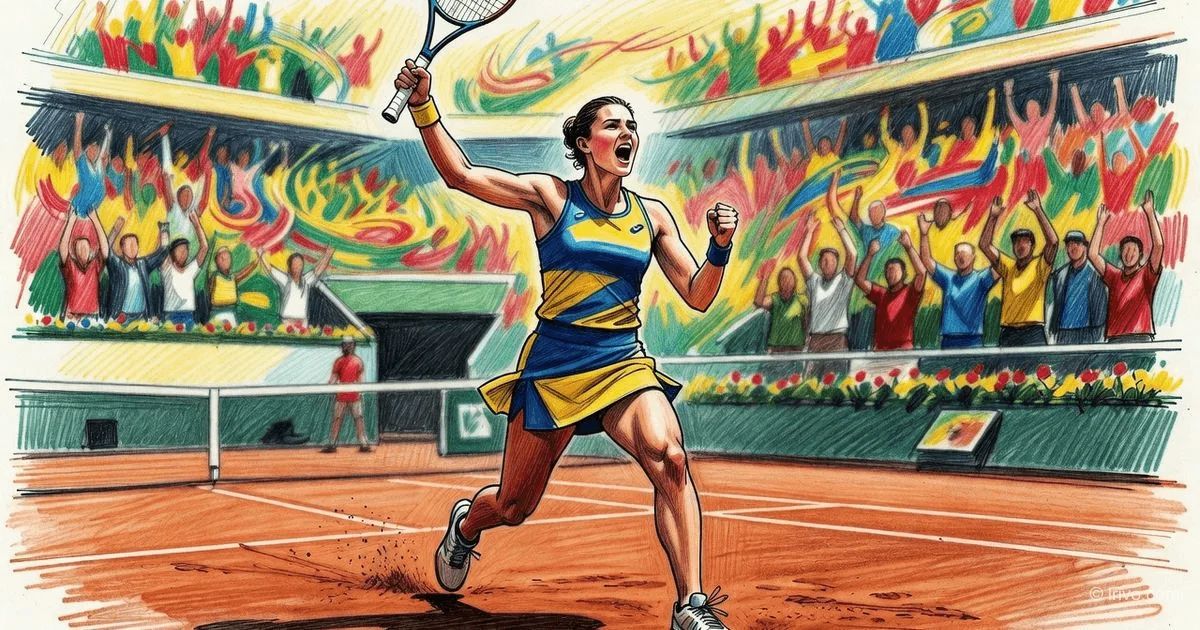
Sensation at Roland Garros: Qualifier Khvalinska Reaches the Final
Polish tennis player Maya Khvalinska (world No. 114) became the first qualifier in the Open Era to reach the Roland Garros final. In the semifinals, she defeated Diana Shnaider 7:6 (7:4), 6:4 and will face Russian Mirra Andreeva for the title.
Cinderella with a racket: How qualifier Khvalinska created the biggest sensation at Roland Garros and challenged Andreeva's genius
Paris, June 6. The courts of Roland Garros are accustomed to greatness. Champions have bathed in the clay here, the world's best tennis players have cried with joy and despair. But even this old, history-soaked surface had not yet seen such a fairy tale. Tonight, on the Philippe Chatrier court, a final will take place that will forever change tennis history. The 19-year-old Russian prodigy Mirra Andreeva will face 24-year-old Polish player Maya Khvalinska, dubbed by journalists as the "Cinderella of Paris."
The difference between them is not just age. It is a chasm between status and money, between expectations and reality. But on the court, where big names and million-dollar contracts don't matter, the fairy tale always has one last chance.
Main Event: A Journey Through the Impossible
Khvalinska's path to the biggest match of her life is worthy of a Hollywood script. The 24-year-old, ranked 114th in the world, started her tournament three weeks ago not even in the main draw. First came three qualifying rounds, where she barely kept her chances alive. Then the main draw, where she faced not just opponents, but true monsters of the professional tour.
But every time she was supposed to be crushed by authority and class, Maya found the strength to surprise. In the first round, she sent home Olympic champion Zheng Qinwen of China, giving her a bagel in the second set (6:4, 6:0). Then came victories over seeded Elise Mertens, over stubborn Greek Maria Sakkari, who could only take one set from the Pole. In the quarterfinals, Russian Anna Kalinskaya fell; in the semifinals, another Russian representative, Diana Shnaider.
The match against Shnaider, which ended 7:6 (7:4), 6:4, was the litmus test of this phenomenon. The first set was a tight battle. Powerful left-hander Shnaider (23rd seed) tried to overpower the Pole but ran into a sticky, uncomfortable defense. On the tiebreak, Maya acted cooler than a robot, not allowing the favorite to make a mistake. In the second set, when physical strength after nine (!) matches should have left the player, Khvalinska played even more composedly. Each of her shots seemed to slow time, nullifying the opponent's aggression.
"Honestly, it's like a dream. I don't know what's happening. I'm just incredibly happy," the athlete admitted in an on-court interview right after the win. Her voice trembled, and tears of relief welled in her eyes — behind her were weeks of titanic effort and fighting with herself.
But this fairy tale also has a dramatic side. At one point, Maya simply ran out of money. The hotel in Paris, flights, food for her and her mother — all of this was an unbearable burden on the budget of a player who had never risen high in the rankings. She was ready to withdraw from the tournament due to financial problems when Polish entrepreneurs heard her story. The sports drink manufacturer OSHEE paid for her accommodation, literally giving the world one of the biggest sensations of the decade.
Details and Statistics: Shocking Numbers
What Khvalinska has done cannot be overstated from a statistical perspective.
- Historic achievement: Maya Khvalinska became the first tennis player in the Open Era (since 1968) to reach the Roland Garros final after starting in qualifying. No one had done it before her.
- Ranking explosion: Starting the tournament at No. 114 in the WTA rankings, after the final she is guaranteed to enter the top 30. If she works a miracle and wins, she will jump straight into the top 15.
- Financial aspect: Her career prize money before this tournament was about $864,000. For reaching the final, she has already earned €1.4 million (about $1.5 million). If Maya wins the final, she will triple her capital in one evening.
- Monster consistency: Despite monstrous fatigue (9 matches vs. 6 for Andreeva), Khvalinska shows unique consistency for a qualifier. Over six main-draw matches, she committed only 99 unforced errors. For comparison, the powerful and attacking Andreeva has more — 153.
- Geography of wins: On her way to the final, Khvalinska defeated players from China, Belgium, Greece, France, and three times representatives of Russia (Kalinskaya, Shnaider in the semifinals, and now Andreeva awaits).
Context and Significance: Clash of Two Universes
What we will see tonight is not just a Grand Slam final. It is a clash of two philosophies, two paths to success, and two eras.
Mirra Andreeva is a product of modern academies. Born in Siberia but training in France under the guidance of Wimbledon champion Conchita Martínez, she is the embodiment of power and progress. At 19, she already has titles at WTA 1000 tournaments, sensational Slam quarterfinals in the past, and the status of Russia's main hope. She is the favorite. Her odds of winning are 1.25. She is expected not just to win, but to dominate. Mirra herself was extremely laconic and cold after the semifinal: "I'm getting closer to the goal. I'm getting a little older with each match."
Maya Khvalinska is the antithesis of Andreeva. While the Russian star bathes in the spotlight, the Pole lived in the shadow of her great compatriot Iga Swiatek before this tournament. In 2019, Maya went through severe depression that made her hate tennis — what she once loved. In 2021, she paused her career, thinking she would never return. She is only 164 cm tall, she doesn't have a monstrous serve (unlike the athletic Andreeva), but she has a head, arrhythmic sliced shots, and an amazing feel for the court.
The significance of this match for tennis is enormous. For the first time since 1977, the Roland Garros final features no Grand Slam title holders. This is a window into a new era. If Khvalinska wins, it will be the biggest triumph of an underdog since Emma Raducanu's US Open 2021 victory, but even that British success pales in comparison to the "qualifier legend" of Paris. If Andreeva wins, she will become the youngest Roland Garros champion since Monica Seles in 1992.
What's Next: Philippe Chatrier Holds Its Breath
The final will take place today, June 6, on the central court Philippe Chatrier. The approximate start time is 4:00 PM Paris time. The stands are expected to be packed to capacity.
While Andreeva will step onto the court as the "new queen of clay," having won 21 matches on this surface this season (best in the WTA), Khvalinska will go out to fight for every ball. The Pole is already guaranteed a contract with a major sponsor, and a tennis school in Dąbrowa Górnicza will be named after her, but she herself thinks only about how to reach the opponent's high ball.
Notably, right after the final, attention will shift to Wimbledon, where Khvalinska may not directly enter the main draw due to closed entry lists, and she might need a wild card from the organizers. But that's a worry for tomorrow. Today is her main battle.
Editorial Prediction
The favorite is obvious, and his name is Mirra Andreeva. Khvalinska's chances are estimated by bookmakers at 1 to 4, which even seems generous for the sensation. However, there are several factors that could turn this final into a real drama.
The first factor is nerves. Maya plays with an open visor. The pressure on her is minimal; she has already exceeded expectations. Andreeva, despite her maturity, has previously lost her temper on court, thrown balls into the crowd, and lost concentration. If Khvalinska imposes a sticky, slow-paced tennis with high lobs and sliced drop shots, she could rattle the favorite's nerves.
The second factor is physique. Yes, Maya has played three more matches. But her style (using the opponent's power, playing on the retreat) is less energy-consuming than Andreeva's constant explosive sprint. Moreover, psychological euphoria works wonders with the body's biochemistry.
Nevertheless, on the Russian's side is class. Her shot is heavier, her serve is a weapon that the opponent lacks. If Mirra can patiently build rallies, not trying to kill the ball immediately but moving Khvalinska around with cross-court shots, the Pole will not be able to counterattack.
Our prediction: Mirra Andreeva wins in three sets. Maya will take one set thanks to an initial surge or a psychological pause, but physical power and youth will ultimately prevail. However, regardless of the score on the board, this Polish girl has already written her name in the annals of history in golden letters. In a world of sports where money and rankings decide everything, a reminder that miracles are possible is worth more than any trophy.
— Editorial Team