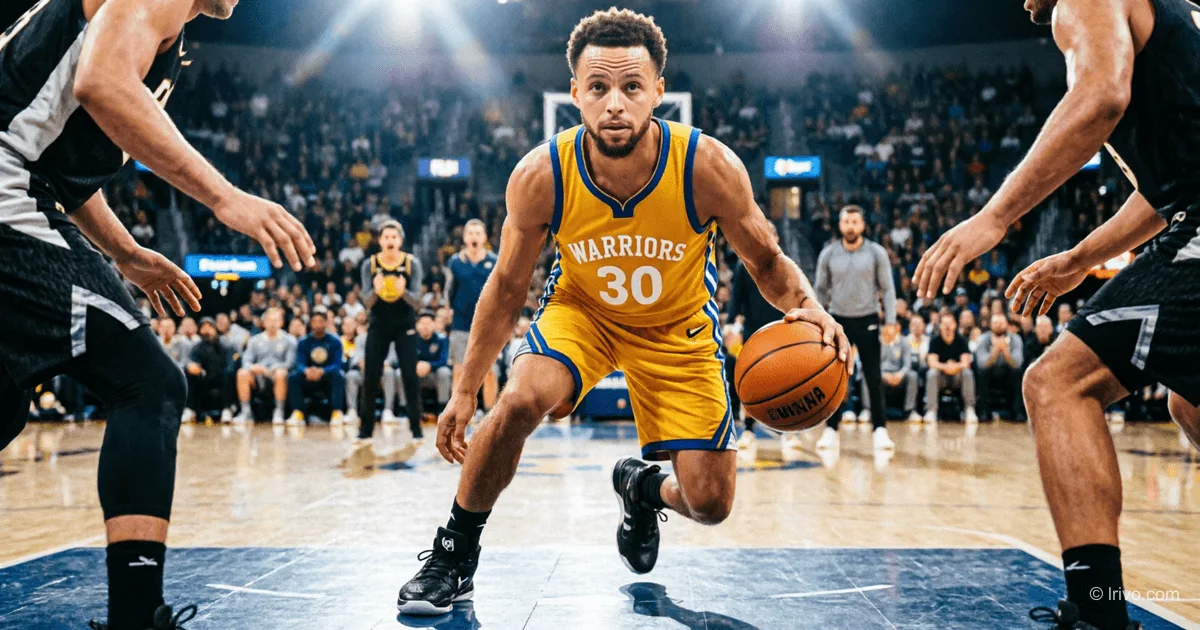
The Great "Lightning Offense": How the Golden State Warriors Changed Basketball
Stephen Curry, Klay Thompson, and Draymond Green sparked a three-point revolution. An analysis of the legacy of a dynasty that forever altered the philosophy of the game and training systems.
The Great "Lightning Offense": How the Golden State Warriors Changed Basketball
Key Takeaways
In June 2015, when the Golden State Warriors hoisted the Larry O'Brien Trophy for the first time in forty years, the basketball world had yet to grasp the magnitude of what had happened. It seemed like just a talented team with an unusual style of play. Today, years later, it's clear: that victory was a point of no return. The Warriors didn't just win titles—they fundamentally changed the philosophy of basketball, and the consequences of this revolution are felt by everyone who steps on the court, from the NBA to school leagues.
The essence of the revolution is encapsulated in a simple statistical fact: a three-point shot yields 1.5 points per possession compared to one point for a drive to the rim. The Warriors were the first to build their entire offensive system around this arithmetic advantage, and the basketball world has never been the same.
Details and Facts
Before Steve Kerr took over as head coach in 2014, the Golden State Warriors already had key assets. Stephen Curry, selected seventh overall in the 2009 draft, showed phenomenal shooting range at Davidson College, but NBA scouts doubted his athleticism. Klay Thompson, the eleventh pick in the 2011 draft, had a classic shooting form and defensive skills. Draymond Green, selected in the second round with the thirty-fifth pick in 2012, seemed too short for a power forward.
Mark Jackson, the previous coach, instilled a defensive identity in the team, but the offense remained chaotic. Kerr, who studied the triangle offense under Phil Jackson and worked as general manager of the Phoenix Suns, brought a system based on constant ball and player movement, endless screens, and spatial positioning. He inserted Draymond Green into the starting lineup as a "point forward"—a power forward who handles the ball—and freed Curry and Thompson from having to create offense off the dribble.
The result stunned the league. In the 2014-15 season, the Warriors won 67 games, and Curry earned his first MVP award. In the 2015-16 season, the team set an NBA record with 73 regular-season wins, breaking Michael Jordan's Chicago Bulls' mark of 72 wins. Curry became the first unanimous MVP in league history and made 402 three-pointers in a season—a staggering number considering that just a decade earlier, league leaders barely reached two hundred.
In the summer of 2016, after a dramatic Finals loss to Cleveland, the club pulled off the biggest trade of the decade. Kevin Durant, a former MVP and one of the planet's best scorers, joined the existing core. Durant's contract was structured as a two-year deal with an option to extend, including a salary of about $26.5 million per year—money that today seems modest for a player of his caliber. Durant fit perfectly into the system as a versatile forward capable of scoring from anywhere.
The next two seasons turned into a display of dominance: 16-1 in the 2017 playoffs, two consecutive championships, a hegemony interrupted only by injuries in the 2019 Finals against Toronto.
Analysis / Tactics / How It Works and What It Teaches
The Warriors' revolution has concrete, measurable consequences. In the 2010-11 season, when Curry was just starting his career, NBA teams averaged 18.1 three-point attempts per game. By the 2025-26 season, that number had risen to 37.2—more than double. In fact, roughly 45% of all field goal attempts in the modern NBA are three-pointers.
The key tactical principle of the Warriors is creating space. Traditional basketball was built on hierarchy: a center near the rim, forwards in the mid-range, guards on the perimeter. Kerr flipped this logic. Draymond Green, nominally a center, positioned himself on the arc and handled the ball. Curry and Thompson moved without the ball, running through a series of screens set by teammates. The opposing defense was forced to stretch across the entire court, opening driving lanes to the rim for Andre Iguodala, Harrison Barnes, and later Durant.
The efficiency of this system is based on math. The Splash Brothers, Curry and Thompson, have a three-point shooting percentage that hovers between 40 and 43 percent. This means each possession ending with their shot yields about 1.26 points. For comparison, the best teams at shooting from close range got about 1.10-1.15 points per possession. The Warriors simply chose a more advantageous mathematical strategy.
For fans and aspiring players, understanding this system provides concrete practical insights. First, the value of off-ball movement: Curry runs more distance per game than any other player because constant movement without the ball disrupts defensive schemes. Second, versatility: positions in modern basketball are blurred, and a player who can defend, shoot, and pass is more valuable than a narrow specialist. Draymond Green, at 6'6", became an elite center not because of his size but because of his understanding of the game and ability to read the development of an attack a step ahead.
Another practical lesson is the importance of spacing. When you watch basketball, pay attention not to the player with the ball but to the positioning of the other four teammates. If they are clustered on one side, the offense will stall. If they are evenly distributed around the perimeter, expect either an open shot or a drive.
Key Moments
- Mathematical revolution: three points at 40% accuracy is more valuable than two at 55%—the Warriors were the first to build a system around this simple truth.
- Versatility as the new standard: the era of strict positional divisions is over; a modern player must be able to shoot, pass, and defend multiple positions.
- Off-ball movement as an art: Curry's legacy is not just long-range shooting but a culture of constant movement that creates chaos in opposing defenses.
- Speed and spacing changed training: youth coaches stopped chasing height and began teaching centers to shoot from beyond the arc because modern basketball demands it.
- Dynasty as a business case: the market value of the Golden State Warriors rose from $450 million when Joe Lacob bought the team in 2010 to over $8 billion by the mid-2020s.
Conclusion
The Warriors' legacy extends far beyond six Finals appearances and four championships. They changed not only how basketball is played but also how it is taught. Today's children in basketball academies around the world grow up understanding that a long-range shot is not a fallback option but a fundamental skill. Centers who ten years ago would never leave the paint are now required to attack from the perimeter, or they won't be drafted by a professional team.
For the fan, the main lesson of this story is: when you see a team playing differently from everyone else, take a closer look. You might be witnessing the birth of a new era. The Golden State Warriors started as a fun team that shot too many threes. A few years later, the entire basketball world was playing by their rules, and the term "splash" became firmly embedded in the lexicon of commentators in every language. Revolutions in sports are rare, but when they happen, missing them means depriving yourself of understanding the game for years to come.
— Editorial Team