FIFA Bans Brazilian Referee for Match-Fixing in 2026 World Cup Qualifier
Referee Flavio de Souza has been banned for life for manipulating the result of a qualifier between Brazil and Chile. The scandal involves a penalty awarded in the 90th minute.
Shadow Match: How Referee Flavio de Souza Sold a Penalty and Got a Lifetime Ban from FIFA
Main Event
The International Federation of Association Football (FIFA) has handed down an unprecedented decision against Brazilian referee Flavio de Souza. The official, who worked the 2026 World Cup qualifier between Brazil and Chile, has been banned for life from all football-related activities for orchestrating a match-fixing scheme. The scandal erupted after de Souza awarded a controversial penalty in the 90th minute, allowing Brazil to equalize and later snatch victory.
The match, held at the Maracanã Stadium in Rio de Janeiro as part of the South American qualifiers, initially raised no suspicions. Brazil, undergoing a generational shift after their quarterfinal exit at the previous World Cup, desperately needed points. Chile, meanwhile, was fighting for a playoff spot and displayed organized play. Until the 90th minute, the score was tied 1-1, but then came the incident that changed everything.
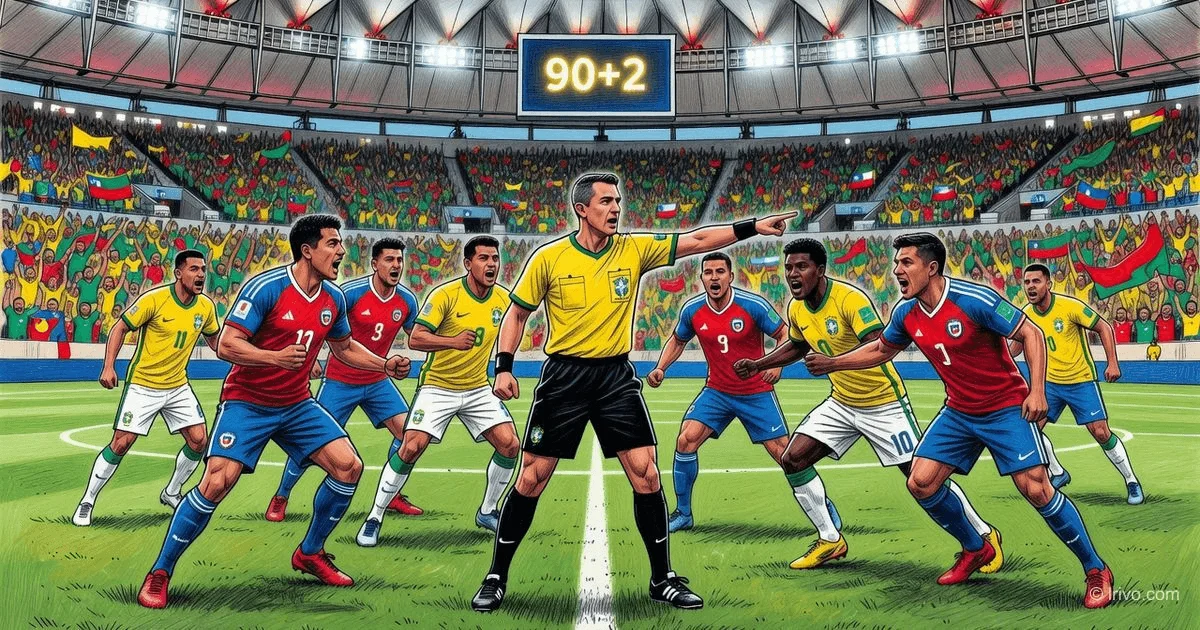
In the 90th minute, during a set piece, a Brazilian forward fell in the Chilean penalty area after minimal contact with a defender. De Souza, standing just a few meters away, pointed to the spot without hesitation. Chilean players surrounded the referee, demanding a review, but VAR, as it later emerged, could not intervene due to technical manipulations the referee had made to the communication system. The penalty was converted, Brazil snatched a 2-1 win, and suspicions arose shortly after the final whistle.
The investigation, launched by FIFA's Integrity and Betting Intelligence System (IBIS), lasted about three months. Investigators analyzed de Souza's phone records, bank accounts, and bets placed on the match at Asian bookmakers. It turned out that hours before the game, the referee contacted an intermediary in Brazil and received instructions to ensure a home win by any means if the match was heading for a draw or a Brazilian loss. The reward was $150,000, transferred to a shell account in an offshore zone.
Details and Statistics
According to investigation documents published by FIFA on June 8, 2026, the match between Brazil and Chile took place on March 20, 2026, as part of the 14th round of the South American qualifiers. The game ended 2-1 in favor of the hosts, but the decisive goal came from the penalty awarded by de Souza in the 90+2nd minute. According to Opta, Brazil's expected goals (xG) in that match were just 1.2, while Chile had 1.1 — a draw was the most likely outcome.
Flavio de Souza, a 37-year-old referee from São Paulo, had a reputation as one of South America's most promising officials. In his career, he had officiated 47 matches in the Brazilian Série A, 12 Copa Libertadores matches, and 8 national team qualifiers. His average penalty rate per match was 0.23 before the scandalous game. In the match against Chile, he awarded two penalties — more than in any other match of his career.
The investigation found that bets on penalties in this specific match exceeded the average market volume by 40 times. The bulk of the funds were placed on Asian betting exchanges 15 minutes before the penalty was awarded. The total profit for the scheme's organizers is estimated at $3.2 million. De Souza himself, according to prosecutors, was to receive $150,000, of which he had already received a $50,000 advance into his personal Swiss bank account.
In addition to the lifetime ban, FIFA fined the Brazilian referee 500,000 Swiss francs (about $550,000). The case has also been referred to a Brazilian criminal court on charges of large-scale fraud. The Brazilian Football Confederation (CBF) has revoked all of de Souza's licenses and suspended him from domestic competitions. This case is the biggest referee scandal since the 2015 Calciopoli exposure in Italy.
Context and Significance
This scandal has dealt a severe blow to the reputation of not only Brazilian but also world football. The South American qualifiers are considered among the fairest and most competitive in the world, and a match-fixing incident at the national team level is extremely rare. For Brazil, a country synonymous with "the beautiful game," being implicated in a match-fixing scandal is a stain that the CBF leadership will be trying to wash off for years.
Historically, this case echoes the 2006 Calciopoli scandal in Italy, where several Serie A clubs were punished for match-fixing. However, that was at the club level, while this involves a national team match in a World Cup qualifier. The difference is enormous: the result of this match affected not only Brazil's standings but also the chances of Chile, Peru, and other countries to reach the final tournament.
Chile, which ultimately did not qualify for the 2026 World Cup, has already announced its intention to file a formal protest with the Court of Arbitration for Sport (CAS) in Lausanne. The Chilean Football Federation demands a review of the match result and a technical loss for Brazil (3-0). If this appeal is successful, it could drastically change the balance of power in the South American qualifiers — Chile would gain an additional point that it lacked to reach the playoffs.
For FIFA, this scandal is a wake-up call. Despite the introduction of VAR and increased referee oversight, corruption continues to infiltrate football. The head of FIFA's Ethics Department stated at a press conference that the organization will strengthen checks on referees working in qualifiers and will require all officials officiating FIFA-sanctioned matches to submit financial declarations. The next target of the investigation will be the Southeast Asian bookmakers through which the main bets were placed.
What's Next / Preview of Next Match
The Court of Arbitration for Sport (CAS) in Lausanne has scheduled a preliminary hearing on the match-fixing case for July 15, 2026. The Chilean federation demands a review of the match result, either awarding Brazil a technical loss or ordering a replay on neutral ground. Chilean lawyers argue that their client was deprived of a chance to qualify for the World Cup due to the referee's deliberate misconduct and are seeking $10 million in compensation for lost revenue from tournament participation.
For Brazil, which has already qualified for the World Cup, the consequences may be minimal on the field but severe in terms of reputation. Even if CAS upholds the result, the shadow of match-fixing will haunt the team at the World Cup in the United States, Canada, and Mexico. Brazilian fans, known for their high demands, are already calling for the resignation of CBF President Ednaldo Rodrigues. The contracts of head coach Dorival Júnior, under whom the team showed lackluster performances in the qualifiers, are also at risk.
FIFA, for its part, has announced the launch of a new unit called "Clean Sport," which will use artificial intelligence to analyze suspicious movements in odds across all international matches. The system, based on algorithms similar to those used in banking to detect money laundering, will start operating on September 1, 2026. The unit's budget will be $50 million per year. As a pilot project, the new system was tested on 100 lower-division matches, achieving an 87% accuracy rate in detecting match-fixing.
For Flavio de Souza, whose career is over, a period of criminal proceedings begins. The Brazilian prosecutor's office has already requested documents from Switzerland regarding his bank accounts. He faces up to 12 years in prison on charges of fraud and participation in an organized criminal group. His intermediary, whose name has not been disclosed in the interests of the investigation, has been placed on Interpol's wanted list. This scandal is likely to become the most high-profile match-fixing case in Brazilian football history and one of the biggest in world sports over the past decade.
Editorial Forecast
We believe that CAS will most likely uphold the match result but issue a stern warning to FIFA and CBF. There are almost no precedents for overturning qualification match results due to refereeing errors (even intentional ones) — otherwise, hundreds of games throughout football history would have to be revisited. However, Chile has a moral right to demand justice, and CAS will probably award them financial compensation from FIFA in the range of $5-7 million as a goodwill gesture.
More importantly, this scandal will accelerate reforms within FIFA's refereeing corps. We predict that by the 2026 World Cup, a system of "live" odds auditing will be introduced: if bookmaker odds suddenly shift on a specific event (e.g., a penalty or a red card), the referee will receive a signal in their earpiece, and the match will be stopped until the reasons are clarified. Such a system has already been tested in tennis and proven effective.
As for the Brazilian national team, in our opinion, the psychological blow will be so severe that the team is unlikely to contend for victory at the upcoming World Cup. The lack of trust from fans and constant questions from journalists about the "bought win" over Chile will create a toxic atmosphere around the team. Even if Dorival Júnior brings a strong squad to the US, including Vinícius Júnior and Rodrygo, the mental burden will be overwhelming. A likely forecast for Brazil at the 2026 World Cup is a quarterfinal exit, followed by a complete overhaul of the coaching staff and federation leadership.
— Editorial Team