Alexander Zverev wins Roland Garros for the first time, defeating Sinner in the final
German tennis player Alexander Zverev defeated world No. 1 Jannik Sinner in the final of the Paris Grand Slam tournament with a score of 4:6, 7:5, 7:6, 6:2. This is Zverev's first Grand Slam title.
Alexander Zverev wins Roland Garros for the first time, defeating Sinner in the final
Main Event
On Sunday, June 6, 2026, on the main court of the Paris tournament Roland Garros, an event occurred that the tennis world had been waiting for for years. Alexander Zverev, the world No. 3 from Germany, finally won his first Grand Slam title, defeating world No. 1 Jannik Sinner in the final with a score of 4:6, 7:5, 7:6, 6:2. This victory was the culmination of nearly a decade-long journey for the elite tennis player, who had lost three major finals and finally shed the burden of being a finalist loser.
The final match on the clay courts of Paris started badly for Zverev. The first set went to Sinner — the reigning Australian Open champion and world No. 1 played confidently, using his trademark precision from the baseline and brilliant defense. The Italian approached the final in peak form: in 2026, he won all five Masters 1000 tournaments — in Indian Wells, Miami, Monte Carlo, Madrid, and Rome — setting a record previously achieved only by Novak Djokovic. Sinner also had a streak of 30 consecutive wins — a phenomenal statistic that made him the undisputed favorite for the final.
However, Zverev, who at 29 had already played three Grand Slam finals and left the court defeated each time, found the strength to turn the match around. The second set was key: the German managed to break his opponent's serve at 5-5 and then confidently served out the set, leveling the match. In the third set tiebreak, which was a tense and dramatic battle, Zverev showed character, outplaying Sinner in long rallies and using his powerful backhand — his signature shot that had saved him many times in difficult situations.
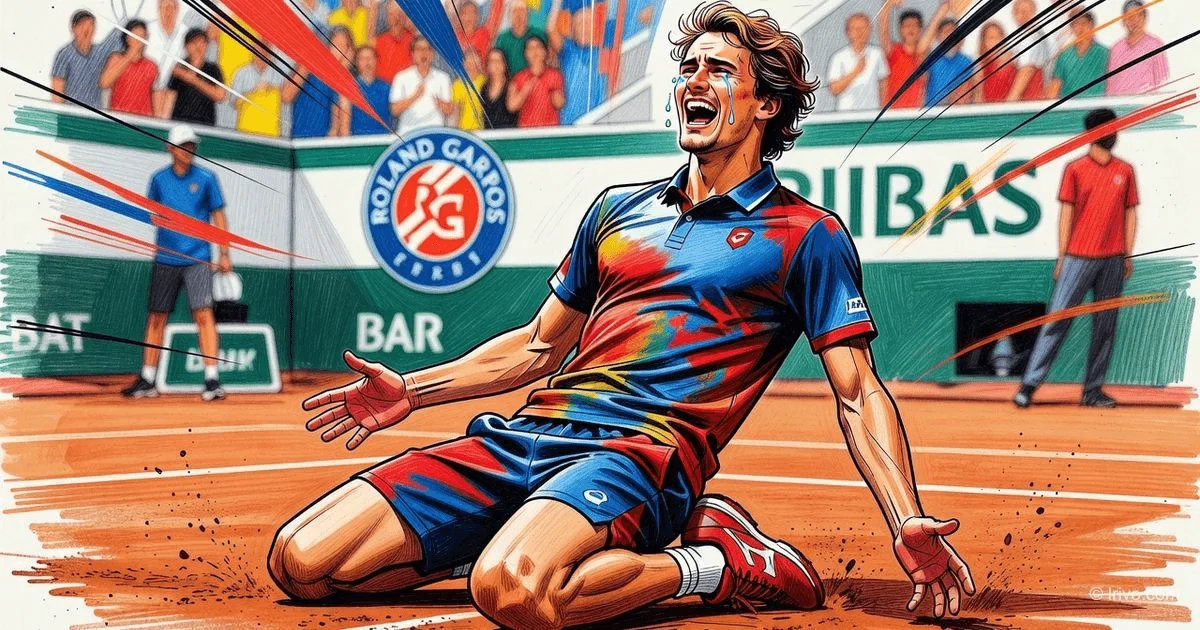
The fourth set became a demonstration of the German's superiority. Sinner, who had not lost a single set earlier in the tournament, unexpectedly broke down physically and emotionally. Zverev secured two breaks and finished the match on his serve at 5-2. When the ball landed in the box after his ace, the German collapsed on the red clay of Court Philippe Chatrier and burst into tears — all the emotions accumulated over years of disappointment, injuries, and close but missed victories poured out.
Details and Statistics
The match lasted 4 hours and 16 minutes — a true marathon that required maximum concentration and physical endurance from both players. Zverev converted 6 of 12 break points, while Sinner managed only 3 of 7 chances on his opponent's serve. The German also outperformed the Italian in winners — 51 to 44, while committing 42 unforced errors to Sinner's 38.
For Zverev, this title was his fourth Grand Slam final — and his first win. Previously, he lost to Dominic Thiem at the 2020 US Open (after leading 2-0 in sets and having a break in the third), to Carlos Alcaraz at the 2024 Roland Garros (in five sets), and to Jannik Sinner in the 2025 Australian Open final. Zverev became the first German in the Open Era to win Roland Garros — a title that eluded even the legendary Boris Becker, who only reached the semifinals in Paris.
The tournament prize fund was €61.723 million (about $71.1 million). For the win, Zverev received €2.8 million ($3.2 million) and 2000 ranking points. Finalist Sinner earned €1.4 million ($1.6 million) and 1300 points. For Zverev, this is the 25th title of his professional career, adding to his already impressive collection: two ATP Finals titles, seven Masters 1000 trophies, and the Olympic gold from Tokyo 2021.
Particularly noteworthy is Sinner's statistics before the final. The Italian approached Roland Garros with a 30-match winning streak, including 18-0 on clay in the 2026 season. He won five consecutive Masters 1000 tournaments — an achievement previously accomplished only by Novak Djokovic in 2015. Moreover, Sinner became the youngest player in history to complete the "Golden Masters" (wins at all nine Masters 1000 tournaments over a career). However, this impressive schedule may have backfired: by the Roland Garros final, the Italian looked physically exhausted.
Context and Significance
Alexander Zverev's victory at Roland Garros has enormous historical significance for world tennis. First, it broke the dominance of the "big three" finalists that had formed in recent years. Starting from the 2021 US Open, all 20 subsequent Grand Slam tournaments were won by only three players — Novak Djokovic, Carlos Alcaraz, or Jannik Sinner. Zverev became the first to break into this exclusive club, and he did so in the absence of the injured Alcaraz but in the presence of the reigning world No. 1, Sinner.
Second, this title is historic for German tennis. Zverev became only the second German in history to win a Grand Slam singles title after Boris Becker and Michael Stich, but he is the only one to win Roland Garros. Becker won Wimbledon three times, the Australian Open once, and the US Open once, but the Parisian clay eluded him. Now Berlin can be proud of a Paris champion.
For Zverev himself, this victory was a psychological liberation. "No matter what happens now, I will always be a Grand Slam champion, and no one can take that away from me," the German said at the post-match press conference. "Maybe this will give me freedom. My mind will be a little calmer when I play a final, because even if I lose, I'll still be a Grand Slam champion." These words reflect the psychological burden Zverev carried for many years.
Finally, it is worth noting the symbolic aspect of the victory. Zverev, whose parents are from Russia (his father was born in Sochi and played for the USSR national team), often speaks to his father and coach in Russian, which draws constant interest from Russian-speaking fans. He became the second "Russian-speaking" Roland Garros champion in one weekend — the day before, 17-year-old Mirra Andreeva won the women's singles title.
What's Next / Next Match Preview
For Alexander Zverev, the Roland Garros victory opens a new chapter in his career. He now enters the grass season, culminating in the Wimbledon tournament starting in late June 2026. The German, who traditionally feels less confident on grass than on hard or clay, will now have the psychological baggage of a Grand Slam champion behind him. This could radically change his performances on the London courts.
Jannik Sinner, despite the final loss, will retain the world No. 1 ranking. For the Italian, the 2026 season remains outstanding even without the Paris title: five Masters 1000 trophies and a Roland Garros final is a result that few in tennis history can boast. Sinner's immediate goal is to recover physically and mentally after the tough match and prepare to defend his title at Wimbledon, where he will be considered one of the main favorites.
Editorial Forecast
With Novak Djokovic's decline (he is 39 and increasingly rarely reaches the later stages of tournaments) and Carlos Alcaraz's injuries (he missed Roland Garros due to a wrist injury), a "window of opportunity" is opening in men's tennis. Zverev, with his triumph, proved he is ready to become a fourth force in men's tennis alongside Sinner, Alcaraz, and possibly rising stars like Flavio Cobolli (who, by the way, reached the final but lost 6:1, 4:6, 6:4, 6:7, 6:1 — that was a different final against a completely different opponent).
We predict that Zverev, having finally shed the burden of "finalist loser," will reach a new level. His powerful serve (up to 220 km/h) and one of the best backhands on tour have always been top-tier weapons, but psychology let him down in crucial moments. Now that he knows he can win a five-set match against the world No. 1, his chances at future Slams increase dramatically. We consider Zverev one of the favorites for Wimbledon 2026 and a top contender for the US Open, where he already reached the final in 2020. Nevertheless, Sinner remains the main force on tour, and this defeat will only add to the Italian's motivation in his quest for a career Grand Slam (he lacks only Roland Garros and Wimbledon). The Zverev-Sinner rivalry promises to be the central storyline in men's tennis for the next two to three years.
— Editorial Team