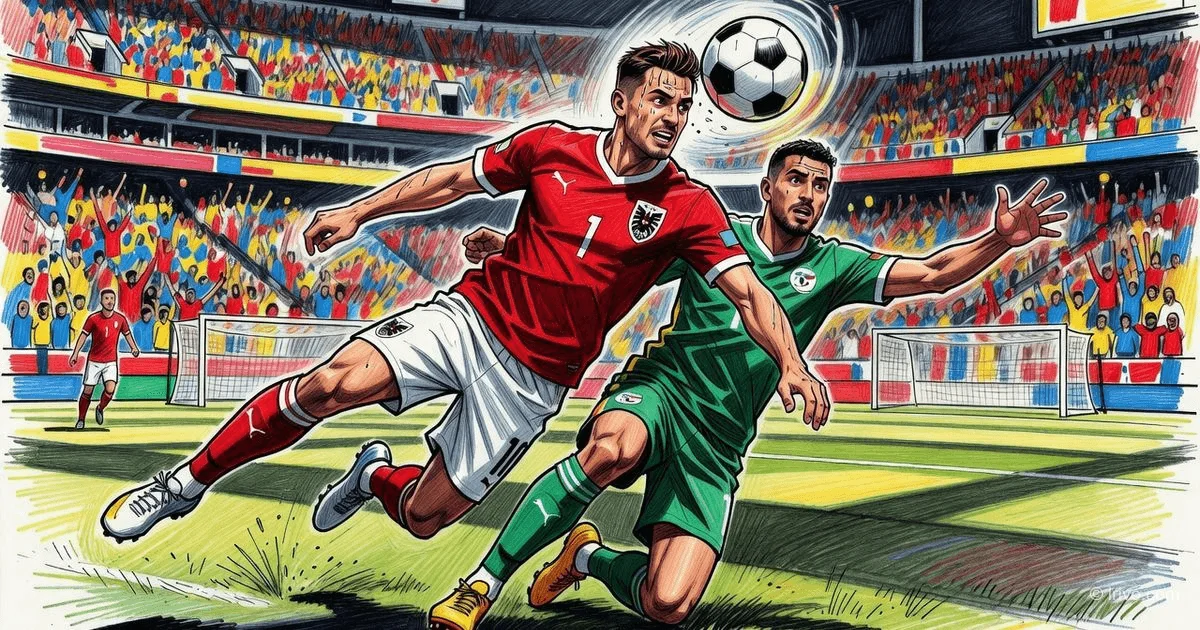
Austria and Algeria's Dramatic Draw Knocks Iran Out of the 2026 World Cup
Austria and Algeria played out a 3-3 draw in the final round, with the Austrians equalizing in the 6th minute of added time. This result dashed Iran's hopes of advancing as one of the best third-placed teams.
Drama in Kansas City: Austria-Algeria Draw Shatters Iran's 2026 World Cup Playoff Dreams
The group stage of the 2026 World Cup, the first to feature an expanded 48-team format, delivered plenty of thrilling storylines for fans. However, the final round of Group J, played on June 28 at Arrowhead Stadium in Kansas City, arguably became the most dramatic moment of the entire opening phase. The match between Austria and Algeria, which ended 3-3, not only sent both teams into the playoffs but also cruelly dashed the Iranian national team's historic chance to advance from their group.
The main paradox of this story is that Iran went through the group stage undefeated. The "Persian Lions" drew all three of their opponents in Group G — New Zealand (2-2), Belgium (0-0), and Egypt (1-1) — picking up three points with a zero goal difference. This result guaranteed them a spot among the best third-placed teams if at least one of the three remaining matches in Groups J, K, and L went against their competitors. But the football gods had other plans, and the drama unfolded right there in Kansas City.
The Main Event: A Rollercoaster of Fate in Stoppage Time
The Austria-Algeria match started with a sense that neither team wanted to take risks. The first 20 minutes were played at a sluggish pace, and the stadium crowd even began to whistle in frustration at the passive play. After all, both Austria and Algeria entered the match with three points each, and a draw suited both sides: Austria would remain in second place and face Spain, while Algeria, from third place, would meet Switzerland.
Everything changed in the 29th minute when David Alaba found Marko Arnautović with a precise pass, and the veteran Austrian striker opened the scoring, temporarily sending Algeria to the bottom of the table. But the Africans quickly recovered: in the 45th minute, Rafik Belgali, beating two defenders, equalized with a powerful strike, scoring one of the group stage's finest goals — 1-1. In the second half, the teams continued trading goals: in the 55th minute, Marcel Sabitzer put Austria ahead, but just five minutes later, Riyad Mahrez restored parity — 2-2. After that, the pace dropped again, and it seemed a draw would satisfy everyone.
However, in the 90+3rd minute, Mahrez scored his second, putting Algeria ahead 3-2. At that moment, Austrian fans froze: their team was losing a playoff spot, while Iranian fans watching the match had already started celebrating. But football is a game until the final whistle. In the 90+6th minute, Saša Kalajdžić, leaping to meet a cross from the flank, headed the ball home to make it 3-3. This goal not only saved Austria but also crushed Iran's hopes, which had only glimpsed light at the end of the tunnel for a brief moment.
Details and Statistics: Goals and the Group Table
The match in Kansas City ended with a fantastic 3-3 scoreline. The goals were scored by:
- Austria: Marko Arnautović (29'), Marcel Sabitzer (55'), Saša Kalajdžić (90+6')
- Algeria: Rafik Belgali (45'), Riyad Mahrez (60', 90+3')
The final Group J standings look like this:
| Position | Team | Played | Wins | Draws | Losses | Goals | GD | Points |
|---|---|---|---|---|---|---|---|---|
| 1 | Germany | 3 | 3 | 0 | 0 | 10-3 | +7 | 9 |
| 2 | Austria | 3 | 1 | 1 | 1 | 5-5 | 0 | 4 |
| 3 | Algeria | 3 | 1 | 1 | 1 | 4-4 | 0 | 4 |
| 4 | Jordan | 3 | 0 | 0 | 3 | 2-9 | -7 | 0 |
After the final whistle, Austria, finishing second, and Algeria, landing among the eight best third-placed teams (alongside Sweden, Ghana, Ecuador, Paraguay, and others), advanced to the Round of 32. Iran, with the same number of points (3) but a worse goal difference compared to their competitors, finished 9th among the third-placed teams and exited the tournament.
Context and Significance: The Price of a "Convenient" Result
This match became a symbol of the problems with the new World Cup format. Expanding the tournament to 48 teams and allowing the eight best third-placed teams into the playoffs created a situation where teams found it more beneficial to play for a draw than to take risks and attack. The situation in Group J was a perfect example: both teams knew perfectly well that a draw guaranteed them advancement, while a win or loss wouldn't change their playoff opponents (Austria would face Spain regardless, Algeria would face Switzerland).
This led to suspicions of a "fixed match." While there is no evidence of collusion, the passive nature of the game in the first half and the relaxed play between goals sparked a wave of criticism. This wasn't the first such incident in the tournament: draws between Australia and Paraguay (0-0), as well as Japan and Sweden (1-1), also had the character of a "mutually convenient result." For Iran, this match was a bitter lesson: even an undefeated group stage doesn't guarantee advancement when your fate is decided not on your own pitch, but in parallel matches.
What's Next: Playoff Opponents
Austria, securing their first playoff berth since 1982, will face the reigning European champions, Spain, in the Round of 32. This will be an incredibly tough test for Ralf Rangnick's team, who must contend with one of the tournament's favorites. Algeria, in turn, will meet Switzerland — an opponent that also advanced from a third-place finish. For both teams, the playoffs represent a new stage where the margin for error is razor-thin, and even such a dramatic qualification doesn't guarantee an easy path forward.
Editorial Prediction
The Austria-Algeria match showed that in the group stage, a precise calculation can be more important than a win. The Algerian national team made the playoffs thanks to a high-scoring draw, but the fairness of this outcome raises questions. Fans and experts are already discussing the need to change the format to eliminate scenarios where opponents benefit from playing for a draw. As for future prospects — Austria faces a meeting with Spain, where "La Roja" will undoubtedly be the favorites. For Algeria, the match against Switzerland looks more manageable, but the Swiss are a tough nut to crack. In any case, both teams received a chance they perhaps didn't deserve based on their play, while Iran is left with the bitter realization that football is a game played until the last second, and other teams' results can matter more than your own.
— Editorial Team