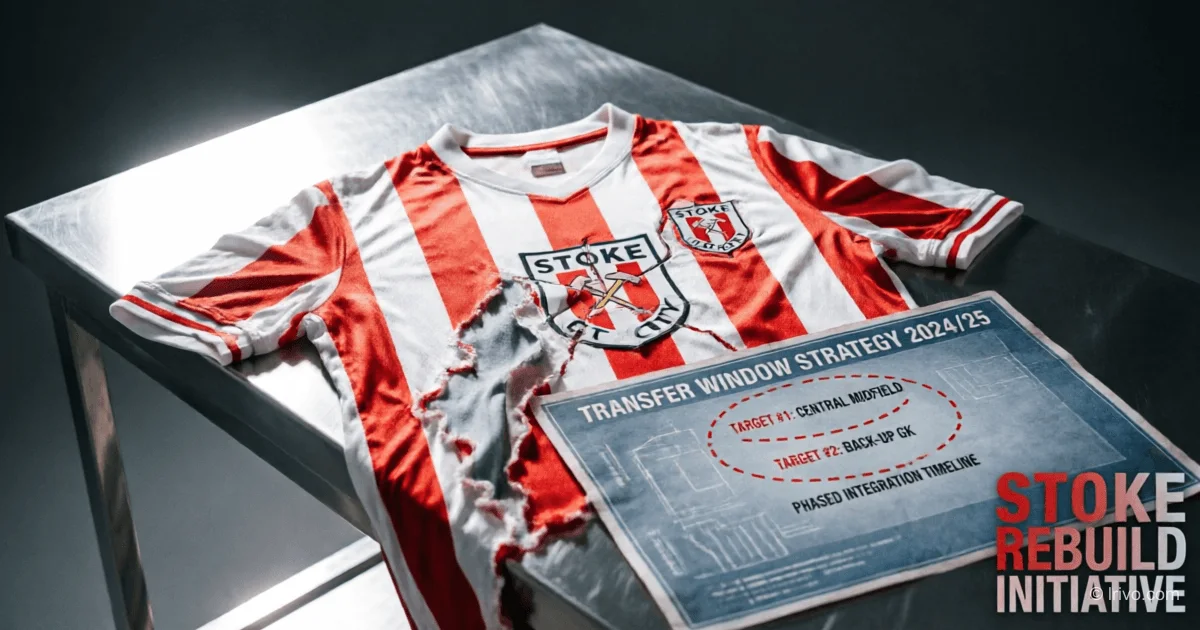
Stoke City's Season Ends with Injury Crisis and Transfer Window Plans
Mark Robins has laid out a clear blueprint for Stoke City's summer rebuild after a campaign plagued by injuries and inconsistency. The manager's post-match comments following a defeat to Wrexham highlighted the need for physically robust and reliable players to compete effectively in the Championship.
The Final Game as a Microcosm
The loss at Wrexham served as a stark illustration of the season's problems. Stoke finished the match with a severely patched-up defensive line. Two wingers were deployed as full-backs, while an attacking full-back played at centre-half alongside an 18-year-old making his professional debut. This makeshift backline was breached twice in quick succession, with Wrexham scoring directly from a corner and capitalizing on a mistake from Aaron Cresswell.
Despite the defensive chaos, Stoke created opportunities and controlled periods of the game. However, poor decision-making and execution in the final third, coupled with an inability to match Wrexham's physical strength, ultimately killed any chance of a comeback. This pattern—defensive vulnerability due to absences and a lack of cutting edge in attack—has defined their entire season.
A Season Defined by Absences
Robins pointed out that the campaign has been shaped by injuries to key players across all positions. The defensive issues in the final game were just the latest manifestation of a long-running problem. The squad has frequently been unable to field its intended lineup, leading to constant improvisation and a lack of stability.
Key issues that emerged throughout the season include:
- A chronic injury list disrupting defensive and midfield cohesion.
- A struggle to score goals consistently, despite having possession and chances.
- A physical deficit compared to many Championship opponents.
- A reliance on young players or players in unfamiliar roles during crises.
The Summer Recruitment Mandate
In his assessment, Robins made it clear what he, the club's ownership, and the recruitment team must prioritize. The primary focus is not just on technical quality, but on specific physical and mental attributes.
The manager's stated requirements for new signings are:
- Physicality: Players must be capable of enduring the rigorous, physical nature of a full Championship season.
- Reliability: New recruits need to be available consistently, reducing the impact of the injury crisis.
- Quality: Technical ability must still be present to improve the team's performance, particularly in attack.
The work ahead is described as substantial. Building a squad with these characteristics, in addition to the necessary skill level, is seen as the fundamental task to avoid repeating this season's struggles.
Key Takeaways for Stoke City
- The injury crisis was the overriding theme of the season, forcing constant lineup changes and tactical compromises.
- The final game against Wrexham perfectly encapsulated the issues: a weakened defense conceded cheap goals, while attack lacked clinical edge.
- Manager Mark Robins has explicitly called for players with physical robustness and availability as top recruitment priorities.
- The summer transfer window will be focused on building a more resilient and reliable squad, not just adding flashy talent.
- Improving goal conversion and defensive solidity under pressure are the two main performance areas to address.
In conclusion, Stoke's season ended with a clear diagnosis and a prescribed remedy. The club's leadership now has a direct mandate from the manager to construct a squad that can withstand the Championship's demands and turn possession into points.
— Editorial Team