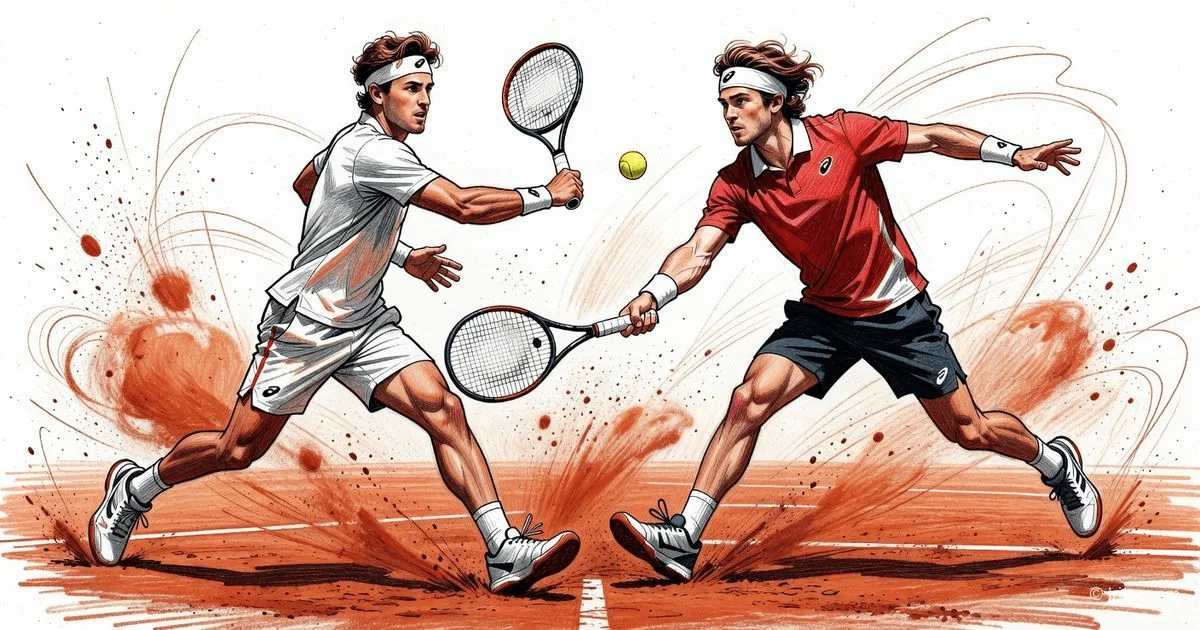
Roland Garros: Casper Ruud and Andrey Rublev to Determine the Strongest in the Quarterfinals
The Norwegian and the Russian tennis player will meet for the right to reach the semifinals of the Paris Grand Slam tournament. The winner of this match could face Alexander Zverev.
Roland Garros: Casper Ruud and Andrey Rublev to Determine the Strongest in the Quarterfinals
Important Update: The Seventh Game Day Completely Changed the Dynamics
Before we dive into a detailed breakdown of the matchup, an important caveat is necessary. The information underlying this article was current at the time of the draw and the start of the tournament, but the course of the competition has made dramatic adjustments.
As of May 31, 2026, the fourth-round match between Casper Ruud and Joao Fonseca ended with a sensational victory for the 19-year-old Brazilian. Moreover, in a parallel match, Czech tennis player Jakub Mensik defeated Andrey Rublev in five sets. Thus, the quarterfinal pair that this article was supposed to discuss—Ruud vs. Rublev—has been replaced by Fonseca vs. Mensik.
Nevertheless, the original matchup between two prominent figures in world tennis—two-time Roland Garros finalist Casper Ruud of Norway and one of the tour's most consistent players, Andrey Rublev—deserves a detailed analysis, both in terms of their paths to a potential meeting and the overall tournament draw. This hypothetical match, which was supposed to take place in the quarterfinals, caught fans' attention as early as the draw.
Main Event (Hypothetical Matchup)
If the draw had pitted Casper Ruud against Andrey Rublev in the Roland Garros quarterfinals, it would have been one of the most anticipated matches of the second week. Both players are among the best clay-court players of today, but their paths to success on this surface differ radically. Ruud is a classic "clay specialist," having grown up at Rafael Nadal's Tennis Academy in Mallorca and absorbed the best traditions of the Spanish school of slow-court play. Rublev, on the other hand, is an all-court player with a powerful first serve and a devastating forehand capable of overpowering any opponent, even on the slowest surface.
A match between them promised to be a clash of styles: Ruud's viscous, grinding baseline game with high topspin and exhausting rallies against Rublev's explosive, aggressive tennis with constant attempts to shorten points and finish with winners. For spectators on Court Philippe Chatrier, it would have been a real tennis spectacle, where every game could turn into a multi-shot chess match.
The key factor in this hypothetical matchup would have been the physical readiness of both athletes. Ruud approached the tournament in excellent form, as confirmed by his run to the final of the prestigious Rome Masters two weeks before Roland Garros. Rublev, on the other hand, stopped in the quarterfinals in Rome, losing to world No. 1 Jannik Sinner 2:6, 4:6. However, the Monte Carlo Masters, where Rublev also reached the third round, showed that his clay-court game is gradually improving.
The turning point of such a match could have been the second or third set, when Rublev traditionally struggles to maintain his explosive pace, and Ruud begins to increase pressure with his incredible topspin—a high-bouncing shot that is particularly difficult for players with a two-handed backhand. If the Russian managed to take the first set in a tiebreak, his chances of victory would have risen sharply. But if Ruud seized the initiative and started to "dry up" the game by prolonging rallies, the Norwegian would have gained a huge advantage.
Details and Statistics
Head-to-head statistics (as of before the tournament) showed that the opponents had only met at major tournaments, and the balance was nearly even. According to the International Tennis Federation (ITF), Ruud and Rublev have played several matches, with clay-court statistics being particularly telling. Rublev won their only clay-court meeting in Barcelona in 2026, but that was the final of an ATP 500 tournament, where the Russian displayed incredible fighting spirit.
Looking at individual player statistics at Roland Garros over the years, the picture becomes clearer. Casper Ruud is the true king of Paris among active players after the "Big Three" era. He has reached the final of this Grand Slam twice, which automatically makes him one of the main favorites every time he steps on court. His game is perfectly adapted to local conditions: the slow clay gives him time to wind up and hit the ball perfectly, and his trademark forehand with immense spin forces opponents to literally "eat" the clay.
Andrey Rublev, on the other hand, has never advanced past the quarterfinals at Roland Garros. His best result here is a quarterfinal appearance, which is still an outstanding achievement given the draw's density. However, in 2025, Rublev finished in the third round, losing to Arthur Fils (though that match ended with the Russian retiring due to injury). In 2026, he intended to improve on that, but unfortunately stumbled early.
In terms of serving statistics for the 2026 season, Rublev had a clear advantage. His first serve reached speeds of up to 220 km/h, and he consistently hit 8-10 aces per match on fast surfaces. On clay, that number dropped but remained high. Ruud, on the other hand, relied on consistency: he rarely had many aces, but his first-serve percentage often exceeded 65%, allowing him to dictate rallies.
Context and Significance
This hypothetical quarterfinal had enormous significance for both halves of the draw. First, the winner of this pair would have had a chance to meet world No. 3 Alexander Zverev in the semifinals, who was considered the main favorite in his quarter. For Ruud, reaching the semifinals would have meant an opportunity to avenge past defeats and try to reach the Paris major final for the third time in his career. For Rublev, it would have been a historic chance to reach the Roland Garros semifinals for the first time and compete for his debut Grand Slam title at age 28.
Moreover, the 2026 Roland Garros was special due to the absence of many stars. Defending champion Carlos Alcaraz missed the tournament due to injury, significantly weakening the top half of the draw. Novak Djokovic, despite participating, approached the tournament without match practice, and Jannik Sinner was seeded in the opposite half and could only meet the winner of this pair in the final. Thus, the bottom half of the draw (the third quadrant), where Ruud and Rublev were placed, became a "zone of opportunity."
The path to the quarterfinals was thorny for both. Ruud was supposed to face the 15th seed and then likely meet Brazilian wunderkind Joao Fonseca. It was Fonseca who became the stumbling block for the Norwegian in the fourth round. The match, which lasted nearly four hours, ended with a Brazilian victory in four sets: 7:5, 7:6 (10:8), 5:7, 6:2. This defeat marked Ruud's fourth consecutive Roland Garros exit at the hands of a non-"Big Three" player, raising questions about his ability to handle the younger generation.
Rublev, for his part, had potential opponents in his quarter: Alex de Minaur, and then either Novak Djokovic or the same Fonseca. But his path was also interrupted by Jakub Mensik—the 26th seed from the Czech Republic, who defeated the Russian in a grueling five-set match.
What's Next / Preview of the Next Match
Nevertheless, the tournament continues, and in the quarterfinals (Tuesday, June 2), we will see a completely different pair: Joao Fonseca (Brazil) vs. Jakub Mensik (Czech Republic). This will be a battle between two "super juniors" who have just burst onto the adult tour. Both are under 20 years old, and both have already defeated top stars.
Fonseca, who before this tournament had never advanced past the third round of a Grand Slam, has now not only reached the quarterfinals but done so by eliminating Novak Djokovic (straight sets in the third round) and Casper Ruud. His game is a mix of Brazilian passion and European schooling. He possesses incredible speed and an amazing feel for the ball. After his victory over Ruud, he said in an interview: "I'm very tired. It's always a first—making it to the second week of a Slam is so tough. But everything is decided by the heart."
Mensik is a more reserved and powerful player. The Czech, often compared to a young Tomas Berdych, has a cannon serve and a composure unusual for his age. In his match against Rublev, he showed incredible mental resilience, turning the match around in the decisive sets. This quarterfinal is a true window into the future of world tennis.
The winner of the Fonseca-Mensik match will face Alexander Zverev in the semifinals, who has already secured his place in the top four. For the German, this is great news: instead of playing against experienced players like Ruud or Rublev, he will face an inexperienced junior. However, as past years have shown, it is precisely such "dark horses" that often create upsets.
Editorial Prediction
Initially, before the elimination of Ruud and Rublev, we assumed that the favorite in the Ruud-Rublev pair would be Casper Ruud. The reason is simple: five sets at Roland Garros is his domain. The statistics speak for themselves: the Norwegian has reached the final twice, while Rublev has never advanced past the quarterfinals. Ruud knows how to manage his energy over the course of a match, does not panic after losing a set, and can "suffocate" an opponent with his grinding baseline game.
However, the current reality (as of June 1, 2026) dictates different conditions. We are revising our prediction for the remaining part of the draw. In the Fonseca-Mensik quarterfinal, we favor the Brazilian. Fonseca is in a "flow" state: after beating Djokovic, his psychological barrier has disappeared, and his victory over Ruud has added confidence in his clay-court abilities. The Brazilian fans, who have filled the Roland Garros stands, create an incredible atmosphere of support, comparable to the French "madness" during Gael Monfils' matches.
As for the semifinal against Zverev, the situation is more complicated. The German is the favorite, and that's not up for debate. But Fonseca is the kind of player who can spring a surprise. He carries no burden of responsibility (unlike Zverev, who is expected to win the tournament after the elimination of all competitors). If the Brazilian wins the first set, the psychological pressure on Zverev will become immense. Our final prediction: Alexander Zverev will still reach the final, but he will do so through a tough four-set semifinal against Fonseca. However, if the Brazilian gets past both Mensik and Zverev, we will witness the birth of a new tennis superstar.
— Editorial Team