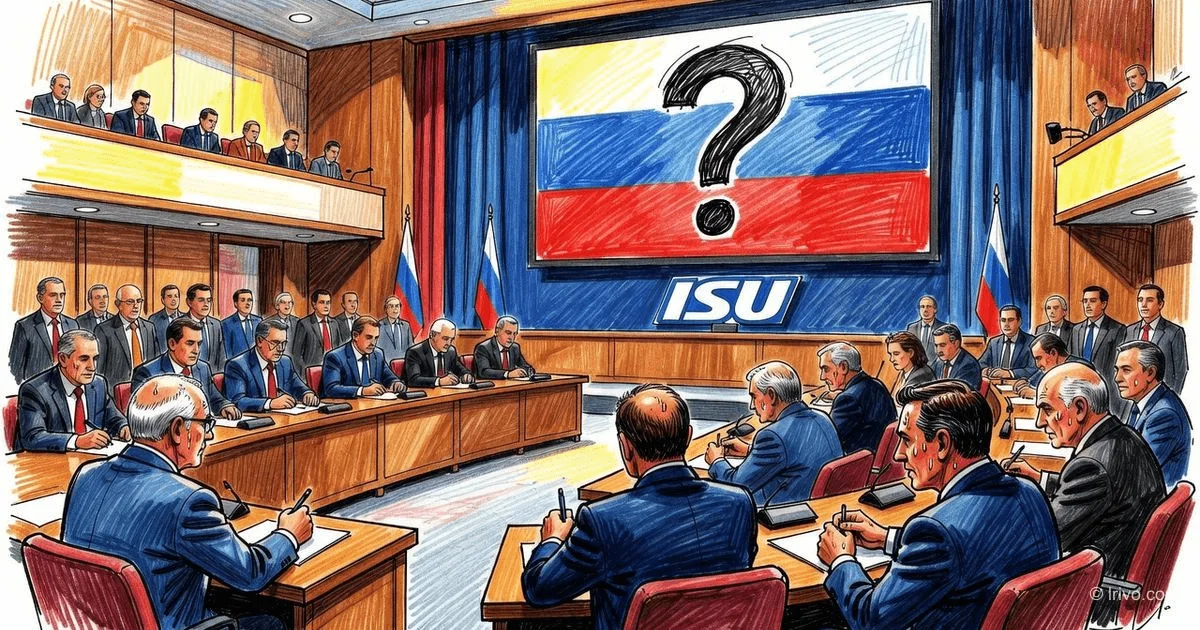
ANNOUNCEMENT: ISU Congress on Tenerife May Decide on Readmission of Russian Figure Skaters
The International Skating Union (ISU) may announce on the third day of its congress the readmission of Russian juniors, and eventually senior athletes, to international competitions. The event will also feature elections for the organization's president.
A fateful day on Tenerife: ISU Congress chooses the future of figure skating
Main Event
On June 12, 2026, the landmark 60th Congress of the International Skating Union (ISU) concludes on the Spanish island of Tenerife, potentially marking a turning point in the history of figure skating. On the final day of the forum, delegates are tasked not only with electing the organization's leadership for a new four-year cycle but also—far more importantly for millions of fans worldwide—laying the groundwork for the return of Russian figure skaters to the international arena.
The Congress, which began on June 10 on the picturesque coast of Tenerife, was officially positioned as the starting point for implementing the "Vision 2030" program, aimed at reviving the fading commercial landscape of winter sports. However, behind the glossy facade of presentations on athlete development lies a deep identity crisis in figure skating. The overarching question hanging in the air throughout all three days of the forum is whether Russian athletes will return to the ice of international competitions after a four-year isolation.
On the morning of June 12, delegates confirmed the re-election of incumbent ISU President Jae Youl Kim from South Korea. Kim, the sole candidate for the post, was re-elected by acclamation—unanimously, with applause from delegates. Speaking to the Congress after his re-election, Kim stated: "I thank you for your support and trust. I assure you that I am as committed today as I was in 2022 to lead this organization and help build a bright future for our sport."
Details and Statistics
Following the presidential election, the climax of the third day of the Congress arrived: elections for vice presidents and members of the ISU Council. It is the Council, which will convene on June 13-14 immediately after the Congress closes, that will make the fateful decision on the readmission of Russian and Belarusian athletes.
Four candidates are vying for the position of Vice President for Figure Skating, and their stance on Russia is a key factor determining the future of the sport. Below is a complete comparative table of candidates for key positions:
| Position | Candidate | Country | Predicted Position on Readmission of Russians |
|---|---|---|---|
| ISU President | Jae Youl Kim | South Korea | Neutral (re-elected) |
| Vice President (Figure Skating) | Fabio Bianchetti | Italy | Likely in favor |
| Vice President (Figure Skating) | György Elek | Hungary | Likely in favor |
| Vice President (Figure Skating) | Benoît Lavoie | Canada | Against |
| Vice President (Figure Skating) | Ubavka Novaković-Kutinu | Greece/Bosnia | Neutral |
| Council Member (Figure Skating) | Alexander Volkov | Ukraine | Against |
| Council Member (Figure Skating) | Susanna Rahkamo | Finland | Against |
| Council Member (Speed Skating) | Alexander Kibalco | Russia | In favor |
| Council Member (Speed Skating) | Chunlu Wang | China | Likely in favor |
In addition to leadership elections, the ISU will also approve the budget for 2027-2028, present a financial report, and make decisions on new rules in figure skating. Russian specialists are running for technical committees: Yulia Andreeva for the Single and Pair Skating Committee, Alla Shekhovtsova for the Ice Dance Committee, Ulyana Chirkova for Synchronized Skating, and Mikhail Sokolov for Short Track Speed Skating.
Context and Significance
Russian figure skaters have been suspended from ISU-sanctioned tournaments since March 2022. During this time, figure skating events have lost a significant portion of their viewership and commercial appeal. The ISU made exceptions only for qualification for the 2026 Olympic Games in Milan-Cortina, where a few Russian athletes competed under a neutral status. However, regular international competitions—World Championships, European Championships, Grand Prix series—remained off-limits.
The situation has reached a boiling point. At the opening of the Congress, organizers conspicuously cut footage of Russian figure skaters from the promotional video, yet observed a minute of silence in memory of outstanding Soviet and Russian specialists who passed away, including legendary speed skater Natalya Petruseva, as well as figure skaters and coaches who died in a 2025 plane crash. This duality vividly illustrates the rift within the ISU: the political lobby demands continued isolation, while the sports community is suffocating without real competition.
This issue is particularly acute in women's singles, where Russian female skaters have dominated the world stage for the past decade. Without their participation, the commercial value of tournaments has plummeted, TV ratings have dropped, and sponsor interest has waned. The planned Grand Prix reform for the 2027/2028 season and the combined World Championships in Beijing in 2028 risk becoming financial failures due to the absence of the main stars.
What's Next / Preview of the Next Event
The most important events will begin after the Congress concludes. On June 13-14, 2026, the ISU Council will meet, and according to sources close to the situation, a positive decision is expected regarding the readmission of Russian juniors to international competitions under neutral status for the 2026/2027 season.
Insiders report that the ISU may approve the return of Russian and Belarusian juniors, subject to conditions: no national symbols, a confirmed history of clean doping tests, and no ties to law enforcement agencies. Senior athletes remain banned for now, but a clear roadmap for their phased return by the end of 2026 may be approved.
If the decision is made, juniors could integrate into the 2026/27 competitive season, which begins in August-September. If the ISU Council, under pressure from the North American coalition, delays the decision, the Russian side is prepared to appeal to the Court of Arbitration for Sport (CAS).
Another important signal will be the results of the elections to the technical committees—if Russian specialists are elected, it will indicate the international community's readiness for cooperation even amid political disagreements.
Editorial Forecast
The editorial board leans toward the most likely outcome of the ISU Council meeting on June 13-14 being a "junior compromise"—the readmission of Russian juniors under neutral status while maintaining restrictions for senior athletes. This scenario benefits all parties. Junior sports are less media-intensive, minimizing the risk of boycotts from Ukraine and its allies. It allows the ISU to test the logistics of neutral status, reassure sponsors, and preserve the promising generation of Russian single skaters from losing motivation.
The key factor will be the results of the election for Vice President for Figure Skating. If one of the European candidates in favor—Italian Fabio Bianchetti or Hungarian György Elek—wins, the chances of a positive decision increase sharply. If Canadian Benoît Lavoie, known for his hardline anti-Russian stance, wins, the process could drag on.
Also crucial will be the neutral position of President Jae Youl Kim. Kim, representing South Korea, is not bound by the strict political obligations of Western countries and is primarily interested in the commercial success of the ISU. And commercial success today is impossible without the participation of Russian figure skaters.
In any case, June 12-14, 2026, will go down in figure skating history as the days when the sport tried to reclaim its right to dictate terms to politicians. Whether this will be a full-fledged return or another step into the dead end of isolation will be decided in the coming hours behind closed doors at the ISU Council. And this decision will determine not only the fate of Russian athletes but also the future of figure skating as one of the most spectacular and popular winter sports in the world.
— Editorial Team